
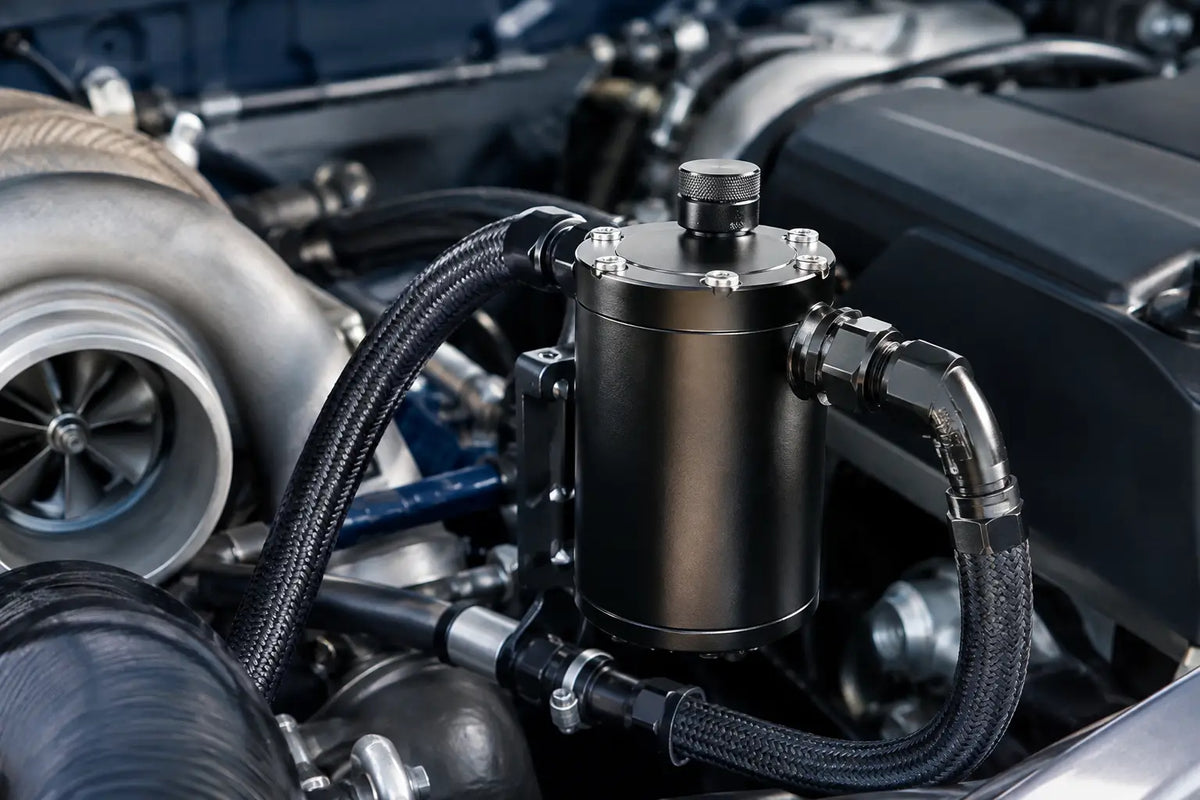
Hard track sessions, sustained boost and repeated heat cycles put the crankcase ventilation system under far more pressure than the average commute. That is where catch can benefits become relevant. A properly specified oil catch can separates much of the oil vapour and moisture carried through the PCV system before it reaches the intake tract, helping keep the parts that make power cleaner for longer.
It is not a magic horsepower part, and it will not fix a tired engine with excessive blow-by. For a healthy modified turbo car, however, it can be a sensible supporting upgrade - especially when the build already includes increased boost, an upgraded intake, intercooler pipework and regular hard use.
What an oil catch can actually does
Every combustion engine creates some crankcase pressure. A small amount of combustion gas slips past the piston rings, carrying fuel vapour, moisture and oil mist into the crankcase. The positive crankcase ventilation system routes those gases back into the intake so they can be burned rather than vented into the atmosphere.
That approach works well on a standard road car. The issue is that under boost, high rpm or prolonged cornering, the volume of vapour can increase. Oil mist then travels through breather hoses and settles in intake pipework, intercoolers, throttle bodies and inlet manifolds. On direct-injection engines, it can also contribute to deposits on the backs of inlet valves, because fuel is not washing over them as it does in a port-injected setup.
An oil catch can sits in the breather line and uses internal baffles, chambers or filtration media to encourage oil droplets and water vapour to separate from the gases. The cleaner gases continue through the system, while the collected fluid remains in the can until it is drained.
Catch can benefits on modified engines
The biggest advantage is cleaner intake-side hardware. Less oil entering the intake means less residue inside boost pipes, intercoolers and manifolds. On a turbo build, this is particularly worthwhile because pressurised intake plumbing gives oil mist plenty of surface area on which to settle.
Cleaner pipework is not just about appearance when servicing a car. Oil residue can coat sensors, contaminate couplers over time and make it harder to spot a genuine boost or oil leak. If you have ever removed an intercooler pipe and found it wet inside, you already understand the problem a well-designed catch can aims to reduce.
A catch can may also support more consistent tuning. Oil vapour lowers the effective quality of the air entering the engine and can contribute to knock sensitivity in demanding conditions. The gain is rarely a dramatic dyno figure from fitting the can alone. Instead, it is about controlling a variable that becomes more relevant as cylinder pressures, intake temperatures and boost rise.
For track cars, another practical benefit is inspection. Draining the can gives you a view of what the crankcase ventilation system is carrying. A modest mixture of condensation and oil is common, particularly in colder weather or on cars used for short journeys. A sudden increase in collected oil, however, can be a prompt to inspect the PCV valve, turbo seals, compression or general engine condition.
Direct injection, turbocharging and track use
Not every engine needs the same solution. A lightly driven naturally aspirated port-injection car may see little real-world benefit from an additional catch can. The factory separator and PCV arrangement may be entirely adequate, provided the engine is healthy and maintained properly.
The argument is stronger for turbocharged direct-injection platforms. Popular performance bases from the Volkswagen Group, BMW, Audi, Toyota and Honda often see higher crankcase vapour volumes once tuned. More boost generally means more cylinder pressure, and more cylinder pressure can mean more blow-by. That does not make every tuned car a catch-can case, but it explains why the modification appears so often on serious street and circuit builds.
Track use changes the equation again. High sustained rpm, hot oil, heavy braking and long loaded corners are very different from a brief full-throttle pull on the road. A baffled system designed for the vehicle can offer better oil control than a universal can mounted wherever there is space in the engine bay.
A catch can is only as good as its design
Cheap universal cans are tempting because they look like a simple aluminium tank with two fittings. The internal design matters far more than the outside finish. A can with poor baffling may allow vapour to pass straight through, delivering little separation. One with restrictive fittings or undersized hose can create unwanted crankcase pressure, which is exactly what you do not want on a hard-driven engine.
Look for a vehicle-specific kit where possible. Proper kits are designed around hose routing, bracket location, port size and the vehicle's existing PCV layout. They are easier to install cleanly and less likely to rub through on engine movement or interfere with heat shields and service access.
The key details to check are straightforward:
- A baffled or multi-stage internal separator rather than an empty chamber.
- Correct hose diameter and fittings for the engine's ventilation flow.
- A secure bracket that keeps the can clear of heat and moving components.
- Easy access to the drain or removable reservoir for routine servicing.
- A closed-loop layout that retains the intended PCV function.
Installation mistakes that erase the gains
The most common mistake is fitting a catch can without understanding the factory breather system. Many modern engines have separate ventilation paths for vacuum and boost conditions. Treating every hose as interchangeable can upset crankcase pressure control, trigger faults or reduce the can's effectiveness.
Another mistake is mounting the can purely for looks. It needs to be upright, well secured and accessible enough to drain. A hidden can that requires half the intake system to be removed will eventually be ignored. In cold conditions, the collected contents can include significant condensation, so servicing intervals matter.
Do not assume that a catch can cures smoke, oil consumption or a heavily contaminated intake overnight. If the engine has worn rings, a failed PCV assembly or turbocharger issues, a can is not a substitute for diagnosis. It may collect more oil than expected, but that is a symptom worth investigating rather than a reason to fit a larger tank and carry on.
How often should you drain it?
There is no fixed interval because climate, engine condition and driving style have a major effect. Check it frequently after installation - perhaps every few hundred miles initially, or after each track day. Once you know how your car behaves, set a routine around oil changes and event preparation.
A road car used mainly for short journeys may collect a pale, watery emulsion during winter. That is often condensation rather than an immediate mechanical disaster. A car that sees long motorway runs and occasional track work may collect a smaller amount of darker oil. Either way, never let the reservoir fill to the point where captured fluid can be drawn back into the intake.
Is a catch can worth fitting?
For a standard daily driver, probably not as the first modification. Tyres, brakes, servicing and known platform weak points deserve attention before adding engine-bay hardware. For a tuned turbo car, a direct-injection engine, or anything built for repeated hard use, the case is much stronger.
Think of it as part of a supporting-modification package rather than a standalone performance upgrade. Just as upgraded cooling, quality fluids and appropriate brake pads help a car survive the pace you ask from it, crankcase vapour control helps keep the induction side cleaner and more predictable.
Choose a properly engineered kit, retain a sensible closed system for road use and inspect what it collects. The best result is not a dramatic before-and-after figure - it is a harder-driven engine bay that stays cleaner, easier to service and better prepared for the next session.