
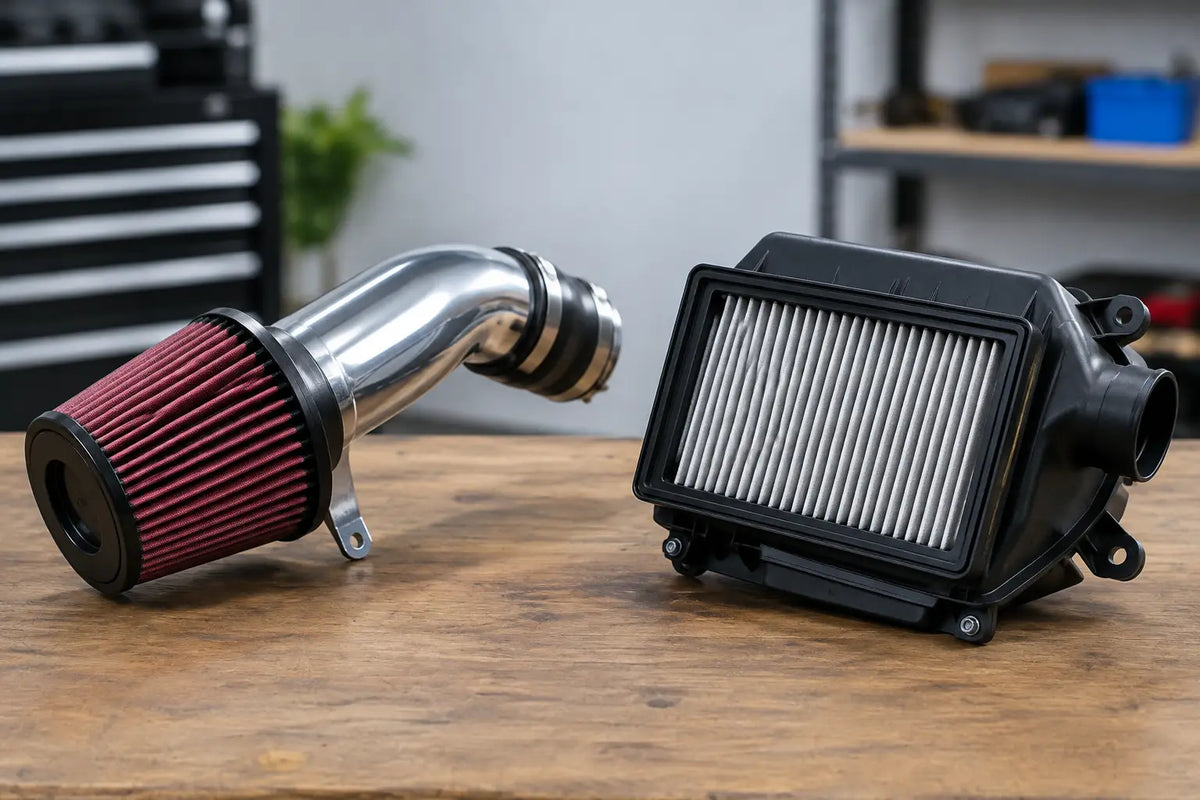
A loud induction roar is satisfying, but it is not proof of more power. When weighing up an open intake vs panel filter, the best choice depends on your engine, factory airbox design, calibration and how you actually use the car. A cone filter under the bonnet can transform the noise of a turbo hatch. A high-flow panel filter in the standard airbox can be the smarter route for consistent power on a hot track day.
The right answer is rarely the part with the biggest claimed flow figure. Your intake system needs to supply cool, clean, stable air without upsetting airflow readings or creating a restriction at your target power level. Get that balance right and the car will feel sharper without sacrificing reliability or drivability.
Open Intake vs Panel Filter: The Core Difference
A panel filter replaces the original filter element inside the factory airbox. It retains the OE ducting, airbox volume, cold-air feed and, in most cases, the factory heat shielding. Performance panel filters are commonly made from oiled cotton gauze or dry synthetic media, with designs intended to reduce restriction while maintaining filtration.
An open intake replaces some or all of the original airbox with an exposed cone or pod filter. Better kits include a heat shield, cold-air ducting, a carefully sized intake pipe and the correct mounting for the MAF sensor or turbo inlet. Cheaper universal setups may simply place a filter in the hottest part of the engine bay. Those are not equivalent products, even if both are described as an open intake.
This matters because an engine does not just need air volume. It needs air density. Cooler air contains more oxygen for a given volume, which is why a factory airbox drawing from behind the grille or wing area can outperform an exposed filter once the car is heat-soaked.
When a Panel Filter Makes More Sense
For most lightly modified road cars, a quality panel filter is the sensible first move. Modern factory intake systems are often less restrictive than enthusiasts assume, particularly on turbocharged platforms. Manufacturers need to meet noise targets and packaging constraints, but they also need an intake capable of supporting the engine reliably in extreme temperatures and at sustained load.
Keeping the original airbox gives you controlled cold-air routing and usually preserves smooth airflow across the MAF sensor. That can be valuable on cars that are sensitive to changes in intake diameter, pipe position or turbulence. You also retain factory fitment, reduced induction noise on motorway runs and a cleaner under-bonnet appearance.
A panel filter is especially well suited to a Stage 1 calibration, a daily-driven performance car, or a build where you want gains without adding noise and attention. On engines where the original airbox is known to support considerably more power than standard, spending the difference on tyres, brakes or a proper remap may deliver a much more noticeable result.
There is a maintenance angle too. Some washable filters need correct cleaning and, where applicable, careful re-oiling. Too much oil can contaminate a MAF sensor; too little can compromise filtration. A dry high-flow panel filter avoids the oiling variable, while a disposable high-quality replacement remains the lowest-fuss choice.
Where an Open Intake Earns Its Place
A properly engineered open intake can be a worthwhile upgrade when the factory system becomes a genuine restriction. This is more likely with larger turbochargers, upgraded turbo inlets, higher-flow intercooler pipework and calibrations that demand substantially more air than the original setup was designed to move.
The benefits are not limited to peak bhp. A larger, smoother intake tract can reduce pressure drop before the turbo, helping it work more efficiently. On the right application, that may improve response, reduce compressor effort and support power higher in the rev range. Naturally aspirated cars can also benefit, although the gain often depends heavily on intake length, resonance tuning and where the kit sources cold air.
Then there is the sound. An open induction kit brings turbo spool, compressor flutter where applicable and a sharper intake note that a sealed airbox deliberately suppresses. For many owners, that is a valid reason to buy one. There is nothing wrong with choosing a part because it makes the car feel more alive, provided expectations are realistic.
The catch is heat management. At low road speeds, in traffic or during repeated track sessions, an exposed filter can ingest very warm under-bonnet air. Intake air temperatures climb, the ECU trims timing or boost to protect the engine, and the strong dyno pull you saw with the bonnet open may not translate to a hot summer drive.
The best open systems address this with a sealed or semi-sealed enclosure, a direct cold-air feed and a filter positioned away from radiator and turbo heat. On some platforms, the strongest option is neither a basic cone kit nor a panel filter, but an enclosed high-flow intake that combines larger ducting with controlled cold-air supply.
Fitment and calibration are not optional
Before buying, check whether the intake is designed for your exact engine code and model year. A kit for a later MAF-equipped Golf GTI may not suit an earlier version, even where the engine family looks similar. Breather connections, sensor bosses, turbo inlet sizes and ECU logic vary more than product photos suggest.
This becomes critical after tuning. If an intake changes the MAF housing diameter or airflow pattern, the ECU may need calibration changes to read load correctly. Symptoms can include hesitant throttle response, unstable idle, fault codes or fuel trims outside their normal range. A reputable vehicle-specific kit is built around these details. A universal cone filter and a silicone elbow are a gamble on a modern engine.
How to Choose for Road, Fast Road and Track
Start with the restriction you are trying to solve. If the car is standard or lightly mapped and the original airbox has a well-designed cold-air feed, a panel filter is normally the disciplined choice. It protects consistency, costs less and avoids creating problems where none existed.
If you are chasing more power from a turbo upgrade, or your platform is proven to respond to a larger intake and turbo inlet, choose a complete vehicle-specific system. Look for evidence of heat shielding, sensible filter placement, proper brackets and compatibility with your existing intake pipes. A claimed flow number is useful only when the kit actually maintains cool inlet temperatures in the car.
For a track-focused build, think beyond the first hard lap. Log intake air temperature, ignition correction, boost and fuel trims if your platform allows it. Consistency across a twenty-minute session matters more than a brief peak figure. An enclosed system or optimised factory airbox often wins here, particularly on tightly packed turbo engines.
For a fast-road car, the decision can be more personal. A quality open kit may provide the soundtrack you want without meaningful downside if it is properly shielded and your driving is mainly on open roads. Just do not confuse a louder throttle opening with a major performance gain. The seat-of-the-pants effect is real, but it is often acoustic.
What to Check Before You Order
Do not buy an intake by filter diameter alone. Confirm your vehicle, engine code, drivetrain layout and any existing modifications. Check whether you need a matching turbo inlet, whether the kit retains the engine cover, and whether it is compatible with an aftermarket front-mounted intercooler pipe route.
Filter location deserves a close look. A low-mounted cold-air intake can access cooler air, but it may be exposed to standing water, road spray and dirt. That does not automatically make it unsuitable, but it means sensible maintenance and cautious driving through deep water are part of the deal. A hydro-locked engine is a very expensive trade for an induction note.
Also consider the rest of the package. A restrictive intake hose, collapsed factory turbo elbow or undersized inlet can limit a larger filter. Equally, fitting the biggest intake available to a stock-power car can add cost and noise with no useful gain. Build around your power target, not catalogue temptation.
Torque Lab stocks performance parts by vehicle, category and brand because fitment is where good builds stay good. Choose the intake that supports your next stage, works with your calibration and delivers the kind of driving experience you want every time you turn the key.