
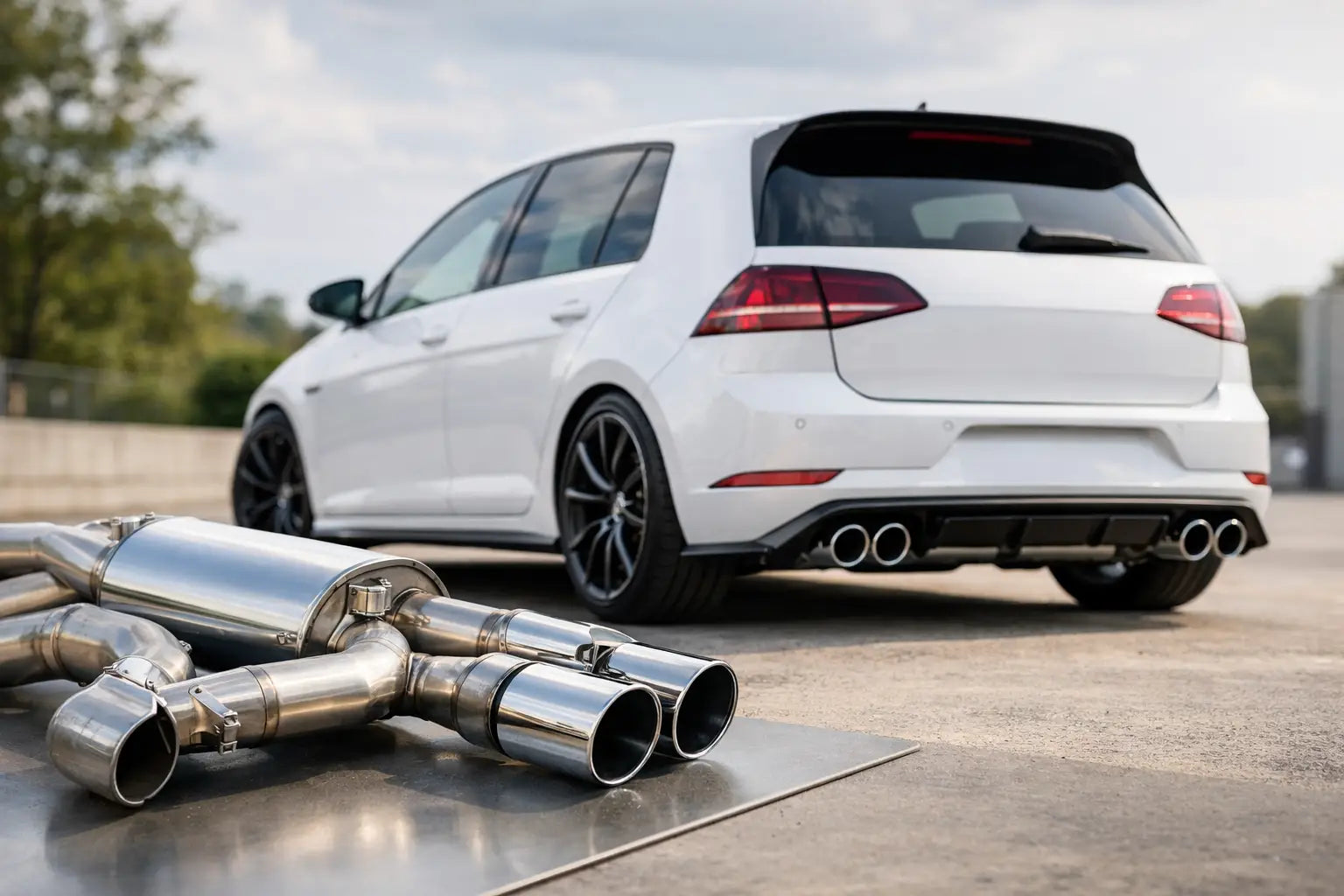
A bad exhaust choice can make a Golf feel cheap fast. Too much drone on the highway, not enough clearance under load, the wrong valve logic, or a noise level that gets old after one week - that is how a good build starts annoying you every time you drive it. Choosing the right performance exhaust for Volkswagen Golf is less about chasing the loudest system and more about matching the car, the engine, and how you actually use it.
Golf owners usually know what they want in broad terms. Better sound. Freer flow. Cleaner rear-end finish. Maybe a small bump in performance, maybe room to grow with a downpipe, intake, or tune later. The catch is that the right answer for a daily-driven Mk7 GTI is not necessarily the right answer for a manual R that sees track days, and it definitely is not the same as a cosmetic cat-back on a 1.5 TSI street car.
What a performance exhaust for Volkswagen Golf actually changes
A quality exhaust upgrade changes more than volume. It affects backpressure, gas flow, thermal behavior, weight, and the car's character from idle to redline. On turbocharged Golf models, especially GTI and R variants, the biggest gains often come when the exhaust is part of a broader setup rather than a standalone mod. Cat-back systems tend to improve sound and flow, but the real performance jump usually comes when paired with a higher-flow downpipe and software calibrated for it.
That said, not every owner wants a full stage build. For plenty of Golf drivers, the exhaust is about sharpening the experience without turning the car into a headache on the commute. In that case, pipe diameter, resonator design, muffler construction, and valve integration matter more than headline dyno claims.
Material choice also matters. T304 stainless is the benchmark for corrosion resistance and long-term durability, especially if the car sees wet roads and year-round use. Lower-grade stainless can still do the job, but it is usually not where experienced buyers want to cut corners.
Which exhaust setup makes sense for your Golf?
The best setup depends heavily on your chassis and engine.
GTI and Golf R
These are the models where a proper performance exhaust makes the most sense from both a sound and tuning perspective. The EA888 platform responds well to improved flow, and there is strong aftermarket support from established brands. If your car is stock or lightly tuned, a resonated cat-back is usually the sweet spot. You get a stronger tone, better presence under load, and less risk of drone on long drives.
If the car is already running a downpipe or is headed toward a stage 2 style setup, exhaust selection gets more serious. Some systems sound excellent with the factory downpipe but become harsh or boomy once the restriction upstream is reduced. That is why experienced builders look at the full combination, not just the rear section in isolation.
For Golf R owners, valve-equipped systems are especially appealing. They preserve some civility when you want it and open up the car when you are on throttle. That flexibility is worth paying for if the car does mixed duty.
TSI non-GTI models
A performance exhaust for Volkswagen Golf on a smaller TSI model can still be worthwhile, but expectations need to stay realistic. You are usually buying for sound, styling, and a slightly freer-breathing system rather than major power gains. That is not a bad thing. A well-designed axle-back or cat-back can clean up the rear end and give the car a more purposeful tone without trying to imitate a GTI.
This is where restraint pays off. Oversized systems on lower-output engines can sound flat, raspy, or just out of character. A moderate setup with proper resonation usually feels more OEM-plus and ages better.
GTD and diesel variants
Diesel Golfs are a different conversation. Some owners want a sharper note and reduced restriction, but modern emissions hardware and legal considerations can quickly complicate the plan. On these cars, the exhaust choice needs to be made with extra care around compliance, check-engine-light risk, and what you actually expect from the sound.
Cat-back, axle-back, or full turbo-back?
This is where buyer intent matters most.
An axle-back is usually the entry point. It changes the rear section only, so installation is simpler and the effect is mostly about sound and appearance. It makes sense if you want a little more character without going deep into the setup.
A cat-back replaces everything from the catalytic section back. For most Golf owners, this is the best balance. You get a more complete change in tone and flow, and quality systems are engineered around the platform rather than acting like a universal compromise.
A turbo-back or full system is the most aggressive route and usually includes the downpipe. This is where meaningful flow improvements show up, especially on tuned turbo cars, but it also brings the biggest trade-offs. Noise rises quickly, emissions compliance becomes a serious issue, and some setups are not appropriate for road use depending on your location.
If you are building a street-driven Golf, the cat-back is usually the safest performance-first choice. If you are building around software, intake, and higher boost targets, then the rest of the exhaust path starts to matter more.
Sound quality matters more than loudness
The worst exhausts are not always the loudest. They are the ones with one-note boom, artificial rasp, or constant cabin drone at normal cruising RPM. Golf platforms are refined enough that a poor exhaust stands out immediately.
A good system should sound tight at idle, stronger through the mid-range, and more aggressive when extended - without making every highway trip tiring. Resonated versions often get overlooked by buyers who think louder automatically means better. In practice, resonated systems are often the smarter buy, especially on DSG cars that spend time in the same RPM band on the highway.
If the car is your only vehicle, think long term. What sounds exciting for the first three days can get old in month three. If it is a weekend car or track toy, you can be more aggressive, but even then, sound quality should come before volume.
Fitment, valves, and brand quality
This is not the category to gamble on mystery-brand hardware. A performance exhaust lives under the car, deals with heat cycles, vibration, road debris, and constant expansion and contraction. Poor welds, weak hangers, bad flange alignment, and cheap clamps quickly turn a bargain into a fix-it-later problem.
Platform-specific fitment is a big deal on the Golf because rear valance style, trim level, diffuser design, and factory valve configuration can all affect what works cleanly. Tip design matters too. Some owners want a subtle OEM-plus look, others want a larger diameter finish that fills the rear properly. Neither is wrong, but it needs to suit the car.
This is why proven aftermarket names carry weight. Brands with solid Volkswagen experience tend to get the routing, clearances, and sound tuning right. Milltek, for example, remains a familiar choice in this space because it offers broad VAG fitment coverage and understands what owners actually want from a fast-road or track-capable exhaust.
Valve integration is another area where quality separates itself. A valved system should not just be louder when open and quieter when closed. It should transition cleanly, avoid rattles, and work with the character of the car. Cheap valve setups often end up being gimmicks rather than useful features.
The trade-offs: power, legality, and daily use
There is no perfect exhaust with zero compromise. More flow can support power, but it can also increase noise and smell depending on the setup. Larger pipe diameter can help a tuned car, but it can be unnecessary on a mostly stock one. A non-resonated system may sound more aggressive in clips, yet be the wrong call for daily driving.
Legality is the other big factor. Road regulations, emissions requirements, and inspection standards vary, and exhaust modifications can put a car on the wrong side of them fast if you are not careful. If the Golf is a daily, street compliance should be part of the buying decision from the start, not something you think about after installation.
The same goes for track use. Some circuits have strict noise limits, and the loudest setup is not always the fastest way onto a session. A well-engineered, controlled sound profile can be more useful than maximum noise.
How to choose the right performance exhaust for Volkswagen Golf
Start with the car's actual role. If it is a commuter with occasional spirited driving, prioritize a resonated cat-back with high-quality construction and clean fitment. If it is a GTI or R heading toward a tuned setup, buy with the end goal in mind so the exhaust still works once supporting mods are added. If it is mainly about aesthetics and tone on a lower-output Golf, keep the system proportional to the engine.
Then look at the details that experienced buyers care about: stainless grade, resonator configuration, valve compatibility, tip style, and manufacturer reputation on the platform. This is where a specialist retailer like Torque Lab makes the search easier, because platform-specific brands and real performance categories matter more than generic parts-bin shopping.
A Golf is a great base because it can be subtle, fast, refined, or all three at once. The right exhaust should amplify that - not fight it. Buy for the way you drive, not for the loudest clip on your phone, and you will end up with a setup that still feels right long after the install day buzz wears off.