
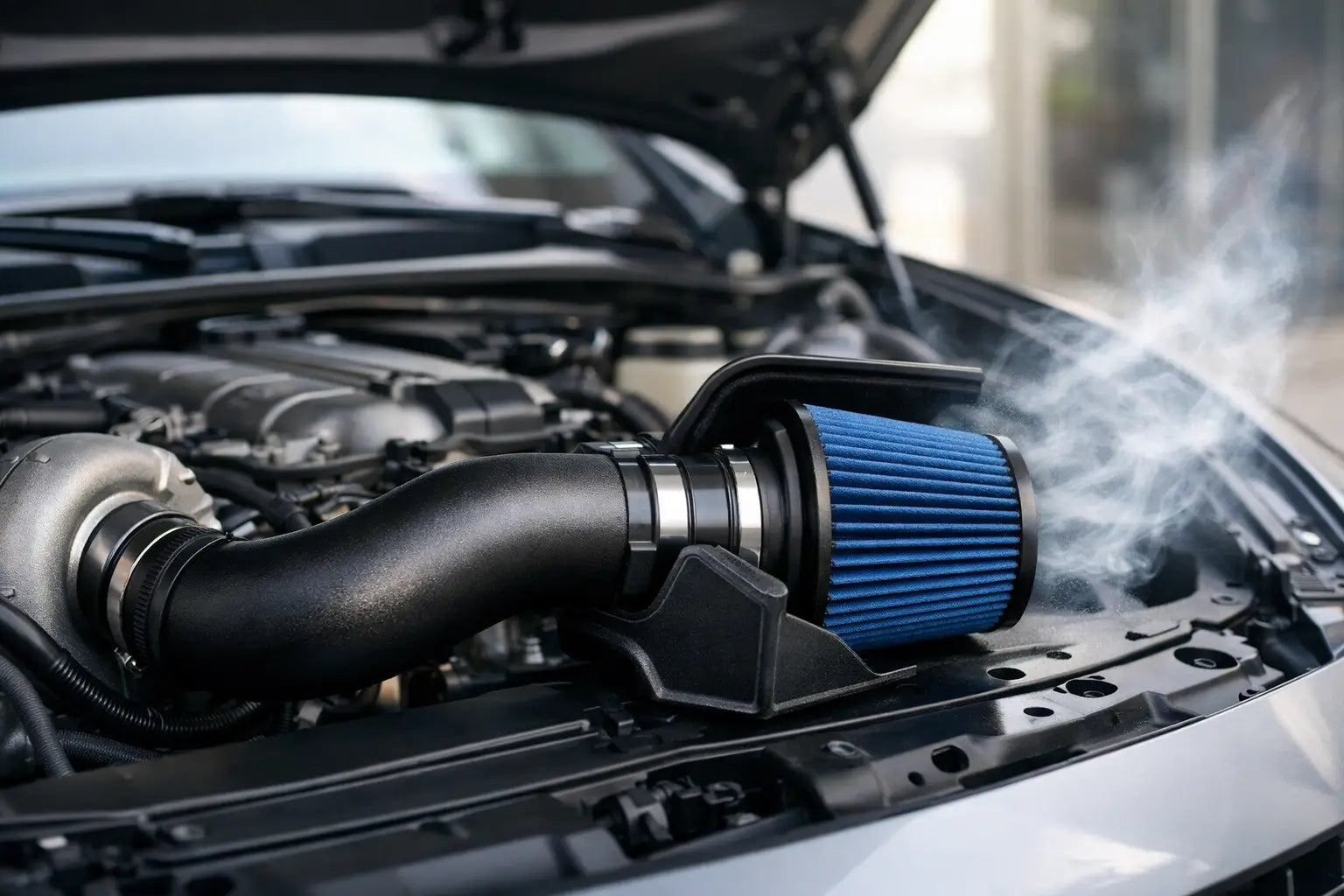
Ask ten enthusiasts about intake mods and you will hear everything from “easy horsepower” to “all noise, no go.” That is exactly why cold air intake gains explained properly matters. On some cars, the upgrade is a smart first step. On others, the gains are modest unless the rest of the setup can actually use the extra airflow.
The short version is simple: a cold air intake can improve airflow, reduce restriction, and feed the engine cooler air than a hot underhood setup. That can help power, throttle response, and consistency. But the size of the gain depends heavily on the factory intake design, the engine’s tuning, and whether the car is naturally aspirated or turbocharged.
What a cold air intake is actually doing
A proper cold air intake is not just a cone filter bolted somewhere in the engine bay. The goal is to route air from a cooler area, smooth out the path into the engine, and reduce restriction versus the stock airbox and piping.
That matters because engines are air pumps. If the intake path is narrow, turbulent, or heat-soaked, the engine has to work harder to pull in the air it needs. Improve that path and you may reduce pumping losses while increasing the amount of dense air available.
Cooler air is denser air. Denser air carries more oxygen per volume, and more oxygen supports more fuel, which supports more power. That is the theory. The real-world result depends on how much the factory system was holding the engine back in the first place.
Cold air intake gains explained by engine type
If you want realistic expectations, engine type is where the conversation starts.
Naturally aspirated engines
Naturally aspirated cars usually see the most debated results because the gains are often small but noticeable. On a modern NA street car with a decent stock intake, expect something like 3 to 10 horsepower at the crank from a quality system, with many setups landing on the lower half of that range.
The real improvement on an NA build is often in throttle response and upper-RPM breathing rather than a dramatic peak power jump. If the stock intake was already well engineered, the aftermarket system may sound faster than it actually is. If the stock system is restrictive, quiet by design, or optimized for packaging rather than flow, the intake can be more worthwhile.
Cars with supporting mods tend to benefit more. If you have headers, exhaust, and tuning, the intake becomes part of a combination instead of a standalone part trying to carry the whole result.
Turbocharged engines
Turbo cars can respond better because the engine is already trying to move a larger volume of air. Reduce restriction before the turbo and you can improve compressor efficiency, spool feel, and overall airflow potential.
On some turbo platforms, a cold air intake or upgraded intake system might show 5 to 15 horsepower, sometimes more with tuning. The gains are often stronger when the factory airbox or inlet pipe becomes a bottleneck at higher boost levels.
That said, not every turbo car gets a huge jump from intake changes alone. Some OEM systems are surprisingly capable until you increase boost, swap the turbo, or add fueling and calibration changes. In those cases, the intake is less about instant dyno glory and more about removing a future restriction.
Why dyno numbers vary so much
This is where most confusion starts. One brand shows a healthy gain on a dyno sheet. Another owner installs a similar setup and barely feels anything. Both can be telling the truth.
Intake performance is highly sensitive to testing conditions. Ambient temperature, engine bay heat, fan placement, hood position, and ECU learning all affect the result. A hot dyno room can punish an open intake design. A road pull with proper airflow may tell a different story.
Then there is the baseline. If the stock system already pulls cool outside air through a well-sized airbox, the aftermarket gain will be limited. If the factory setup has a resonator-heavy path, narrow tubing, or a paper filter in a cramped box, there is more room for improvement.
The tune also matters. Many modern ECUs can adapt to airflow changes within a range, but that does not always mean they fully capitalize on the hardware. On MAF-based cars especially, intake design has to play nicely with sensor placement and airflow stability. A poorly designed kit can cause turbulence, inconsistent fueling, or check engine lights instead of usable gains.
The biggest mistake: confusing any intake with a good intake
Not all intake systems deserve the same reputation. A quality cold air intake is engineered around heat management, sensor scaling, pipe diameter, filter placement, and fitment. A cheap short-ram sucking hot engine bay air may add induction sound and lose power once temperatures rise.
That trade-off gets ignored a lot because sound is persuasive. The louder turbo flutter or intake growl can make the car feel transformed. Sometimes it is transformed. Sometimes the stopwatch says otherwise.
Heat shielding helps, but it is not magic. A fully sealed system drawing air from outside the engine bay usually does a better job of maintaining intake air temperatures than an exposed cone filter sitting near the radiator and manifold. If consistent performance matters, especially for track days or repeated hard pulls, intake temperature control matters as much as raw flow.
Supporting mods change the answer
A cold air intake rarely exists in isolation on a serious build. Once you look at the whole package, the value of the intake becomes clearer.
On an NA platform, the intake works best alongside an exhaust upgrade and a tune that adjusts fueling and ignition to suit the improved airflow. On a turbo car, the intake often pairs naturally with an inlet pipe, intercooler, charge piping, downpipe, and software. Each part on its own may offer a modest gain. Together, they make the airflow path more efficient from filter to combustion chamber.
This is why experienced builders do not just ask, “How much power does the intake make?” They ask whether the stock intake is a restriction at the current power level, whether the sensor housing is correctly sized, and whether the tune will take advantage of the change.
When a cold air intake is worth it
If your goal is the best horsepower-per-dollar mod on every platform, the answer is: it depends. There are cases where tires, brakes, or a tune deliver more obvious gains for the money. But there are still plenty of reasons an intake makes sense.
It is worth it when the stock system is restrictive, when you are building around future power upgrades, or when you want sharper response and better sound without diving straight into major engine work. It also makes sense on cars where the aftermarket has developed platform-specific kits with proven data and clean fitment.
For a track or hard-driven street car, consistency matters more than marketing claims. An intake that keeps temps under control and supports repeatable performance is a better buy than one giant peak number on a best-case dyno run.
What to look for before buying
Fitment should be first. A well-designed intake for your exact chassis and engine is far more valuable than a generic setup with universal promises. MAF housing dimensions, filter size, routing, and heat shielding all need to work with the vehicle, not against it.
Construction quality matters too. Good couplers, proper brackets, durable pipe materials, and a filter from a known performance brand make a difference over time. If the intake requires trimming, relocation, or software changes, that should be clearly understood before you order.
It is also smart to be honest about your use case. A daily driver in wet conditions may not need an extremely low-mounted intake path. A tuned turbo build chasing flow may prioritize a larger inlet and filter surface area. A street car that sees occasional spirited driving may benefit most from a sealed system that balances sound, drivability, and temperature control.
For enthusiasts shopping real upgrade paths, this is where specialist retailers like Torque Lab stand out - platform-specific options from proven brands are easier to trust than random kits with flashy claims and no fitment depth.
The realistic answer enthusiasts should use
Cold air intake gains explained in one sentence: the mod can work well, but only when the design, vehicle, and setup all line up.
If you are expecting a night-and-day power jump from an intake alone, you will probably be disappointed. If you are choosing a well-engineered system for the right platform, especially as part of a broader airflow and tuning package, it can absolutely be a worthwhile upgrade.
The best intake mods are not the ones with the loudest claims. They are the ones that match the car, support the build, and keep delivering when the engine is hot, the road is long, and you are actually using the car the way it was built to be driven.