
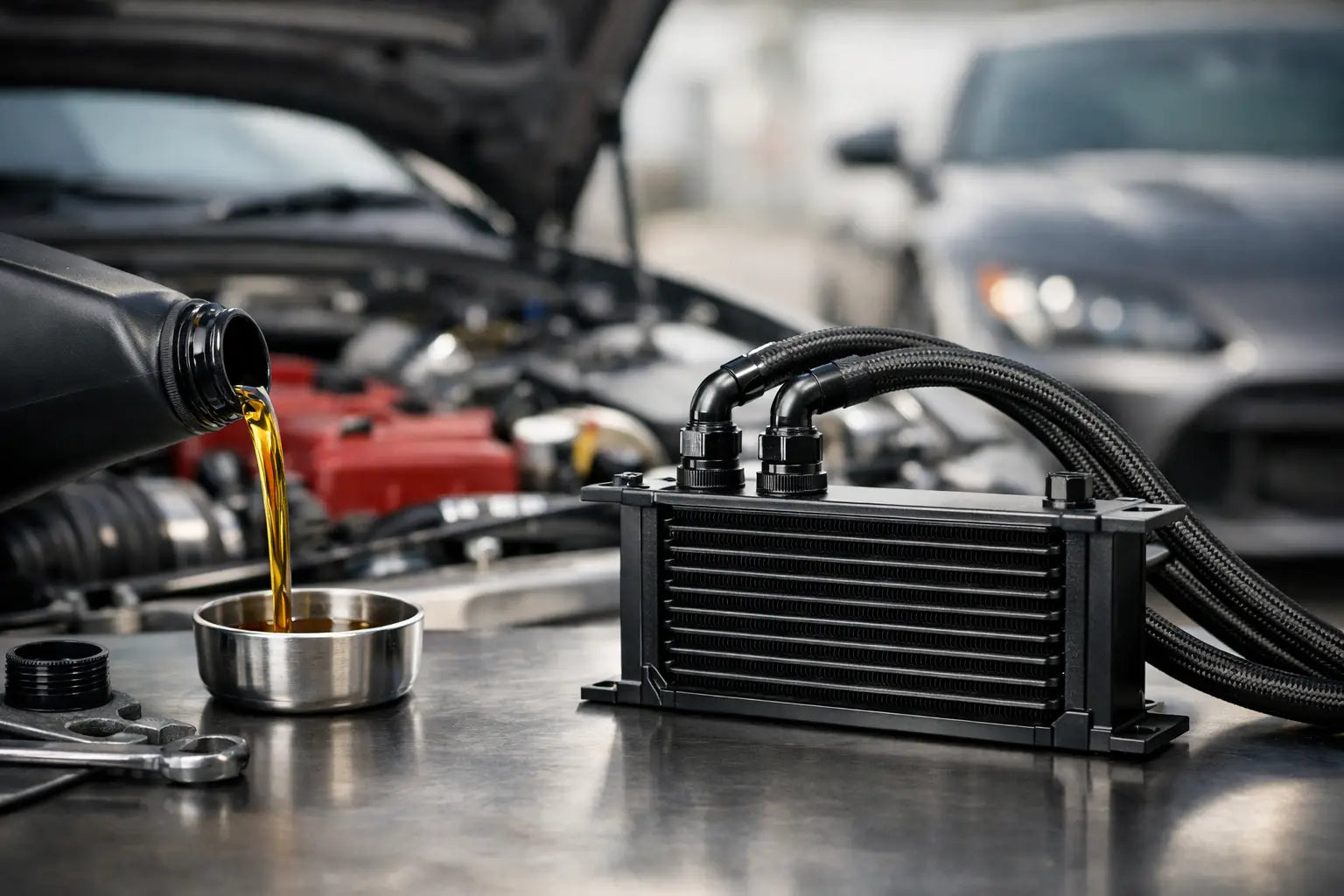
You usually start asking when do you need an oil cooler right after the car gives you a reason to. Maybe oil temps creep past where you’re comfortable on a track session. Maybe a tuned turbo setup feels heat-soaked after a few hard pulls. Maybe your tow rig sees long grades in summer and the oil starts working harder than the factory system was ever meant to handle. That’s the point where an oil cooler stops being a cosmetic add-on and becomes a real reliability mod.
An oil cooler is not a universal must-have. Plenty of stock street cars will never need one, even if they’re driven hard now and then. But once power, load, ambient heat, or sustained RPM go up, oil temperature can become a limiting factor. And when oil gets too hot for too long, it stops doing its job as well as it should.
What an oil cooler actually solves
Engine oil has a rough life. It lubricates bearings, cushions moving parts, helps control wear, and carries heat away from critical areas inside the engine. In a performance car, especially a turbo car, oil is doing even more work because it is exposed to higher combustion temps and often turbocharger heat as well.
When oil temperature climbs too far, viscosity drops. That means the oil film can thin out under load, which is exactly what you do not want when the engine is under boost, pulling long RPM, or spending lap after lap at full song. High oil temps can also speed up oxidation and shorten oil life, so even if the engine survives, the fluid is being pushed past its comfort zone.
An oil cooler gives that heat somewhere else to go. It adds cooling capacity to the system and helps keep oil in a more stable operating range. That stability matters just as much as peak temperature. A car that swings wildly from acceptable to overheated is harder on parts than one that stays consistent.
When do you need an oil cooler for a street car?
For a normal daily driver with stock power, no towing duty, and no hard mountain runs every weekend, the honest answer is often never. Most modern street cars are engineered to handle regular commuting, highway use, and occasional spirited driving without an external oil cooler upgrade.
Where things change is when the car is no longer being used like the factory intended. If you have added power, especially forced induction, oil temperature can rise quickly. A tuned turbo hatch or sedan that sees repeated pulls, aggressive backroad use, or hot-weather traffic can run hotter than the stock cooling system was designed for.
The same goes for heavier vehicles used under load. Trucks, SUVs, and wagons that tow regularly or haul weight in high ambient temperatures can benefit from extra oil cooling, even if the engine itself is mechanically stock. Sustained load is what matters here, not just peak horsepower.
If your car spends most of its life on public roads and you never see troubling oil temps, an oil cooler may be unnecessary complexity. More parts means more plumbing, more fittings, and more chances for leaks if the kit or install is poor. On a true street car, that trade-off should be taken seriously.
When do you need an oil cooler for track use?
This is where the answer gets much more straightforward. If you track the car regularly, especially with longer sessions, sticky tires, and upgraded power, an oil cooler often moves from nice-to-have to essential.
Track driving creates sustained heat, not just short bursts. You’re sitting in higher RPM for longer, braking harder, loading the engine harder on corner exit, and usually dealing with less airflow margin than you think. Coolant temp may still look acceptable while oil temp quietly climbs into a range that starts thinning the oil and stressing the engine.
Some factory performance cars come with decent oil cooling from the start. Others absolutely do not. It is common to see cars that feel great for one or two laps, then start running hot once the pace stays high. If you are forced to back off because oil temp is climbing, the car is telling you what it needs.
For time attack, HPDE, drift, and endurance-style use, stable oil temp is part of a proper build. It is not just about protecting the engine. It is about maintaining repeatable performance across a full session.
Signs your track car needs an oil cooler
The clearest sign is measured temperature. If you have an oil temp gauge and consistently see numbers pushing beyond a safe range for your oil and engine setup, that is the data you should trust.
There are other clues too. The car may feel strong early in a session, then lose consistency as heat builds. Oil may degrade faster than expected. In more serious cases, you may notice pressure behavior that gets less stable once temperatures are high. None of those should be ignored.
If you track without an oil temp gauge, you are guessing. On any serious performance build, that is a weak link.
Power mods that change the answer
A mild bolt-on setup is one thing. Once you move into bigger turbo territory, higher boost, aggressive tuning, or repeated high-load use, the oil system starts dealing with much more heat.
Turbo cars are the obvious example because the turbo itself adds thermal load. But naturally aspirated cars are not exempt. Raise RPM, increase compression, run sticky tires, and spend more time at wide-open throttle, and oil temperature can still become an issue.
Engine swaps also deserve attention here. A swap that fits physically is not always a swap with ideal thermal management. If you are building a platform that now makes much more power than stock, or uses the engine in a tighter bay with less airflow, an oil cooler should be part of the planning conversation early, not after the first overheating scare.
Climate, driving style, and vehicle setup matter
Not every car with the same mods needs the same cooling package. Ambient temperature changes everything. A car that survives spring track days in the Northeast may struggle badly in a Southern summer. The same setup can behave very differently depending on climate, tire grip, aero, and session length.
Driving style matters too. A driver doing one clean fast lap and a cooldown will create a different heat load than someone running flat-out for 20 minutes. Tire setup matters because more grip often means more engine load on corner exit. Aero can help or hurt depending on how it affects airflow through the front of the car.
That is why the best answer to when do you need an oil cooler is not based on internet folklore. It is based on how your car is used, what temps you actually see, and whether the current system has enough margin.
The trade-offs before you buy
An oil cooler is a smart mod when it solves a real heat problem. It is not automatically a smart mod just because the part looks serious.
Overcooling is one concern, especially on street cars in colder climates. Oil needs to reach proper operating temperature. If it stays too cool, lubrication and moisture control can suffer. That is why a thermostatic sandwich plate is often the better route for dual-purpose cars. It lets the oil warm up properly before routing it through the cooler.
Installation quality also matters. Cheap lines, poor fittings, weak mounting, or bad airflow placement can create new problems fast. A cooler hidden behind blocked airflow or placed where it gets minimal fresh air will not do much. A quality core, proper hose routing, and a well-matched thermostat setup make the difference between a useful upgrade and a headache.
There is also the question of priority. If your coolant system is marginal, your ducting is poor, or your tune is overly aggressive, an oil cooler may treat the symptom without fixing the root issue. Good builds work as a system.
How to decide if your car actually needs one
Start with data. If you do not know your oil temperatures, install a proper gauge or log them through your ECU if the platform supports it. Watch what happens during the kind of driving you actually do, not just a short cruise around town.
If oil temps stay in a healthy range with enough margin, you probably do not need an external cooler yet. If temperatures keep climbing during track sessions, towing, hot-weather mountain runs, or repeated pulls, you are past the guessing stage.
Then look at the build honestly. Stock daily with no temp issues? Probably not necessary. Tuned street car in a hot climate with repeated hard use? Very possible. Track car that has already shown heat-related limits? Yes, this belongs on the shortlist.
For enthusiasts building with intent, this is the real mindset: install an oil cooler when the car’s use case demands more thermal control than the factory gave you. Not before the evidence, and definitely not after the damage.
If your setup is asking more from the engine every time you drive it hard, stable oil temperature is not a luxury mod. It is part of building a car that can keep showing up, session after session, without flinching.