
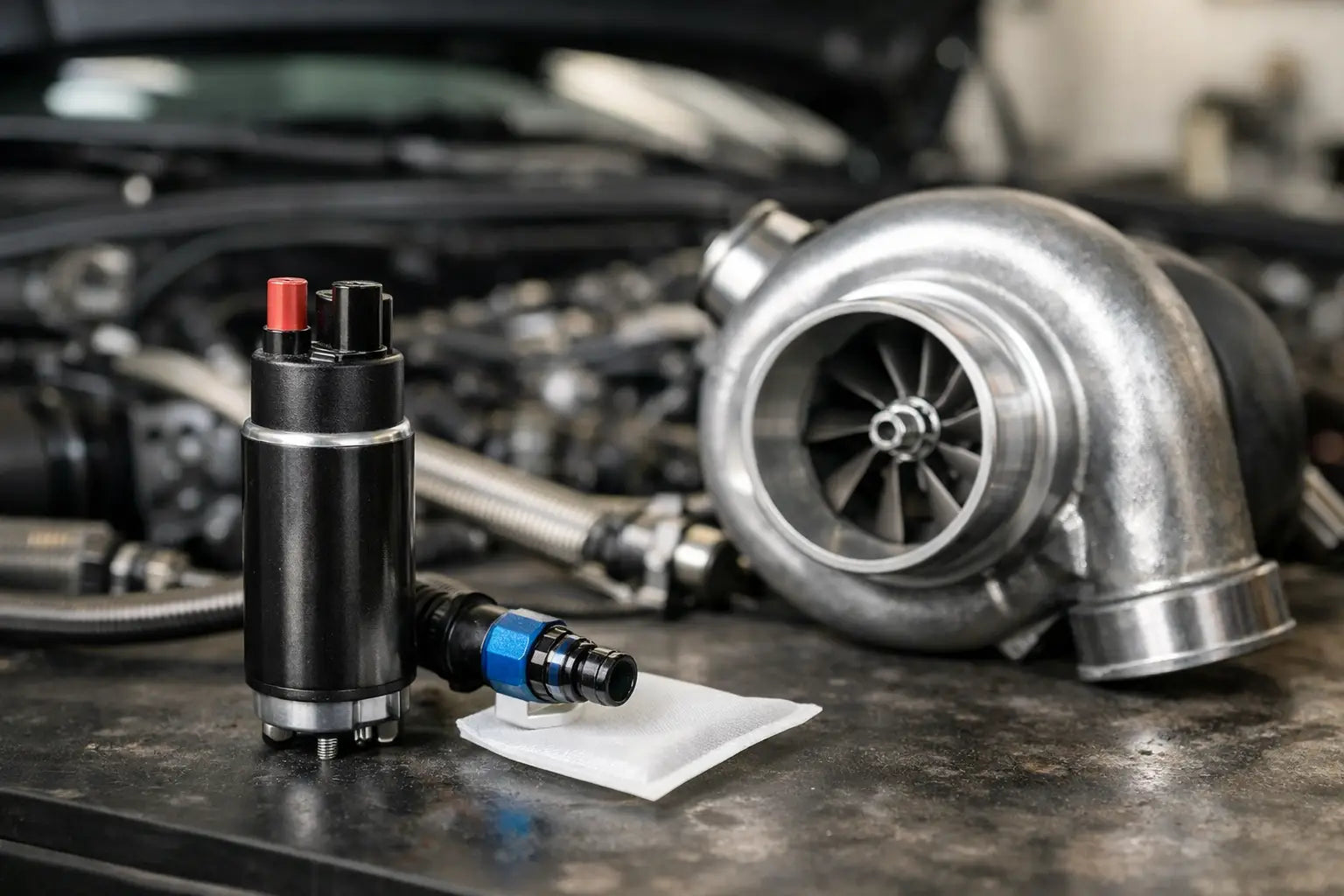
If your turbo setup starts leaning out at the top of a pull, the problem usually is not the turbo. It is the fuel system asking for mercy. An upgraded fuel pump for turbo build planning is one of those parts that gets ignored until the logs show pressure drop, injector duty climbs, or the engine starts doing expensive things.
A lot of builds reach the same point. The intercooler is in, the turbo is sized, the tune is close, and the car feels strong right up until fuel demand outruns supply. That is why the pump matters. It is not a glamour mod, but it is the part that decides whether your boosted setup is repeatably fast or just briefly fast.
Why an upgraded fuel pump for turbo build matters
Turbo cars do not just need more fuel. They need more fuel at the right pressure, consistently, under load, heat, and extended high rpm use. A stock pump may keep up on mild boost for a while, especially on newer platforms with decent OEM headroom, but that margin disappears quickly once you raise boost, add ethanol blend, or move to a larger injector.
The key issue is that fuel demand increases harder than many people expect. More boost means more air mass. More air mass needs more fuel to maintain a safe air-fuel ratio. If the pump cannot hold the required flow at operating pressure, you end up with falling rail pressure, unstable fueling, and a tune that cannot protect the engine forever.
This gets even more critical on track cars and hard-driven street builds. A setup that survives a short third-gear hit may struggle after repeated pulls, long right-handers, or a hot summer session where fuel temps climb and voltage drops. That is where a quality pump upgrade stops being optional.
Start with the actual fuel goal, not the power number
Most buyers ask one question first - how much horsepower will this pump support? That question is useful, but it is also incomplete. Pump capacity depends on fuel type, base pressure, boost reference, system voltage, and whether you are talking about crank horsepower or wheel horsepower.
A pump that looks comfortably sized for pump gas can become marginal on E85 because ethanol requires significantly more volume. The same thing happens when base pressure is increased or when boost-referenced fuel pressure rises further under load. Real pump performance is always lower at higher pressure than the headline number on the box suggests.
So instead of shopping by marketing claims alone, work backward from the build. Consider your boost target, injector size, fuel type, intended use, and future headroom. If you are already planning a bigger turbo or ethanol later, buying right once is cheaper than replacing a barely adequate pump in six months.
In-tank vs external pump setups
For most modern street and track builds, an in-tank upgraded fuel pump is the cleanest route. It keeps packaging simple, tends to be quieter, and works well for a wide range of single-pump setups. Many enthusiasts can support a healthy turbo build with a properly chosen in-tank pump, matched injectors, and the right wiring support.
External pumps still have a place, especially on higher-horsepower builds, motorsport applications, or cars being converted to more elaborate surge tank systems. They can offer serious flow and serviceability, but they also add complexity, noise, plumbing demands, and often more heat management concerns.
For the majority of street-driven turbo cars, the answer is not automatically the biggest external pump you can fit. It is the pump that supports your target safely without creating unnecessary compromises.
The wiring side gets overlooked too often
A fuel pump is only as good as the voltage it actually receives. This is where plenty of turbo builds get caught out. Someone installs a larger pump, assumes the problem is solved, and still sees poor fuel delivery because the factory wiring cannot support the current draw under load.
Voltage drop reduces pump performance. That means your shiny new pump may never deliver its rated flow if it is starved electrically. On many platforms, a hardwire kit, upgraded relay setup, or revised wiring path is not just a nice extra - it is part of doing the job properly.
This matters even more with high-output pumps and ethanol setups. If your tuner is fighting unstable pressure, it is worth checking the electrical side before blaming injectors, the regulator, or the calibration.
Fuel type changes everything
If your build is staying on premium pump gas, your fuel system requirements are more forgiving. You still need enough pump overhead, but the demand curve is manageable on many moderate turbo setups.
Once ethanol enters the plan, sizing gets more serious. E30, E50, and full E85 all require more fuel volume than gasoline for the same power output. That means a pump that was perfectly fine on pump gas can become the restriction almost immediately after a fuel switch.
This is why ethanol-ready planning saves time. If there is even a decent chance your car will move to a flex-fuel setup later, choose components that support that path from the start. Pump internals, hose compatibility, filters, and supporting hardware all need to match the fuel you intend to run.
One pump is not the whole system
An upgraded fuel pump for turbo build reliability does not work in isolation. The pump is one piece of a chain that includes the fuel filter, wiring, lines, regulator strategy, injectors, and tank behavior under hard driving.
A bigger pump will not fix undersized injectors. It will not solve a clogged filter. It will not cure fuel starvation caused by poor tank pickup during cornering. And on some returnless systems, it may require additional control strategy or supporting hardware to behave properly.
That is why experienced builders look at the complete fuel path. If one component is weak, the rest of the system cannot perform at its best. The smart move is to build around balanced capacity, not just one headline upgrade.
Common buying mistakes
The first mistake is buying based on maximum advertised horsepower with no attention to pressure and fuel type. Those numbers are often best-case figures, not a guarantee for your specific platform.
The second is overbuying for a mild street build and ending up with extra noise, heat, and drivability compromises that were never necessary. Bigger is not always better if the car spends most of its life commuting, cruising, and doing occasional pulls.
The third is ignoring fitment and platform specifics. Basket design, fuel level sender integration, controller compatibility, and OE module limitations matter. A universal solution is not always a clean solution.
The fourth is forgetting the tuner. Your calibrator needs stable, predictable fuel pressure and injector behavior. A parts list that looks impressive on paper but behaves inconsistently on the car is not a good setup.
How to choose the right upgraded fuel pump for turbo build goals
The right choice starts with being honest about the car. Is it a stock-engine daily on low boost, a street car headed toward flex fuel, or a track machine that lives at high load? Those are three very different jobs, and they should not use the same shopping logic.
For a mild turbo build, a quality in-tank pump from a proven performance brand is often the sweet spot. It gives you dependable flow, cleaner installation, and enough overhead for safe tuning without turning the car into a science project.
For a more serious setup, especially one using ethanol or chasing larger power numbers, you may need more than a simple drop-in. That can mean higher-capacity in-tank solutions, dual-pump arrangements, a return-style conversion, or surge tank support. The right move depends on the platform and how the car is driven.
Brand quality matters here. Cheap pumps with big claims are all over the market, but inconsistent flow, poor longevity, and questionable compatibility are not worth the gamble. When you are buying fueling parts, proven manufacturers and fitment-correct options are worth paying for.
Think beyond peak power
A strong fuel system is about repeatability. Anyone can build a car that makes one hero pull on a cool night. The harder target is a setup that delivers stable pressure every time, whether you are street driving, doing back-to-back runs, or spending twenty minutes on track.
That is why fuel upgrades should be planned with margin. Not a ridiculous amount, but enough that the pump is not living on the edge every time boost comes in. Headroom gives your tuner room to work and gives your engine a better chance of staying healthy.
At Torque Lab, that is how performance parts should be chosen - not by hype, but by whether they support the full build properly. If your turbo setup is getting more serious, treat the fuel pump like a foundation part, because that is exactly what it is.
The best time to upgrade fueling is before the logs tell you that you waited too long.