
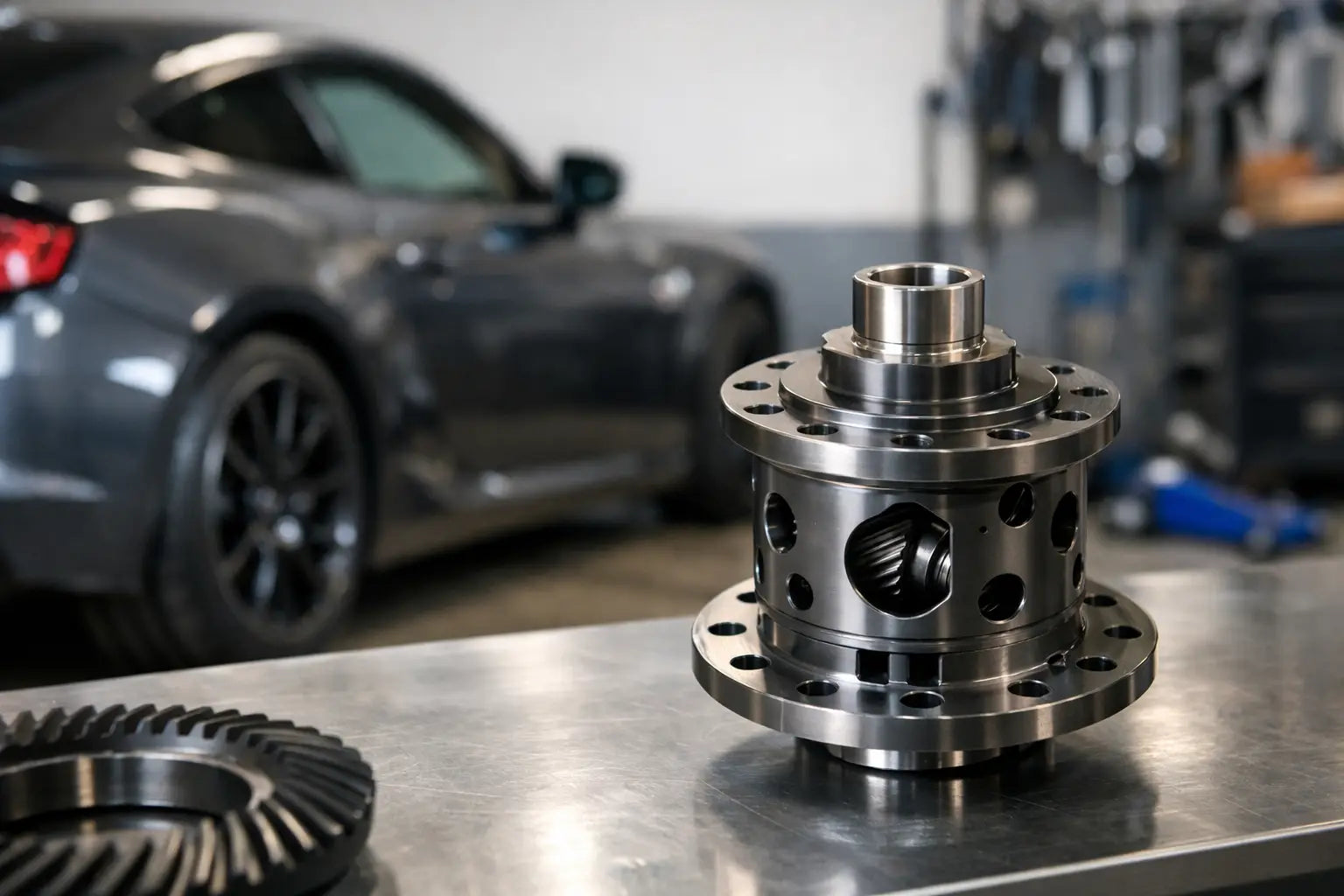
You feel it most when exiting a tight on-ramp a little harder than usual - one tire lights up, the inside wheel goes light, and all that engine effort turns into wasted traction. That is exactly where a limited slip differential for street car use starts to make sense. It is one of the few drivetrain upgrades that can change how the car puts power down every single time you drive it, not just on a dyno sheet or at full throttle.
For enthusiasts, an LSD sits in that sweet spot between daily drivability and real performance gain. It is not as visible as wheels or as easy to talk about as horsepower, but when matched properly to the platform, it can make a front-wheel drive hatch feel less frantic, a rear-wheel drive coupe feel more planted, and an all-wheel drive build feel more predictable coming out of a corner. The key is choosing the right type for how the car is actually used.
What a limited slip differential for street car builds actually does
A standard open differential lets the left and right drive wheels rotate at different speeds, which is necessary in corners. The problem shows up when one tire has much less grip than the other. Power follows the path of least resistance, so the wheel with less traction spins while the wheel with grip gets shortchanged.
A limited slip differential reduces that problem by biasing torque across the axle instead of simply letting one wheel freewheel away the car's momentum. On the street, that means cleaner launches, better traction in wet conditions, and more confidence when accelerating out of a turn. On a tuned car with more boost, more torque, or stickier tires, that difference becomes even more obvious.
This is why an LSD often feels like a more complete upgrade than raw power mods alone. More power without traction just exposes the weakness faster. A well-chosen differential helps the rest of the setup work properly.
The main LSD types and how they behave on the street
Not all limited slip differentials drive the same. This is where buyers either get a car that feels sharp and usable or one that feels like too much hardware for the commute.
Helical LSD
For most street-driven builds, a helical LSD is the easy first choice. It uses gears rather than clutch packs to transfer torque, which usually means quieter operation, smoother engagement, and lower maintenance. In normal driving, it tends to feel natural rather than aggressive.
That makes it especially popular in front-wheel drive performance cars where you want better corner-exit traction without turning every parking lot maneuver into a drivetrain event. Helical units are often the best fit for daily drivers, fast road cars, and weekend back-road builds.
The trade-off is that a helical differential needs some resistance at both wheels to work effectively. If one wheel is fully unloaded, such as over curbing or on very uneven surfaces, its torque transfer advantage can drop off compared with a clutch-type setup.
Clutch-type LSD
A clutch-type LSD uses friction plates to lock the axle more aggressively under acceleration, deceleration, or both, depending on ramp angles and setup. This is the more motorsport-focused option. It can deliver very strong traction and a more deliberate locking effect, which is great for track use, drifting, and high-power rear-wheel drive builds.
On the street, though, it comes with compromises. You may hear chatter during low-speed turns. The car can feel more mechanical, more reactive, and sometimes less forgiving in poor weather if the setup is too aggressive for the tire and suspension package. Clutch-type units also need servicing over time.
That does not mean they are wrong for road use. It just means they are best for owners who understand what they are buying and want that sharper, more locked-in behavior.
Viscous LSD
Viscous differentials were common in some OEM applications, but they are rarely the enthusiast's first upgrade choice now. They rely on fluid shear to react to speed differences between wheels, so engagement can feel slower and less consistent under hard use.
For a modern performance build, viscous units are usually not the target unless you are maintaining a factory-style setup on a specific platform.
Street car benefits that actually matter
The biggest mistake people make is thinking an LSD is only for racing. In reality, many of its best qualities show up in normal driving.
If you drive a front-wheel drive turbo car, a limited slip differential can reduce inside wheelspin when pulling out of a junction or accelerating through a bend. If you drive rear-wheel drive, it can make throttle application more stable and balanced, especially on uneven pavement. In wet or cold conditions, it can help the car deploy power with less drama.
It also changes how the chassis feels. Instead of one tire giving up and the traction control stepping in early, the car can feel more composed and more connected to throttle input. That is why experienced builders often rate an LSD as one of the most worthwhile drivetrain upgrades after tires and suspension basics are sorted.
When an LSD is worth it and when it is not
If the car is stock, lightly driven, and used mostly for commuting, an LSD may not deliver enough value to justify the cost of the unit plus installation. Differential upgrades are not usually cheap, and labor can be significant depending on the transmission layout.
But if the car already has more power than factory, regularly fights for grip in first and second gear, or sees fast-road and track-day use, the case gets much stronger. The same goes for drivers who hate intervention-heavy traction control or want a more mechanical, predictable feel from the drivetrain.
There is also the platform factor. Some cars desperately benefit from an LSD because the factory open diff is a clear weak point. Others already have strong electronic torque management and a decent stock package, so the gain is smaller. Fitment and platform-specific behavior matter more than broad claims.
Choosing the right limited slip differential for street car setups
Start with use case, not marketing. Ask how the car is driven for 90 percent of its life.
If it is a daily-driven hot hatch or sport compact that sees spirited street driving and occasional autocross, a helical unit is usually the smart play. It improves traction without making the car tiring to live with. If it is a high-power rear-wheel drive build that sees regular track work, a clutch-type differential may be the better match because it gives more aggressive locking under load.
You also need to think about the rest of the package. Tire compound, alignment, suspension geometry, engine output, and even bushing compliance all affect how the differential feels. An LSD does not work in isolation. A poorly aligned car on budget tires will not suddenly become magic because the diff is upgraded.
For buyers shopping performance parts, this is where specialist fitment support matters. Brands and applications vary, and the right setup for a Honda Civic track toy is not the same as the right setup for a BMW street build or a turbocharged Volkswagen daily. Torque Lab's audience already understands that the best mod path is the one that matches the platform, not the loudest product page.
Installation and setup are part of the result
A differential is not a bolt-on intake. Proper installation matters. Bearing preload, backlash, fluid choice, and break-in procedure all affect how the unit performs and how long it lasts.
For clutch-type units especially, setup details shape the driving experience. Ramp angles, preload, and plate arrangement can turn the same base differential into something street-friendly or something clearly aimed at competition. If you are paying for the job, it makes no sense to guess your way through those decisions.
This is also why some enthusiasts choose complete transmission refreshes while the box is apart. If the transmission has mileage on it, combining an LSD install with bearings, synchros, or seals can be the smarter long-term move.
The trade-offs enthusiasts should be honest about
There is no perfect differential, only the right compromise.
A helical LSD is excellent for most street cars, but it is not as aggressive in low-grip or wheel-lift situations as a clutch unit. A clutch-type LSD gives stronger locking and can feel incredible when pushing hard, but it may be noisier, harsher, and more demanding in everyday traffic. Some setups can increase torque steer in front-wheel drive applications or make low-speed turning feel tighter.
Fuel economy is usually not the reason to care one way or the other, but NVH, tire wear, and low-speed manners definitely are. If the car spends hours in city traffic, those details matter. If it spends weekends chasing lap times, they matter less.
That is the real buying mindset: stop asking which LSD is best in general and ask which one makes your car better on the roads and in the conditions you actually drive.
A limited slip differential is rarely the flashiest line item in a build sheet, but it is often one of the smartest. If your car already has the power and the grip is not keeping up, this is the upgrade that helps everything else work harder, cleaner, and with a lot less wasted motion.