
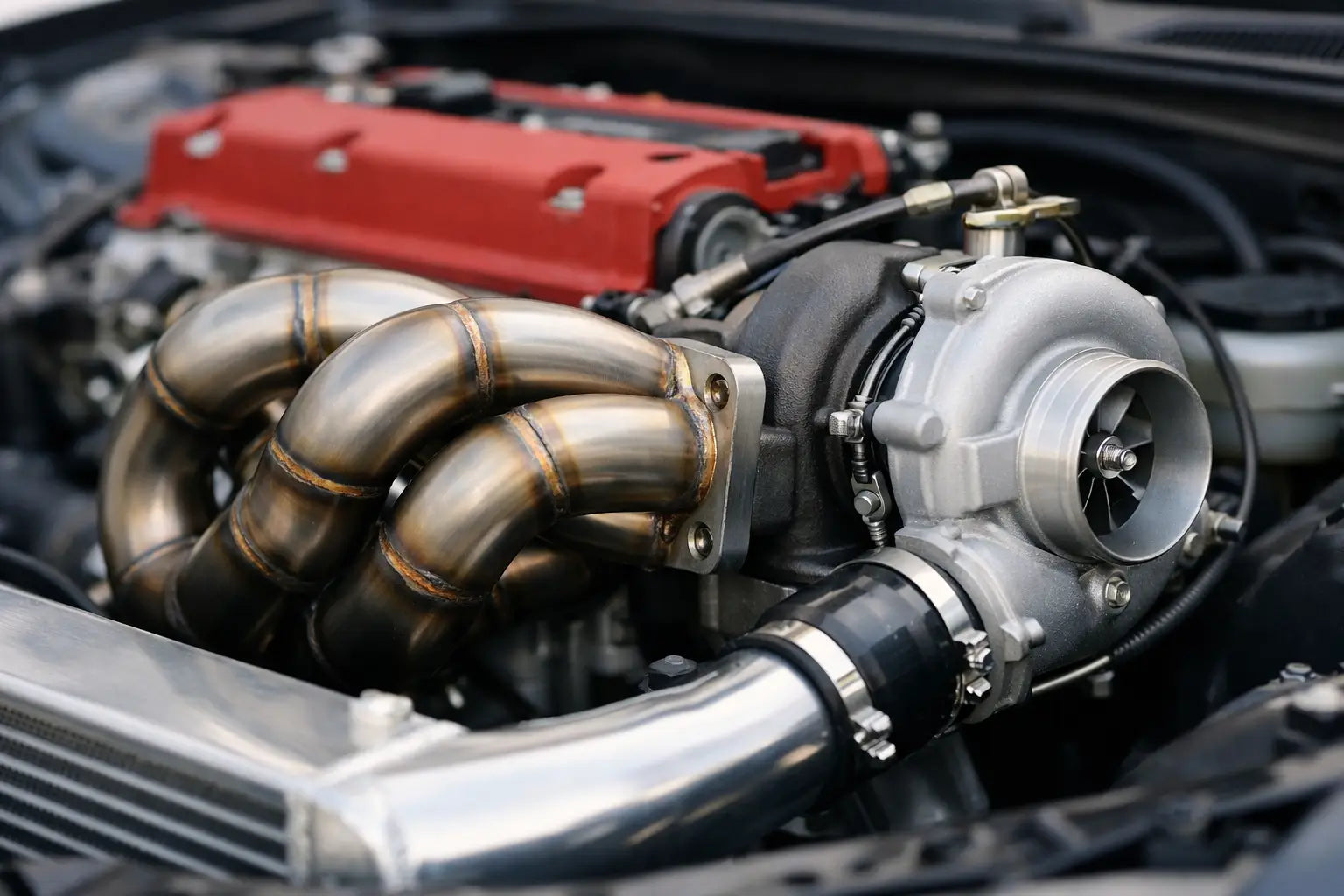
If you are hunting for the best turbo manifold for Honda Civic builds, the wrong choice will show up fast - cracked welds, boost creep, poor fitment, and a setup that fights the rest of your parts instead of supporting them. On a Civic, the manifold is not just a place to hang the turbo. It sets the tone for spool, reliability, engine bay clearance, and how far the build can actually go.
What makes the best turbo manifold for Honda Civic builds?
There is no single answer because Civic turbo setups vary wildly. A street-driven EK with a modest B-series setup needs something very different from a K-swapped track car chasing bigger power and long-session heat control. The best manifold is the one that matches your engine family, turbo frame size, power target, and how the car gets used.
That means you should ignore generic marketing claims and look at four things first: material, runner design, flange quality, and fitment. If one of those is off, even a good-looking manifold can become the weak link.
Cast vs tubular
For a lot of street Civics, cast manifolds make a strong case. They are usually thicker, more stable under repeated heat cycles, and less prone to cracking than cheap tubular units. If your goal is a dependable street car with quick spool and reasonable power, cast can be the smart choice.
Tubular manifolds are where a lot of enthusiasts end up when they want better flow, more turbo placement options, and room to support higher power. A properly built tubular manifold with quality welds and good material can work extremely well, but this is also where the market gets messy. Cheap stainless manifolds often look the part and fail early.
Material matters more than the ad copy
A quality stainless tubular manifold can perform well, but grade, wall thickness, welding quality, and bracing all matter. Thin-wall manifolds with poor support around the collector tend to suffer once real heat and vibration hit them. Cast iron or high-silicon cast options usually give away some of the visual appeal, but they often win on longevity.
If your Civic is a daily driver or sees a lot of stop-and-go use, durability should rank high. If it is a weekend build that gets regular inspection and maintenance, a higher-end tubular option may be worth it.
Choosing the right manifold by engine platform
Honda Civic fitment is never just “for Civic.” You need to buy around the engine.
D-series Civic manifolds
D-series turbo builds are still popular because they are affordable and fun, but space and budget usually shape the parts list. For these setups, a compact cast manifold or a well-proven log-style manifold often makes more sense than a flashy equal-length design. You are usually trying to keep response decent, fitment simple, and cost under control.
For modest street power, a log-style design is hard to argue against. It may not be the top-flowing option on paper, but it packages well and tends to be less dramatic to install.
B-series Civic manifolds
B-series cars open up more options, and this is where buyers often start debating spool versus top-end. A street B16 or B18 setup running a small to mid-frame turbo usually does well with a cast or compact tubular manifold that keeps velocity up. If you go too large on runner volume for your setup, the car can feel softer down low than it needs to.
For bigger B-series builds, especially those aiming well beyond entry-level boost, a better tubular manifold starts to make more sense. The key is buying proven design and fabrication, not the cheapest thing with polished welds.
K-series Civic manifolds
K-swapped Civics and factory K-powered newer Civics can make serious power, but they also punish bad fitment. Clearance around the radiator, fans, hood, and downpipe path becomes a bigger deal. On these builds, manifold choice is tied closely to turbo placement and the rest of the hot side.
A good K-series manifold should not force ugly compromises elsewhere. If the wastegate placement is poor, if the downpipe routing gets awkward, or if the turbo sits in a heat-soaked dead zone, the whole setup suffers.
The fitment issues that separate good manifolds from junk
Fitment is where a lot of budget manifolds get exposed. A manifold can technically bolt on and still be wrong.
Flanges need to be flat, thick enough to resist warping, and accurately machined. Port alignment should be close enough that you are not creating unnecessary turbulence or sealing headaches. Turbo placement needs to work with your radiator setup, fans, charge piping, wastegate, and hood clearance.
Then there is the downpipe. Plenty of buyers focus only on manifold-to-head fitment and forget that the manifold also determines how painful or clean the rest of the fabrication will be. A manifold that saves $150 up front can easily cost more in custom work later.
Spool, power, and why runner design is not everything
Enthusiasts love talking about equal-length runners, merge collectors, and flow theory. Fair enough - these things matter. But on many Honda street builds, the gains from a premium race-style manifold do not always justify the trade-offs in cost, complexity, and durability.
Shorter-runner, compact manifolds often spool well and package easily. That is good for responsive street cars. Longer-runner tubular designs may help at higher power levels and support stronger top-end performance, especially with the right turbo, but they usually ask more from the budget and the install.
The best turbo manifold for Honda Civic owners is often not the one with the most exotic design. It is the one that matches the actual turbo and engine combination. A manifold built for a large-frame turbo and big-power setup will not magically improve a mild street build.
Wastegate placement is not a small detail
A lot of buyers treat external wastegate placement like an afterthought. That is a mistake.
Good wastegate priority helps control boost properly, especially on Honda engines that get pushed hard and live in the upper rpm range. If the manifold design gives the wastegate a poor path to exhaust flow, boost control can become inconsistent. That can mean creep, unstable boost, and more tuning frustration than necessary.
For lower-power street setups, you may get away with less-than-perfect design. As power goals rise, wastegate placement becomes much more important. This is one of the biggest differences between proven manifolds and bargain options.
Should you buy for your current setup or the next one?
That depends on how realistic your upgrade path is. If your Civic is running a stock bottom end and a conservative turbo, buying a manifold sized around a future 700-hp plan usually does not make sense. You will often give up response, spend more money, and complicate the install for gains you will not use.
On the other hand, if you are already building the engine, choosing the turbo, and know the car will move up in power soon, it can be smart to buy once. Just be honest about the timeline. A lot of “future-proof” parts end up being expensive placeholders.
What to avoid when shopping
The bottom of the market is full of manifolds that look decent in photos and disappoint everywhere else. Watch for vague fitment descriptions, no mention of flange thickness, no collector details, and no evidence that the part has actually been used on real builds.
You also want to be careful with manifolds that promise broad compatibility across multiple engine families and chassis with no trade-offs. Civic platforms are too specific for that kind of claim to be taken seriously. If the product listing is light on technical information, that is usually a sign.
This is where buying from a performance-focused source matters. A specialist retailer like Torque Lab is geared around fitment-aware, enthusiast-relevant parts rather than generic catalog filler, which saves time when you are trying to match a manifold to a real build.
So what is the best choice?
For a modest street Civic, a quality cast or log-style manifold is often the best value. It gives you reliable performance, decent spool, and fewer headaches. For a more serious B-series or K-series build, a proven tubular manifold from a respected manufacturer can be worth the extra cost if the fabrication, collector design, and wastegate placement are right.
That is really the answer. The best turbo manifold is not about hype or polished photos. It is about fitment that makes sense, material that survives heat, and a design that supports your actual powerband.
If you are building a Honda the right way, buy the manifold like it is part of the system, not a standalone trophy piece. Your turbo setup will work better, your tuner will have less to fight, and the car will feel more sorted every time it comes on boost.