
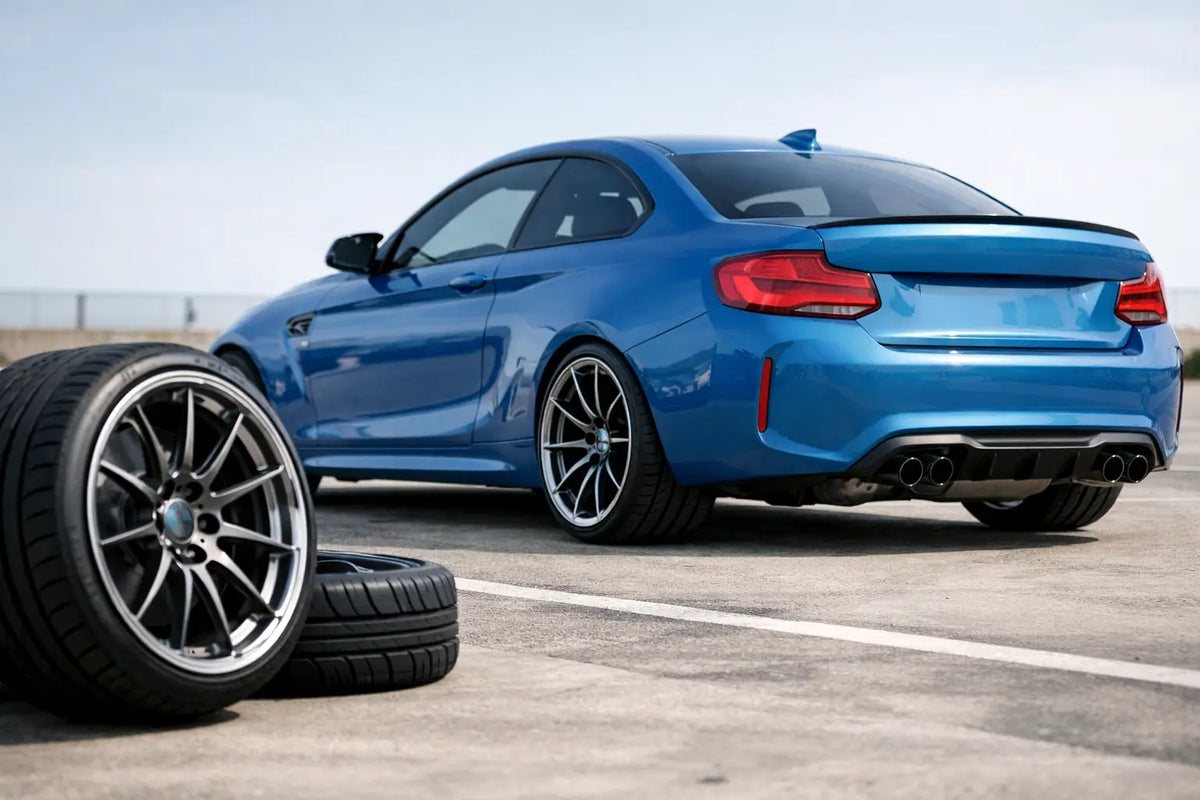
A good M2 fitment example starts with one hard truth: an F87 and a G87 may share the M2 badge, but they do not share the same wheel fitment rules. Buy on looks alone and you can end up with inner-strut contact, a wheel that will not clear the caliper, tyre rub under compression, or a setup that dulls the way the car drives.
For an M2 that sees fast-road miles, track days or both, fitment is more than diameter and width. Offset, brake clearance, tyre sidewall, suspension height and alignment all work together. Get the package right and the car gains grip, steering confidence and a properly planted stance. Get it wrong and even premium wheels become an expensive compromise.
Start with the M2 generation
Before comparing wheel specs, identify the exact platform. The original F87 M2, including M2 Competition and CS variants, uses a 5x120 PCD and a 72.6 mm centre bore. The newer G87 M2 uses a 5x112 PCD and a 66.6 mm centre bore. That difference alone rules out direct wheel swaps between generations.
Brake hardware also matters. The M2 Competition, CS and G87 carry larger brake packages than the early N55-powered F87 M2. A wheel can have the correct PCD, width and offset yet still foul the caliper face or barrel. Never treat a claimed wheel diameter as proof of brake clearance. A 19-inch wheel is not automatically an M2 Competition wheel, and an 18-inch track wheel needs a confirmed barrel profile to work over the brakes.
Your first fitment checks should therefore be platform, brake package, PCD, centre bore and wheel design. Only then is it worth deciding whether you want a staggered street setup or a square track-focused arrangement.
M2 fitment example: F87 fast-road setup
A well-proven F87 M2 fitment example is a staggered 19-inch package built around the factory tyre balance. The popular baseline is approximately 19x9 ET29 at the front with a 245/35 R19 tyre, then 19x10 ET40 at the rear with a 265/35 R19 tyre. This follows the OEM-style staggered approach: eager turn-in at the front, strong rear traction and no need to force an extreme alignment just to make it work.
It is a sensible starting point for a standard-height car or one sitting on quality lowering springs. It also gives enough tyre choice for performance road rubber, including fast-road compounds that can cope with wet British conditions better than a full track tyre.
There are trade-offs. A staggered package limits tyre rotation, so rear tyres usually disappear first on a rear-wheel-drive M2. It also makes sense only if the rear traction bias is valuable to you. For a road car with occasional circuit use, that is often a fair compromise. For a car doing repeated track days, a square setup usually brings more to the table.
Why square fitment changes the M2 on track
The F87 responds extremely well to a square wheel and tyre package because it adds meaningful front-end grip and allows tyres to be rotated between corners. A common direction is a 18x10 or 19x10 square wheel with a 275-section tyre, but the precise offset depends heavily on the wheel barrel, suspension choice and brake clearance.
An 18x10 wheel around ET25 is often seen on track-prepared F87s with 275/35 R18 tyres. That does not make it a universal bolt-on answer. Some wheel designs will not clear larger calipers, and a lower car with aggressive tyre shoulders may need front negative camber, careful ride-height control or minor liner adjustment. Tyre brand matters too. A 275 from one manufacturer can measure wider and square-shouldered compared with another 275.
The payoff is substantial when the geometry supports it. A square setup helps the M2 resist front-end washout, makes brake-zone rotation more predictable and lowers consumable costs when tyres can be rotated. It can also make the car feel less rear-biased at corner entry, which many track drivers prefer.
For a dual-purpose car, do not chase the widest possible tyre just because it fits under static inspection. A tyre that clears on the driveway may rub at full lock over a compression or when the suspension loads up through a kerb. Real fitment happens at steering lock, bump and full suspension travel.
Offset is the number that decides where the wheel sits
Wheel width tells you how broad the rim is. Offset, expressed as ET, tells you where that width sits relative to the hub. Lower ET pushes the wheel outward; higher ET pulls it inward. On an M2, both extremes create problems.
Too much positive offset can put the inner barrel into the strut, spring perch or damper body. Too little offset can push the tyre into the arch, liner or bumper tab. Spacers can correct a wheel that sits too far inboard, but they are not a shortcut for buying the wrong wheel. They change scrub radius, add another interface to inspect and can leave you with inadequate stud engagement if you do not use correctly matched extended bolts or studs.
A quality hubcentric spacer can be useful for a verified setup. It should be the final adjustment, not the foundation of the build.
G87 M2 fitment needs a cleaner slate
The G87 M2 is wider, heavier and built around a different hub specification. Its factory staggered wheel package also uses different front and rear diameters, so copying an F87 forum spec is a non-starter. Start from G87-specific wheels with confirmed 5x112 PCD, 66.6 mm centre bore and clearance for the intended brake option.
For a G87 road build, a model-specific staggered package remains the easiest route. It preserves the car's intended balance, gives a clean OEM-plus result and avoids the clearance uncertainty that can come with universal fitment claims. If you want a square G87 track setup, choose a wheel manufacturer that publishes brake-clearance data for the car rather than relying on offset alone.
This is especially relevant on modern BMWs because wheel spokes can be the limiting factor. Two wheels with the same 19x10 ET figure may have very different spoke concavity and inner-face clearance. One clears the caliper comfortably; the other needs a spacer or will not fit at all.
Suspension and alignment are part of the answer
Lowering an M2 changes more than the arch gap. It reduces bump travel and alters where the tyre travels through the wheel arch. A wheel-and-tyre package that works on standard suspension may need revised camber or a higher ride height once coilovers are fitted.
For a fast-road M2, modest lowering with a conservative wheel spec is normally the smarter route. You retain useful suspension travel, reduce the chance of rubbing and avoid turning every speed bump into a clearance test. Choose springs or coilovers from a recognised performance manufacturer and set the ride height with tyre clearance in mind, not purely for photographs.
For circuit work, additional front negative camber is often the missing piece. It helps keep the outside front tyre working through long corners and can create the clearance needed for a wider tyre under load. There is a limit, though. More camber can accelerate inner-edge wear during motorway use and may make a road-biased car less relaxing on uneven surfaces. Set the alignment around how the car is genuinely used.
Do not overlook the tyre itself
Tyres are not interchangeable simply because the sidewall number matches. A 265/35 R19 ultra-high-performance road tyre, a semi-slick and a track-focused road-legal tyre can differ in actual width, sidewall shape and heat behaviour. That affects clearance and handling.
For road miles, prioritise wet grip, temperature range and predictable breakaway. For track use, consider heat tolerance, shoulder support and whether the tyre will survive repeated sessions without going greasy. A sticky tyre on a heavy, powerful M2 also exposes weak geometry and poor damping faster than an ordinary road tyre will.
Keep overall rolling diameter sensible as well. Major changes can affect speedometer accuracy, gearing feel, traction-control behaviour and the gap between tyre and arch. Staying close to a known M2-specific combination removes unnecessary variables.
A fitment check before you order
Confirm these details with the wheel supplier or vehicle specialist before committing to a package:
- Exact M2 model and year, including whether it is F87, M2 Competition, CS or G87.
- Brake package and any future brake upgrade you plan to run.
- Wheel width, offset, PCD, centre bore and confirmed caliper clearance.
- Tyre make, model and size, not just the nominal width.
- Ride height, coilover spring position and alignment targets.
- Spacer requirement, hubcentric design and the correct bolts or stud hardware.
Build from a confirmed M2-specific wheel design, leave room for suspension movement, and choose tyres for the miles you will actually drive. The result is an M2 that looks properly purposeful and stays composed when you finally ask it to earn that stance.