
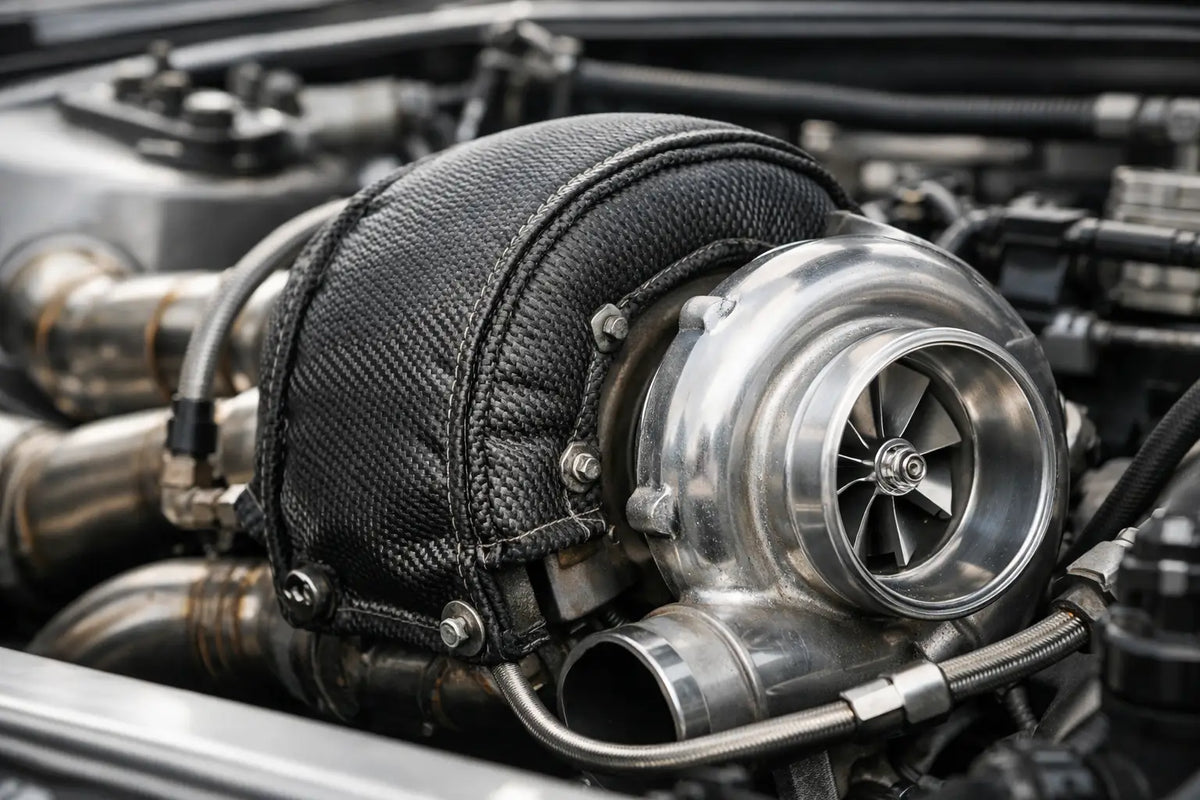
A turbocharger can turn the engine bay into a serious heat zone. After a hard pull, a track session or repeated launches, the turbine housing is hot enough to punish anything placed too close to it. That is where turbo blanket benefits explained properly starts: a quality blanket is primarily a heat-management part, not a magic power adder.
For modified road cars, drift builds and track-day machines, controlling under-bonnet temperature can protect surrounding hardware, reduce heat soak and make an already well-planned turbo setup easier to live with. The gains depend on the car, turbo position, airflow and the rest of the build, but the right blanket has a clear job to do.
What a turbo blanket actually does
A turbo blanket wraps around the turbine housing - the hot side of the turbocharger where exhaust gas drives the turbine wheel. Most quality examples use high-temperature insulation inside a heat-resistant outer layer, secured with springs, wire or a purpose-designed fastening system.
The aim is to retain more heat within the turbine housing and reduce the radiant heat escaping into the engine bay. Think of it as a focused thermal barrier. It does not make the turbocharger cold, and it does not remove the need for sensible heat shielding elsewhere. It simply keeps a large portion of the heat where it is less likely to damage nearby components.
This matters most where packaging is tight. Modern turbo engines often place the turbo close to intake pipework, wiring looms, brake components, coolant hoses and bulkhead materials. On an aftermarket manifold setup, the space can be even more limited. A blanket gives those parts a better chance of surviving sustained hard use.
Turbo blanket benefits explained: where the gains come from
The most obvious benefit is reduced radiant heat. The turbine housing emits heat in every direction, and nearby alloy, rubber, plastic and composite parts absorb it. Lowering that heat exposure can help protect intake pipes, silicone hoses, coil wiring, vacuum lines, master cylinder reservoirs and painted or coated surfaces.
On a front-engined performance build, this can also reduce the amount of heat soaking into the intake tract. Cooler intake plumbing does not automatically mean a dramatic drop in inlet-air temperature, particularly when the intercooler is doing its job. But reducing under-bonnet heat load is still valuable when the car sits in traffic, queues in a pit lane or runs repeated sessions without much cooldown time.
There is also a performance argument. Exhaust gas temperature and velocity influence how effectively the turbine is driven. By retaining heat around the turbine housing, a blanket may help preserve exhaust energy. Some setups show sharper transient response or slightly earlier spool, especially where the turbo, manifold and downpipe are already designed around efficient heat retention.
The key word is may. A turbo blanket is not a substitute for selecting the correct turbocharger, manifold, wastegate, fuelling system and calibration. If a car has poor boost control or a mismatched turbine housing, wrapping it will not transform the setup. Treat potential spool improvement as a supporting benefit rather than the reason to buy one.
Why track and hard-driven cars benefit most
A lightly tuned daily driver that rarely sees boost for long periods may get little more than extra protection for nearby parts. A track car, hillclimb build or high-power street machine is different. It spends more time with exhaust gas temperatures elevated and repeatedly heat-soaks the engine bay.
That repeated exposure is where insulation earns its place. It can help keep vulnerable components away from the worst radiant heat while making service items less likely to become brittle, discoloured or prematurely tired. It is especially relevant on compact turbo conversions, rear-mounted engine layouts and cars where the factory heat shielding has been removed to make room for larger hardware.
Heat control can also improve consistency. When an engine bay is less saturated with heat, charge pipework, sensors and fluid reservoirs are under less thermal stress. That does not eliminate heat-related problems, but it gives the whole package a better operating environment when you are asking a lot from it.
The trade-offs: blankets are not fit-and-forget
A turbo blanket keeps heat inside the turbine area by design. That means the turbine housing itself can remain hotter after shutdown, and the surrounding exhaust system is still extremely hot. Never assume a wrapped turbo is safe to touch or safe to work around immediately after running.
Moisture and contamination are another consideration. A cheap, poorly fitted blanket can trap oil, coolant or road grime against the housing. If there is an oil leak, fix the leak first. Do not use a blanket to hide it. Oil-soaked insulation near a turbocharger is a fire risk, regardless of how high-temperature the product claims to be.
You also need clearance around the actuator, wastegate lines, V-band clamps, oxygen sensor wiring and downpipe. On internal-wastegate turbos, check that the blanket does not foul the actuator rod or prevent full movement. On external-wastegate setups, remember that the wastegate and its dump tube produce their own serious heat and may need separate shielding.
Finally, not every turbo should be wrapped. Some OEM units have integrated shielding, complex actuator arrangements or housings that make universal blankets a poor fit. A blanket that leaves large gaps, presses against lines or has to be forced into place is not the right solution. Use a turbo-specific option where available, or measure the housing and compare dimensions carefully before ordering.
Choosing the right blanket for your setup
Fitment comes before marketing claims. Identify whether your turbo uses a common frame size, such as a T25, T3, T4, GT28, GTX30 or G-series layout, but do not rely on the frame name alone. Turbine housing A/R, actuator placement, compressor orientation and manifold position can all change what fits.
Look for a blanket designed for sustained temperature exposure, with secure stainless fastening hardware and properly finished edges. The outer material should resist abrasion and heat, while the insulating layer needs to be substantial enough to control radiant energy without becoming bulky and awkward to fit.
For a road car, prioritise tidy fitment, service access and clearance from lines. For a track build, thermal performance and retention under vibration matter more. In either case, avoid the temptation to buy the cheapest universal item available. Poor stitching, weak springs and inaccurate sizing can turn a useful heat-control upgrade into something that rubs through or works loose.
A blanket works best as part of a wider plan. Consider heat sleeves for nearby hoses and wiring, reflective barriers where components sit close to the turbo, a properly routed intake, and adequate bonnet or bay ventilation where appropriate. The aim is not to wrap every hot part indiscriminately. It is to control heat where it threatens reliability or performance.
Installation checks worth doing
Install the blanket only with the turbo fully cold. Position it so the insulation covers the turbine housing without blocking actuator movement or bearing against oil and coolant lines. Secure it firmly, then inspect clearances with the engine off before starting the car.
After the first heat cycle, let the car cool completely and check the fastening again. Expect some initial smoke or smell as manufacturing residues burn off, but persistent smoke, a burning smell or visible contact with wiring is a stop-and-inspect situation. Recheck the blanket during routine servicing, particularly on cars that see track use or rough-road mileage.
A well-chosen turbo blanket will not replace careful fabrication or a safe calibration. It can, however, be one of the smarter supporting upgrades on a hard-driven forced-induction build: protecting the parts around the turbo while helping the engine bay stay more controlled when the boost comes in.