
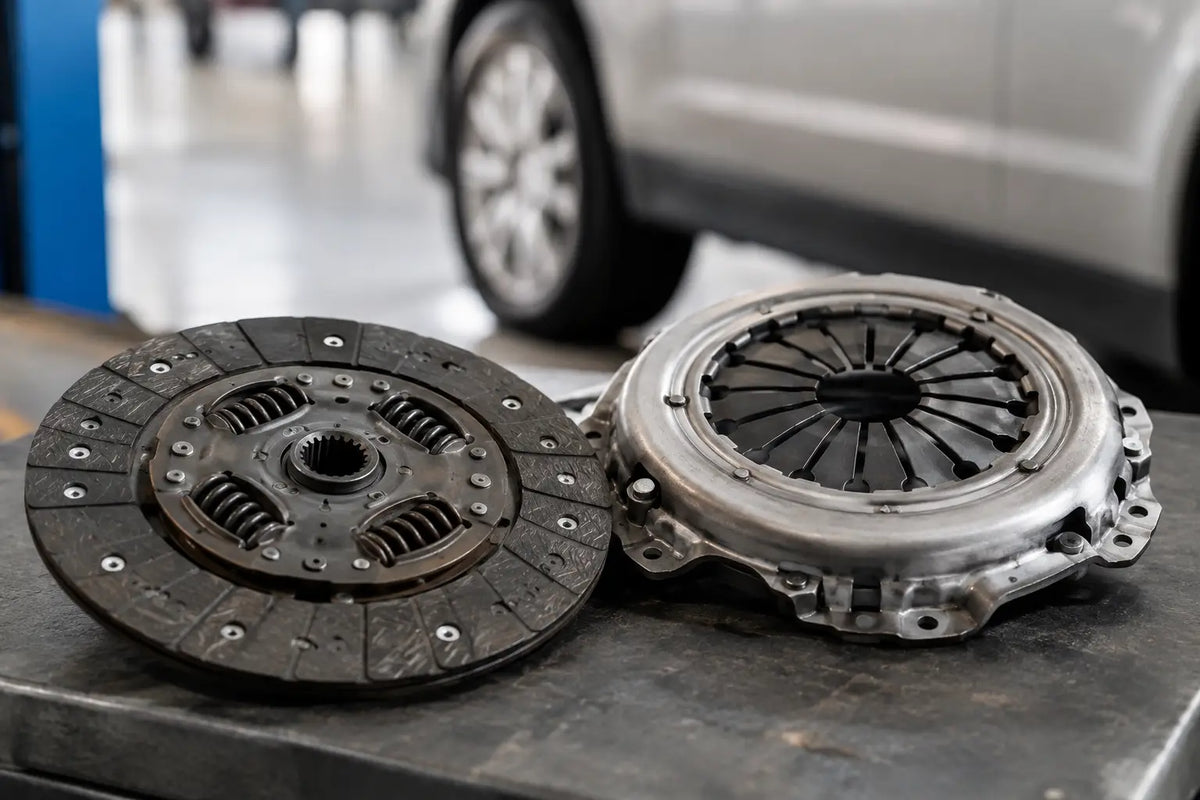
You roll into the throttle in a higher gear, the rev counter jumps, but the car does not pull as hard as it should. That is the classic sign of clutch slip - and clutch slipping causes are not limited to a worn-out friction disc. On a tuned road car or track build, the underlying fault can be anything from contamination and poor adjustment to a clutch package that simply cannot hold the engine’s torque.
Ignore it and the problem rarely stays cheap. Continued slip creates serious heat, glazing the disc and damaging the flywheel and pressure plate faces. Catch the cause early, and you may be able to protect the rest of the drivetrain while choosing the right repair or upgrade.
What clutch slip actually feels like
A manual clutch works by clamping the friction disc tightly between the flywheel and pressure plate. With the pedal released, engine torque should pass through that clamped assembly and into the gearbox. Slip happens when the available clamping force and friction are lower than the torque being applied.
The obvious symptom is a rise in engine speed without a matching increase in road speed, usually most noticeable in fourth, fifth or sixth gear under hard acceleration. On a standard car, it may first appear when overtaking or climbing a steep hill. On a remapped turbo car, it often shows up the first time boost arrives in the mid-range.
You may also notice a burning smell after a hard pull, a high bite point, or acceleration that feels inconsistent once the drivetrain is hot. None of these signs alone proves the clutch is at fault, but together they warrant a proper inspection.
Do not confuse slip with a misfire, wheelspin or a gearbox issue. A misfire makes the engine stumble and lose power. Wheelspin is normally easy to spot through tyre noise, traction-control intervention or a sudden change in steering feel. Genuine clutch slip lets the engine flare cleanly while the car fails to convert that revs rise into forward motion.
Clutch slipping causes: the faults worth checking
A worn or glazed friction disc
Normal wear is the most common cause. Every pull-away, gear change and hill start removes a small amount of friction material. Eventually, the disc becomes too thin to transfer torque reliably, even if the pressure plate is still functioning.
Glazing can make a relatively new disc slip too. Excessive heat hardens and smooths the friction surface, reducing grip. Repeated clutch dumping, holding the car on the bite point, heavy traffic with an aggressive clutch, or a few hard launches before the clutch has bedded in can all create the problem. Once badly glazed, the disc generally needs replacing rather than hoping it will recover.
A pressure plate that has lost clamping force
The pressure plate diaphragm spring supplies the load that keeps the disc clamped. Age, heat cycles and sustained high torque can weaken that load. The disc may look serviceable when removed, yet the assembly still slips because the pressure plate cannot hold it firmly enough.
This is a common weak point on cars that have gained a remap, larger turbo, upgraded injectors or other power parts while retaining an original-equipment clutch. Peak horsepower is only part of the story. Torque delivery matters more, particularly on diesel engines and turbo petrol setups that make a strong low-rpm torque surge.
A clutch rated close to your engine’s claimed torque can work on a gentle road car but leave little margin for an enthusiastic launch, a hot track session or a tuner whose figures are optimistic. Choose capacity with headroom, not just a number that matches the dyno sheet.
Oil or grease contamination
A dry clutch needs clean, dry friction surfaces. Engine oil from a rear main crankshaft seal, gearbox oil from an input shaft seal, or excess assembly grease can contaminate the disc. The result may be intermittent at first, often worsening once everything warms up.
Contamination is not a repair that a new disc alone will solve. The leak must be identified and fixed, while the flywheel and pressure plate are assessed for heat spotting and residue. Fitting fresh parts without correcting the seal failure is a fast route back to the same job.
Hydraulic and release-system faults
Hydraulic clutches use a master cylinder, slave cylinder and fluid pressure to disengage the clutch. A fault in this system more commonly causes dragging - where the clutch will not fully disengage - but an incorrectly adjusted or sticking release system can also prevent complete engagement and contribute to slip.
Check whether the clutch pedal returns consistently, whether the bite point changes, and whether fluid level is dropping. On vehicles with a concentric slave cylinder inside the bellhousing, replacement can involve gearbox removal, so it makes sense to inspect and renew related wear items while access is available.
Cable-operated systems have their own issue: incorrect adjustment. If the cable is adjusted too tightly, the release bearing can hold the pressure plate slightly off its fully clamped position. There should be the specified free play, not a pedal adjusted purely for a very high bite point.
A damaged flywheel
The flywheel is not just a mounting surface. Its condition directly affects clutch grip and engagement quality. Heat checks, deep scoring, blueing and uneven surfaces reduce the contact quality between the disc and flywheel.
Dual-mass flywheels need particular attention on torque-heavy builds. Excess rotational play, rattling, poor damping or surface damage can turn a clutch replacement into a false economy if the flywheel is reused without inspection. A solid flywheel conversion can suit certain motorsport-focused cars, but it often brings more drivetrain noise, vibration and harshness. For a road-driven GTI, BMW or Honda, that trade-off should be deliberate rather than assumed.
Installation errors and incompatible parts
A clutch can slip shortly after fitting if the friction surfaces were touched with oily hands, the disc was installed incorrectly, the pressure plate bolts were not tightened evenly to specification, or the incorrect release bearing was used. Fitment matters as much as brand reputation.
Mixing components can also create trouble. A disc, pressure plate and flywheel should be designed to work together. Some platform-specific upgrades require a matching flywheel, release mechanism or flywheel bolts. Check the exact engine code, gearbox type, spline count and flywheel arrangement before ordering. A clutch that fits physically is not automatically a clutch that operates correctly.
Diagnose before buying parts
A controlled road test can help confirm the fault. With the engine fully warm and on a clear, legal stretch of road, accelerate firmly in a higher gear from low-to-mid revs. If revs rise sharply ahead of vehicle speed, ease off rather than repeating the test. Repeatedly forcing a slipping clutch only adds heat and damage.
Before the gearbox comes out, look for external leaks around the bellhousing, check the clutch fluid where applicable, and consider whether the problem began immediately after tuning or after clutch work. A recent power increase points towards capacity. A sudden issue alongside oil loss points towards contamination. A gradual loss of drive on a high-mileage car points more strongly to wear.
If the car is a dual-clutch automatic rather than a conventional manual, diagnosis is different. DSG, DCT and similar transmissions use electronically controlled clutch packs, adaptation values and transmission-specific fluid requirements. A manual-clutch test or a generic aftermarket kit is not the answer. Read fault codes and use a specialist familiar with that transmission.
Choose a clutch for how the car is used
A replacement clutch should match the real brief, not just the biggest torque figure available. For a standard daily driver, an OE-style organic clutch gives smooth engagement, low pedal effort and civilised traffic manners. It is usually the right call when reliability matters more than launch control.
For a fast-road build, a higher-clamp organic kit often provides the best balance. It can handle moderate tuning without making every school-run junction feel like a pit-lane start. This is where platform-specific kits from proven performance manufacturers earn their place.
Track cars, drift builds and high-torque forced-induction projects may need ceramic, paddle or twin-disc assemblies. They offer greater heat tolerance and torque capacity, but engagement can be sharper, chatter more noticeable and drivetrain shock higher. A puck-style clutch is not automatically an upgrade for a car that spends most of its life in city traffic.
When replacing the clutch, assess the whole system: flywheel condition, release bearing or concentric slave cylinder, pilot bearing where fitted, fork and pivot hardware, seals and gearbox mounts. Labour is the expensive part of most clutch jobs. Replacing a questionable release bearing while the gearbox is already out is sensible preventative work, not unnecessary parts swapping.
Torque Lab’s fitment-led catalogue approach is useful here: start with the exact vehicle and gearbox, then choose the clutch type around your current torque, planned power and intended use. That avoids buying a competition-focused setup for a road car, or an OE replacement that will slip as soon as the new map goes on.
A slipping clutch is your drivetrain giving you a clear message. Diagnose the reason, fix any leak or release-system fault, and fit a properly matched package before heat turns a manageable repair into a flywheel, clutch and gearbox-out bill.