
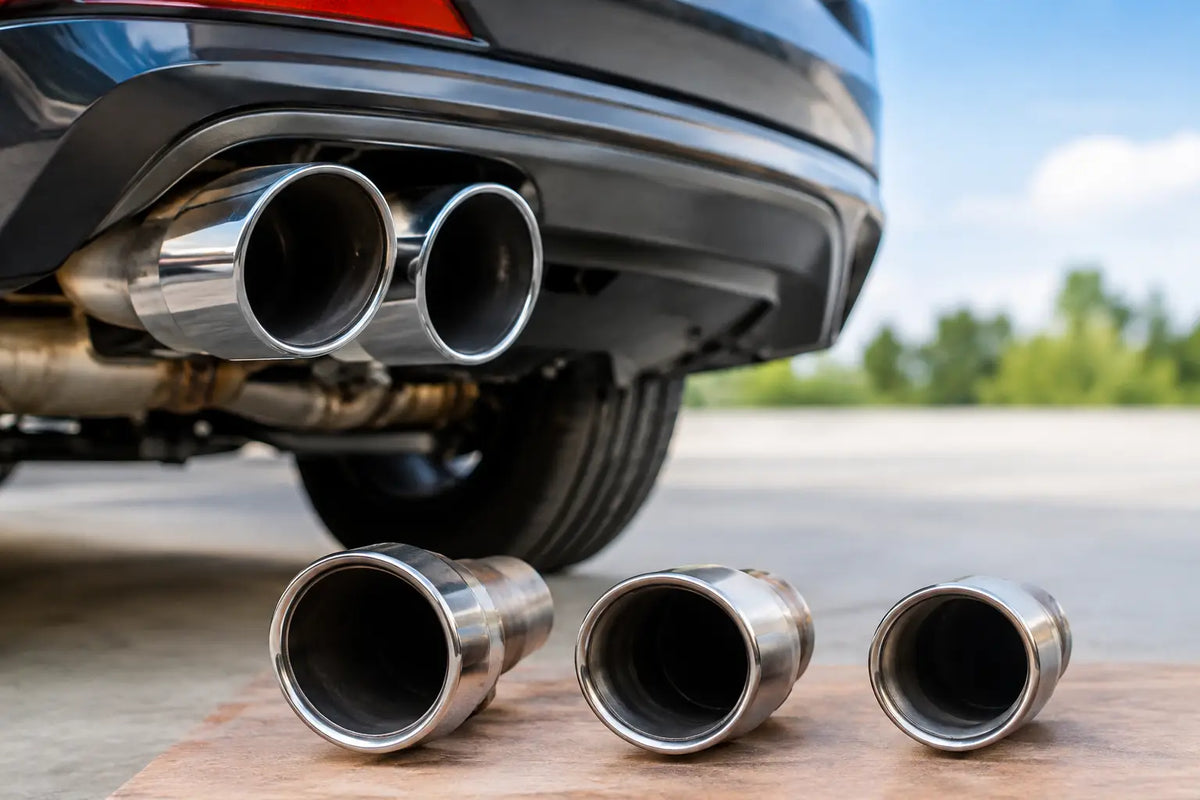
A 3-inch exhaust may look like the obvious upgrade next to a restrictive factory system, but bigger pipe is not an automatic power gain. Does exhaust diameter affect power? Absolutely - but the result depends on how much air the engine moves, where it makes power, and what sits before and after the pipe.
For a road car, a badly matched exhaust can trade useful mid-range response for noise and a questionable peak-power figure. For a tuned turbo build or track car, the same diameter may be exactly what stops backpressure becoming the next restriction. The right choice is not about choosing the largest tailpipe in the catalogue. It is about matching the complete system to the engine and the job.
How exhaust diameter affects power
An exhaust system has two competing jobs. It needs enough cross-sectional area to move spent gases without excessive restriction, while maintaining gas speed and pressure-wave behaviour that supports cylinder scavenging.
Restriction matters most when engine airflow rises. At high revs and high load, narrow pipework creates backpressure. The engine must work harder to push exhaust gases out, reducing volumetric efficiency and limiting the power available at the crank. Increasing diameter can reduce that restriction, allowing a tuned engine to hold power further towards the redline.
But exhaust flow is not simply a case of slow gases being bad and fast gases being good. On a naturally aspirated engine, exhaust pulses travel through the manifold and system as pressure waves. Correctly sized primary pipes, collectors and downstream sections can help create a low-pressure effect at the exhaust valve during valve overlap. That assists scavenging - clearing residual gas from the cylinder and making room for the fresh intake charge.
Make the system excessively large for the engine's airflow, and gas velocity falls. Pulse energy weakens, low-speed scavenging can suffer, and the car may feel softer through the rev range where it spends most of its road miles. The loss is not always dramatic, especially behind a well-designed manifold, but it is why an oversized system is not a shortcut to a faster car.
Bigger exhausts suit some builds better than others
Turbocharged engines generally benefit from freer-flowing exhausts more readily than naturally aspirated engines. The turbine is a major restriction and sits between the engine and the rest of the exhaust. Reducing pressure after the turbine improves the pressure ratio across it, helping the turbo work more efficiently. This can support faster spool, lower exhaust gas temperatures and more power at higher boost levels.
That is why a 3-inch turbo-back system is a familiar upgrade on many tuned four-cylinder platforms, from hot hatches to Japanese performance cars. Once power targets rise further, 3.5-inch or larger systems become sensible - provided the downpipe, turbine housing, fuelling, calibration and cooling strategy all support the target.
Naturally aspirated engines demand more care. A modest capacity four-cylinder with mild cams may respond best to a properly designed 2.25-inch or 2.5-inch system, rather than a huge single pipe. A high-revving K-series Honda, a BMW straight-six or a larger V8 has different airflow demands again. Cylinder count, displacement, cam timing, manifold design and intended rev range all matter more than a generic rule based on badge or engine capacity alone.
Supercharged engines sit somewhere between the two. They can move considerably more air than their naturally aspirated equivalent, so the exhaust must support the increased mass flow. Yet their manifold and camshaft requirements still influence how the engine responds below peak rpm.
Diameter is only one part of the system
A headline pipe size does not describe the whole exhaust. A cheap 3-inch system with abrupt transitions, crushed bends, poor merge collectors and restrictive silencers may flow worse than a well-engineered smaller system. Internal diameter is what matters, too. Two systems sold by nominal outside diameter can have different bore sizes because wall thickness varies.
The downpipe and first section after the manifold or turbo are usually the critical areas. This is where gas temperature, pressure and volume are highest. A restrictive factory catalytic converter or narrow downpipe can cap gains even if the rear section is enormous. Conversely, replacing only the rear silencer on a standard car normally changes sound far more than power.
Catalytic converters, particulate filters, resonators and silencers all need consideration. Quality sports catalysts and straight-through silencers can support strong flow while keeping the car civilised enough for road use. Removing emissions equipment may create warning lights, legal problems, failed inspections and an unpleasantly loud car. For most street builds, a properly engineered, road-legal performance exhaust is the smarter route.
Choosing an exhaust diameter for your power target
Treat common pipe sizes as starting points, not guarantees. For many mildly tuned turbo four-cylinders around the 250-350 bhp mark, a quality 2.5-inch or 3-inch system is often appropriate. Around 350-500 bhp, 3-inch is frequently the proven choice. Beyond that, 3.5-inch may be needed depending on turbo size, boost, fuel and track use.
For naturally aspirated four-cylinders, 2.25-inch to 2.5-inch is common on serious road and track builds, with larger sizes reserved for high-output or high-capacity applications. Six-cylinder and V8 engines may use larger single systems or twin-pipe layouts. In a dual system, remember that two smaller pipes have a combined flow area that can be substantial. Do not compare a twin 2.25-inch layout with a single 2.25-inch pipe as if they are equivalent.
The best way to choose is to start with a realistic power target and the modifications required to reach it. Then select a system from a manufacturer with experience on the exact platform. A Milltek or HKS system designed around a specific vehicle's floorpan, turbo location and noise control will usually make more sense than guessing from universal tubing alone.
Road response, track use and noise control
Peak dyno power is only one part of a quick car. A road-driven GTI, Civic Type R, M140i or GR Yaris needs clean response, manageable cabin noise and enough ground clearance to survive daily use. A track-focused car can accept more resonance and a narrower useful rev range if it spends its time above 5,000 rpm.
Diameter affects sound as well as flow. Larger systems often produce a deeper note and can make low-frequency drone more noticeable at motorway speeds. Resonators are not dead weight; they are tuning tools. A well-placed resonator can remove the exhausting boom that turns a long journey into a punishment, without materially compromising performance.
Fitment matters just as much. Check whether the system is intended for your exact chassis, drivetrain and bumper arrangement, particularly on quattro, xDrive, 4Motion and rear-wheel-drive platforms where propshafts, differentials and rear subframes affect routing. Ground clearance, hanger position and access for servicing are details that separate a clean installation from a system that rattles after a month.
Do not ignore the tune
An exhaust upgrade can change how a turbo engine controls boost and how its sensors read flow. On some cars, especially when fitting a high-flow downpipe, calibration is essential to get the benefit safely. The ECU may otherwise reduce boost, flag faults or run outside the intended load model. More flow without adequate fuelling, ignition control and charge-air cooling is not a power plan.
Naturally aspirated builds also benefit from looking at the package. Intake, headers, cams and ECU calibration should work towards the same rpm and power goal. Fitting an oversized cat-back while retaining a restrictive manifold is rarely the best use of budget.
Before buying, decide whether you are building for a reliable fast-road car, repeated track sessions, or a specific dyno target. Torque Lab's vehicle- and brand-led approach makes that process easier: match proven exhaust hardware to the platform, then build the supporting modifications around it.
A correctly sized exhaust should feel like part of the engine, not an oversized accessory bolted to it. Choose the diameter that serves your airflow target, power band and driving use, and spend the difference on the parts that make the whole combination work.