
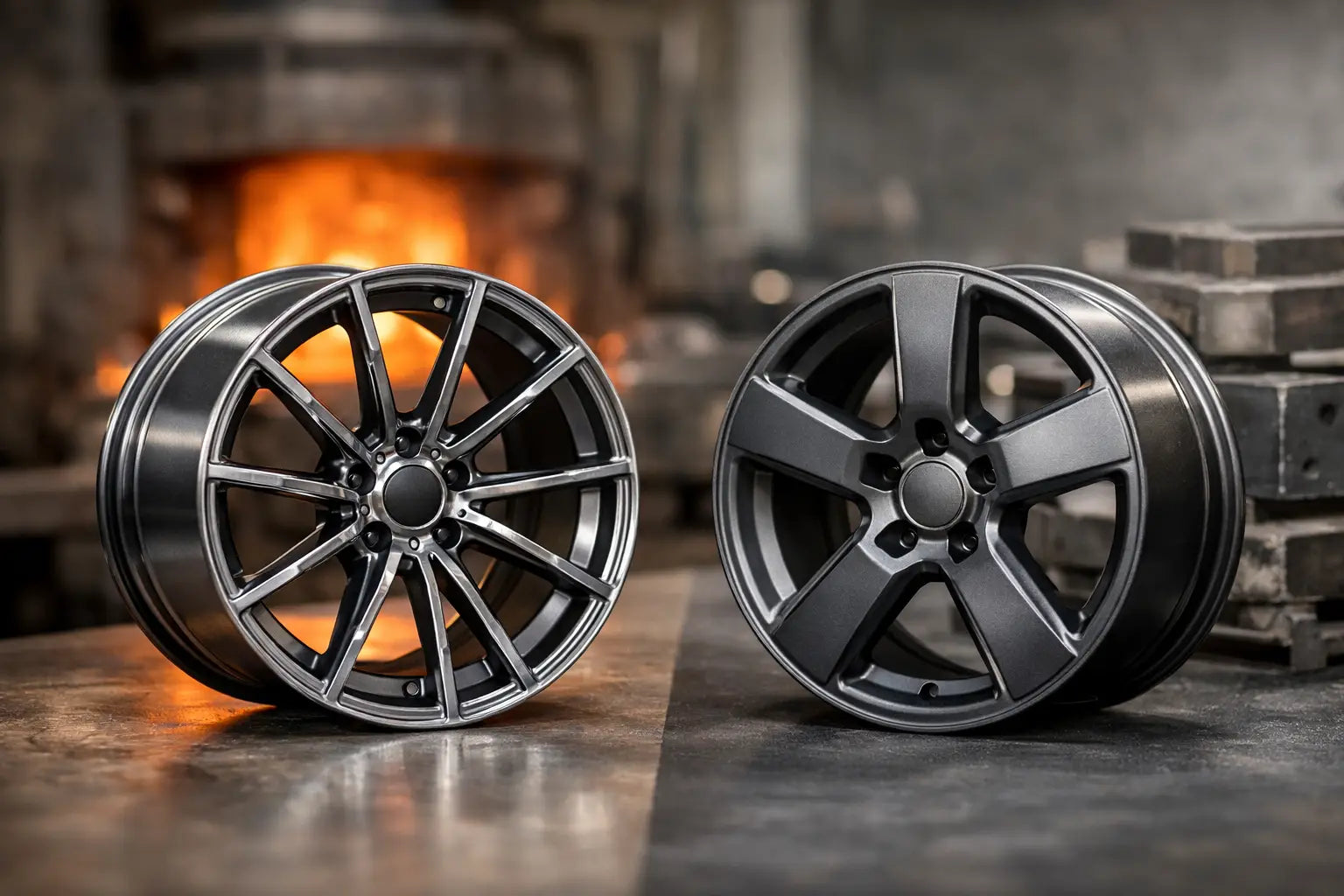
Wheel choice can change the way a car feels more than plenty of owners expect. Swap to the wrong set and you can end up with harsher ride quality, slower response, or money tied up in a spec that never suits how you actually drive. That is why forged wheels vs cast wheels is not just a forum argument - it is a proper buying decision with real effects on performance, durability and value.
Forged wheels vs cast wheels - what is the actual difference?
The basic difference is in how the wheel is made. Cast wheels are produced by pouring molten aluminium into a mould, then machining the finished wheel to its final shape. Forged wheels start with a solid billet of aluminium that is compressed under very high pressure and then machined into the final design.
That manufacturing process changes the grain structure of the metal. In simple terms, forging creates a denser, stronger material. That means a forged wheel can often achieve the same strength as a cast wheel while using less material. Less material usually means less weight, and that matters anywhere you care about steering feel, suspension response and acceleration.
Cast wheels are far more common because they are cheaper to produce and can still perform very well when designed properly. A good cast wheel from a respected manufacturer is not junk. It is simply built around a different cost and performance target.
Why wheel weight matters more than people think
When enthusiasts talk about wheels, they usually go straight to looks. Fair enough - wheels define the stance of the whole car. But from a performance point of view, weight is the bigger story.
Wheels are part of the unsprung mass of the car. That means the suspension has to control them directly over bumps, kerbs and surface changes. Lighter wheels make that job easier. The result can be sharper turn-in, better damping control and more consistent grip over uneven tarmac.
There is also the rotational aspect. A lighter wheel generally takes less energy to spin up and slow down. You will not turn a hot hatch into a race car with wheels alone, but on a well-sorted build the difference is noticeable. The car can feel more eager, less lazy changing direction, and more precise on the front axle.
That is one of the strongest arguments for forged wheels. If you are chasing lap time, steering feel or a more responsive chassis, cutting wheel weight is rarely a wasted upgrade.
Strength is not just about surviving potholes
People often assume stronger means indestructible. It does not. Any wheel can be damaged by a hard enough impact. The question is how much abuse it can handle for a given weight, and how it behaves under repeated load.
Forged wheels are widely chosen for track work and motorsport because they offer excellent strength for their mass. That matters under hard cornering, heavy braking, repeated heat cycles and occasional kerb strikes. If you are running sticky tyres, uprated suspension and aggressive brake packages, wheel load increases quickly. A forged wheel is built for that kind of environment.
Cast wheels can still be strong enough for spirited road use, fast road builds and even occasional track days. The catch is that a cast wheel often needs more material to reach the same strength target. That means extra weight. Some lower-quality cast wheels also cut corners in design or quality control, which is where problems start. The issue is not casting as a process on its own - it is cheap casting combined with weak engineering.
Cost is where the gap gets real
This is the point where most buying decisions are actually made. Forged wheels cost more. Often much more.
That higher price comes from more expensive raw material, more intensive manufacturing and tighter machining. If you are building a serious track car, time attack setup or high-end road car, the cost may be easy to justify. You are paying for lower weight, high strength and a premium product with clear performance benefits.
If your car is mainly used on the road, sees the odd spirited B-road run and maybe one or two track days a year, premium cast wheels can make far more sense. You can still get excellent fitment, good weight figures and proven durability without stretching the budget into forged territory.
It is the classic tuning trade-off. The best part on paper is not always the best part for your build.
Cast wheels are not the weak option
There is a habit in enthusiast circles to treat cast wheels as the budget compromise and forged wheels as the only serious choice. That is too simplistic.
A well-made cast wheel from a proper performance brand can be a very strong option for daily-driven performance cars. Many owners simply do not need the absolute weight saving or extreme load capacity of a forged wheel. If the car spends most of its life commuting, road driving and parked outside coffee stops, the performance gain per pound matters.
That money might be better spent elsewhere. On plenty of builds, tyres, brake pads, alignment and suspension setup will deliver a bigger real-world improvement than moving from a good cast wheel to an expensive forged one.
For a lot of enthusiasts, cast wheels hit the sweet spot. Better looks than OE, solid performance, manageable cost and enough durability for real use.
When forged wheels make the most sense
Forged wheels earn their place when the rest of the build is serious. If you are trimming unsprung mass across the car, chasing faster lap times, or trying to get the most from a chassis with quality coilovers and proper tyre, forged wheels fit the brief.
They also make sense on heavier performance cars where wheel loads are higher to begin with. Fast saloons, powerful four-wheel-drive platforms and modern turbo performance cars can benefit noticeably from weight reduction at each corner. It helps offset the mass those cars carry.
There is also a durability angle for hard users. If the car regularly sees circuit work, repeated heat, rough kerbs or less-than-perfect roads, the strength-to-weight advantage of forged wheels becomes easier to justify. Not because cast wheels cannot cope, but because forged wheels are built with less compromise.
How to choose between forged and cast for your car
The best way to decide is to be honest about the car, the use case and the budget.
If your priority is maximum performance, the lightest possible setup and a wheel that suits hard driving without compromise, forged is the stronger answer. If your priority is strong value, excellent looks and dependable performance for daily and fast road use, cast is often the smarter buy.
Fitment matters just as much as construction. Offset, width, diameter and brake clearance can make or break how the wheel performs. A badly chosen forged wheel will not outperform a properly specced cast wheel just because the manufacturing process sounds more impressive. Get the size wrong and you can ruin steering feel, rubbing clearance and tyre behaviour in one move.
It is also worth thinking about road conditions. Ultra-light, expensive wheels on rough roads can feel like overkill if the car is constantly dealing with potholes, broken surfaces and winter grime. In that case, a strong cast wheel you are not terrified to use every day can be the more enjoyable option.
The right answer depends on the build
There is no universal winner in forged wheels vs cast wheels because different builds ask different things from a wheel. A track-focused Civic on semi-slicks, a fast-road Golf GTI and a show-and-go BMW coupe do not need the same solution.
What matters is choosing a wheel that matches the rest of the package. Tyre quality, suspension geometry, brake setup and overall vehicle weight all influence whether the extra spend on forged wheels delivers enough return. For some drivers, it absolutely does. For others, a quality cast wheel is the better-balanced upgrade.
The smart move is to buy for the job, not the badge. If the car is built to be used hard, forged wheels are worth serious attention. If you want strong performance without burning budget that could go into tyres or chassis setup, cast wheels still deserve respect.
Pick the wheel that suits the way you drive, not the way the internet argues.