
You feel it after a few hard pulls. The car was sharp on the first run, then softer, flatter, less willing. That is usually where the front mount intercooler vs top mount debate stops being forum noise and starts becoming a real build decision. Intercooler layout changes how your car handles heat, how it delivers boost, and how much headroom you have when the tune gets more serious.
For a lightly modified road car, either setup can work brilliantly. For a track build, repeated heat cycles expose weaknesses fast. The right choice depends less on internet myths and more on your platform, your packaging, and what you actually expect from the car.
Front mount intercooler vs top mount - the basic difference
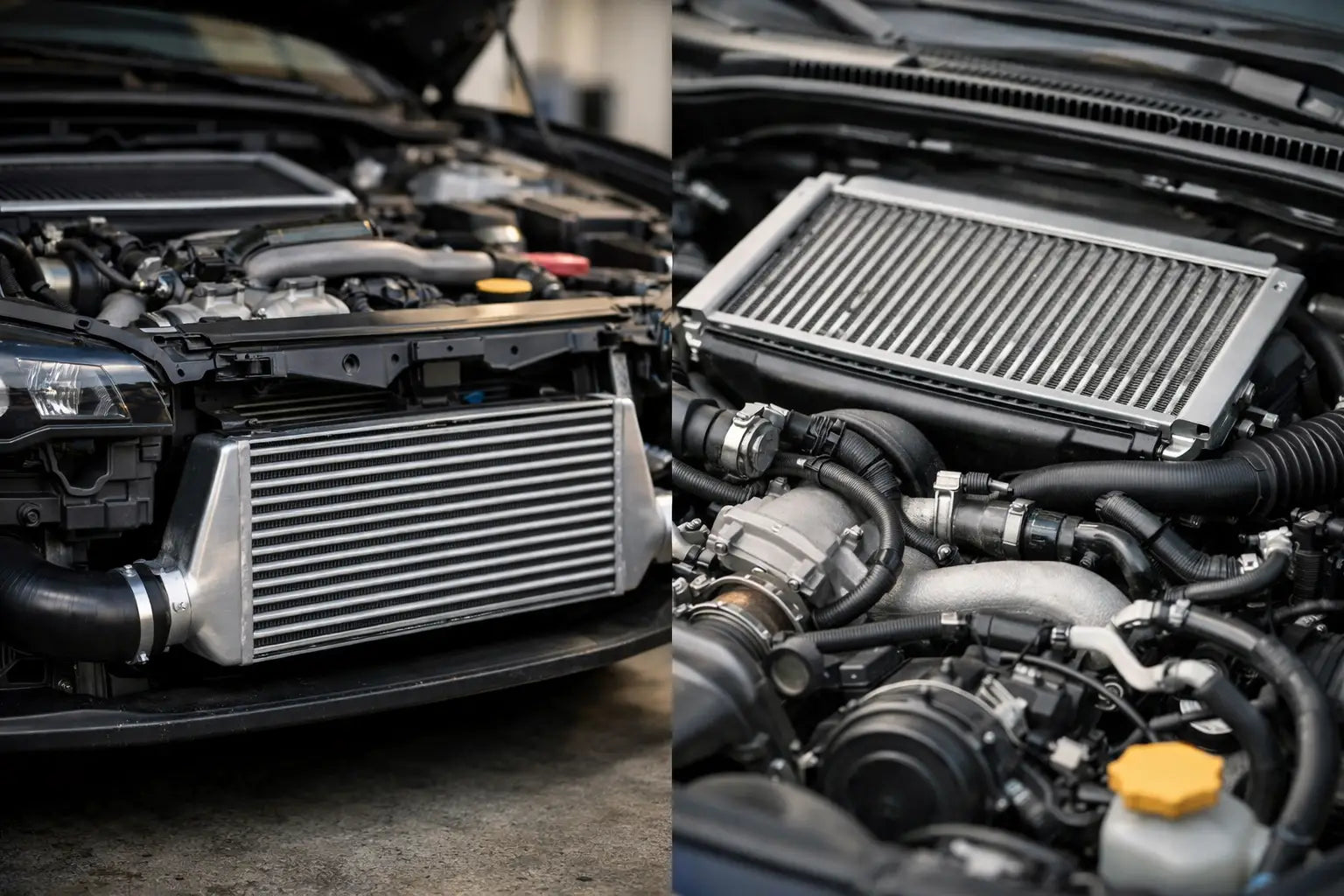
A top mount intercooler sits above the engine, usually feeding from a bonnet scoop or ducting. Subaru owners know the layout well, but it appears on other turbo platforms too. The pipework is short, the install can be compact, and throttle response often feels crisp because there is less volume for the turbo system to fill.
A front mount intercooler sits behind the front bumper in direct airflow. It usually uses longer charge pipes routed from the turbo to the front of the car and back to the intake. That adds complexity, but it puts the core in cooler, cleaner air and usually gives you more room for a larger intercooler.
That is the headline. The real difference comes from heat management and compromise.
Why intercooler position matters
An intercooler is there to reduce intake air temperature after the turbo compresses the air. Cooler air is denser, which helps power, consistency and knock resistance. Once intake temperatures climb, the ECU may start pulling timing, power will taper off, and the car can become less repeatable.
Position affects how efficiently the intercooler can shed heat. A core mounted at the front of the car generally has better access to ambient airflow. A core mounted above the engine sits closer to engine bay heat, and its performance depends heavily on scoop design, shrouding and vehicle speed.
That is why the same boost pressure can feel very different on two cars with different intercooler layouts. One will stay stable after repeated use. The other might be brilliant once, then heat-soak.
Top mount intercoolers - where they work best
A good top mount setup suits cars where the factory intended it, especially if the bonnet ducting is well designed. On a fast road car with modest power goals, a high-quality upgraded top mount can be a very smart choice.
The biggest advantage is response. Shorter pipework usually means less system volume, so boost can build with a more immediate feel. That does not mean a front mount automatically feels laggy, because turbo sizing and tuning matter far more, but a top mount often keeps the whole system tidy and direct.
Fitment is another win. You avoid routing long alloy or silicone pipework around the front of the car, and you usually keep crash structure changes to a minimum. For owners who want an OEM-plus engine bay and straightforward installation, that matters.
The downside is heat soak. Once the intercooler sits over a hot engine, especially in traffic or after repeated hard use, intake temperatures can climb quickly. A top mount depends on airflow through the scoop. If the ducting is poor or the car spends time at lower speeds, performance can drop away sooner than many owners expect.
For occasional spirited driving, that trade-off may be completely acceptable. For repeated laps or sustained high-boost use, it becomes much harder to ignore.
Front mount intercoolers - where they pull ahead
A front mount is usually the better answer when power targets rise and the car needs consistency. Put a larger core in direct airflow and you give the system a much better chance of controlling intake temperatures run after run.
That is why front mounts are common on builds that see track use, drag use, or any setup running more boost than stock. They provide more thermal capacity and often support greater airflow without becoming a restriction. If your plan includes bigger turbo hardware, more aggressive mapping, or repeated full-load use, a front mount starts to make a lot of sense.
It also removes the intercooler from the hottest part of the engine bay. That alone helps with recovery between pulls. Instead of baking above the engine at idle, the core sits in a better environment and takes advantage of the pressure zone at the front of the car.
The price you pay is packaging. Front mounts need room behind the bumper, and not every kit keeps fog lights, crash support clearance, or factory trim panels happy. Cheap kits can create pressure drop, awkward routing, poor fitment and bumper-cutting drama that turns a simple upgrade into a weekend of frustration.
Does a front mount always mean more lag?
Not always, and this is where the conversation gets oversimplified.
A front mount usually has longer pipework and more system volume, so on paper it can affect transient response. But in the real world, core design, pipe diameter, turbo choice, boost control strategy and tune quality all play a bigger role than people admit. A well-matched front mount on a properly tuned setup can feel excellent.
A badly chosen front mount can feel worse, though. If the core is oversized for the power level, if the piping runs are needlessly long, or if the kit has poor flow characteristics, you can blunt response for no meaningful gain. Bigger is not automatically better. The intercooler needs to match the build, not just fill the bumper opening for social media.
Cooling efficiency, pressure drop and real performance
The best intercooler is not simply the biggest one. It needs to balance cooling performance with acceptable pressure drop.
A very efficient core lowers charge temperatures, but if airflow through the core is poor, the turbo has to work harder to hit target boost. That can increase heat elsewhere in the system and reduce efficiency overall. Equally, a small core with low pressure drop may respond well but struggle to control temperatures once the car is pushed hard.
That is why proven kits from respected brands matter. Core construction, end tank design and proper vehicle-specific fitment make a real difference. On enthusiast platforms, there is usually a reason certain intercoolers keep turning up on quick, reliable cars. They work.
What suits your car and your use case?
If your car came with a top mount from the factory and you want a sharp, road-focused setup with mild to moderate power gains, staying top mount can be the right move. It keeps the character of the car, usually preserves response, and avoids unnecessary fabrication. For many daily-driven turbo cars, that is enough.
If you are chasing stable intake temperatures under repeated abuse, stepping into higher horsepower territory, or preparing for track days where consistency matters more than a single dyno number, a front mount is usually the stronger solution. It gives you more margin when the engine is working hard and ambient temperatures are against you.
There is also a middle ground. Some owners move to a larger top mount first, then switch to a front mount later when the turbo and tune evolve. That can be a sensible staged upgrade path rather than buying parts twice without a plan.
Fitment matters more than most buyers expect
Intercoolers are not universal in practice, even when they are sold that way. Pipe routing, bumper clearance, air-con compatibility, washer bottle location, crash bar design and sensor placement all affect how cleanly a kit goes on.
This is especially true on European and Japanese platforms where small differences between model years can turn an easy install into a headache. A great intercooler on the wrong application is still the wrong part. That is why platform-specific kits from brands with proper fitment development are worth the money.
If you are building the car once and building it properly, buy for your actual end goal. It is cheaper than replacing a compromised setup after the first hot track session.
Front mount intercooler vs top mount - which should you choose?
Choose a top mount if your platform is designed around it, your power target is sensible, and you value response, simplicity and OEM-style packaging. A quality upgraded top mount is not a half-measure when it matches the job.
Choose a front mount if heat control, repeatability and future power headroom matter more. For harder-driven cars, bigger turbo setups and motorsport use, it is usually the layout with fewer thermal compromises.
Neither option wins in every scenario. The smart choice comes from being honest about how the car is used, not how you talk about it online.
Build for the road, the circuit, or the power target you genuinely have in mind. Get that part right, and the intercooler stops being a cosmetic mod and starts doing what it is supposed to do - keeping the car fast when it counts.