
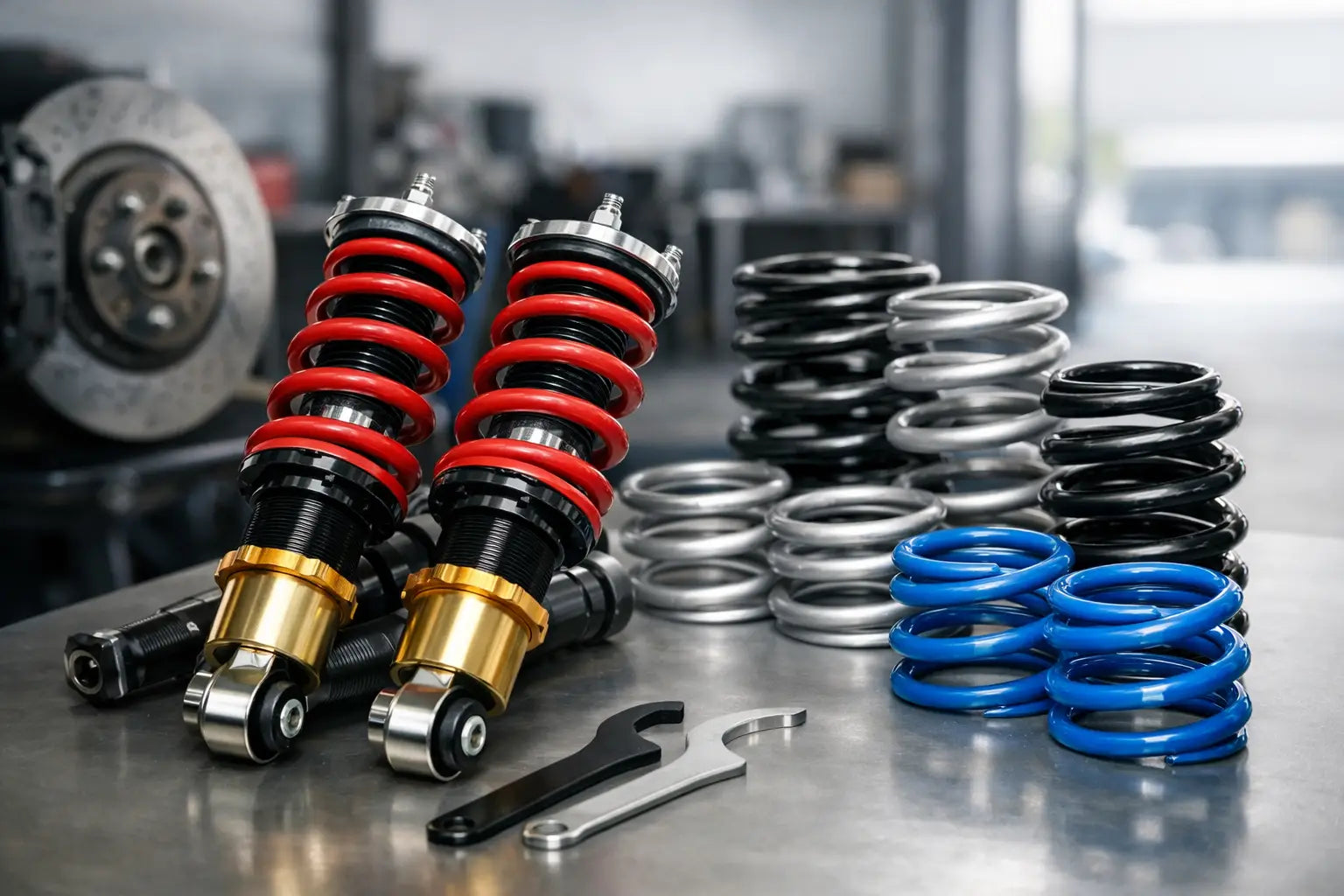
Ask any tuner why a car feels nervous mid-corner, skips over bumps, or chews through grip on corner exit, and spring rate is usually somewhere in the conversation. If you are working out how to choose coilover spring rates, the real job is not picking the stiffest option you can tolerate. It is matching the spring to the car, the tyre, the damper, and what you actually do with the vehicle.
That matters because spring rate changes everything. It affects body control, pitch under braking, squat under power, kerb behaviour, traction on rough surfaces, and how hard the dampers need to work. Get it right and the car feels tied down without being snappy. Get it wrong and even a high-end coilover kit can feel busy, inconsistent, or flat-out slower.
What coilover spring rates actually do
Spring rate is simply how much force is needed to compress the spring by a given amount. In the performance world you will usually see rates listed in kg/mm or N/mm. Higher numbers mean a stiffer spring. Lower numbers mean a softer spring.
That sounds simple, but the effect on the car depends on more than the number printed on the spring. Motion ratio, suspension design, vehicle weight distribution, aero load, tyre sidewall stiffness, and damper valving all shape the result. A 10 kg/mm front spring on one platform may feel perfectly balanced, while the same number on another car feels harsh and underdamped.
This is why copying someone else’s setup can be hit and miss. If their car has different tyres, different ride height, stripped interior, added aero, or revised anti-roll bars, the spring rate that works for them may not work for you.
How to choose coilover spring rates for your use case
Start with the car’s main job. Not the fantasy job - the real one.
A daily-driven hot hatch that sees the odd B-road blast needs a different setup from a Time Attack build or a Nürburgring-focused road car. If the car spends most of its life on rough public roads, over-springing it usually costs more performance than it gains. The tyre spends less time in clean contact with the tarmac, the chassis gets edgy over mid-corner bumps, and the ride becomes tiring fast.
For fast road use, the target is usually controlled body movement without making the car skate over imperfect surfaces. For track work, especially on smoother circuits and with stickier tyres, you can move stiffer because you need more support in braking zones, high-speed transitions, and loaded corners. If the car runs aero, spring rate becomes even more critical because the platform has to stay stable as downforce builds.
So before you compare numbers, decide where the compromise should sit. Road comfort, mixed-use pace, smooth-circuit grip, rough-circuit compliance, or competition sharpness. There is no universal best rate.
Weight, balance and suspension geometry
Heavier cars generally need more spring. Cars with a front-heavy layout often need stronger front support to manage dive and outer-wheel loading. But choosing rates is not as simple as matching spring stiffness to axle weight.
Suspension geometry changes how much influence the spring actually has at the wheel. A MacPherson strut layout often has a more direct relationship between spring and wheel movement than a separate spring-and-damper rear setup. That means two springs with the same quoted rate can produce very different wheel rates depending on where and how they are mounted.
This is one reason platform-specific kits matter. Reputable coilover manufacturers do not just throw generic rates at random fitments. They build around the chassis layout, expected vehicle mass, and intended use. If you are looking at quality options from brands with proper development behind them, the baseline rates are usually there for a reason.
The damper has to match the spring
A spring does not work on its own. Dampers control how quickly that spring compresses and rebounds. If you fit a much stiffer spring than the dampers were designed for, the car can feel bouncy, crashy, or unsettled because the damper cannot manage the energy properly.
This is where people go wrong when they treat spring rates like bragging rights. A stiffer spring is not automatically a better handling spring if the damper valving is not in the same window. Good coilover packages are balanced combinations. Change one part too far without considering the other and you move away from performance, not towards it.
If you are ordering custom rates, make sure the damper can support them. Some dampers have the range to cope with moderate changes. Others really need revalving to work properly. If you are not sure, that is the question to ask before buying, not after fitting.
Softer versus stiffer - what you really gain and lose
Softer spring rates usually improve compliance and mechanical grip on rough surfaces. The car can follow the road better, the tyre stays loaded more consistently, and confidence on real-world tarmac often improves. The trade-off is more roll, dive, squat, and platform movement.
Stiffer spring rates give the chassis more support. Steering response can sharpen, transitions feel cleaner, and the car is often more predictable under heavy load on smooth surfaces. The downside is reduced compliance. On bumpy roads or aggressive kerbs, the tyre can spend more time skipping than gripping.
That trade-off is why there is no magic number. If your local roads are broken and greasy for half the year, a very stiff track-biased setup may feel exciting for ten minutes and frustrating every day after that. If the car is a serious circuit tool on semi-slicks, a softer road-biased rate may leave too much performance on the table.
Front-to-rear balance matters more than headline stiffness
When people talk about spring rates, they often focus on the absolute number. The more useful question is how the front and rear rates work together.
More front spring relative to rear can help support a heavy nose and reduce dive, but go too far and the front tyres give up earlier in the corner. More rear spring relative to front can make the car rotate better, but too much can make it nervous on entry and traction-limited on exit.
Drive layout matters here. Front-wheel drive cars often respond well to careful rear-rate increases to help rotation, but there is a limit before the rear becomes too lively. Rear-wheel drive cars usually need a more measured balance so they can still put power down cleanly. All-wheel drive setups often tolerate a firmer overall package, but they are still not immune to poor balance.
This is also why anti-roll bars and alignment cannot be ignored. If you are trying to fix understeer or oversteer purely with spring rate, you may be using the wrong tool.
Road, fast road and track starting points
If you want a practical way to think about how to choose coilover spring rates, work backwards from tyre and surface.
A road car on premium road tyres usually wants moderation. Enough spring to keep the shell under control, not so much that the tyre gets bullied by poor surfaces. A fast road or occasional track car can go firmer, especially if it runs a quality damper with proper adjustment and a more aggressive alignment setup. A dedicated track build on semi-slicks or slicks can justify significantly higher rates, but only if the rest of the chassis package supports it.
As a rule, every step towards track bias narrows the car’s comfort and compliance window on the road. That is fine if you accept the compromise. It is a bad idea if you expect one setup to feel plush on the commute and razor-sharp in a dry session.
Common mistakes when choosing spring rates
The first mistake is buying based on internet folklore. Forum setups can be useful reference points, but they are rarely complete. Without the full spec, driver preference, and actual use case, the numbers mean very little.
The second is chasing stiffness to solve damping, tyre, or geometry problems. If the car rolls too much, it may need spring. It may also need better damping, more camber, or a different anti-roll bar strategy.
The third is ignoring unsprung and rotational changes. Wheel and tyre packages alter how the suspension behaves. A move to lighter wheels and stiffer sidewall tyres can change what spring rate feels right.
The fourth is forgetting passengers, fuel load, boot weight, or stripped interior. A road car with tools, seats and a full tank is not the same as a stripped track car with a bucket seat and half a tank.
Buy for the whole setup, not just the spring number
The best move is usually to start with a well-developed coilover kit built for your platform and your intended use, then fine-tune from there if needed. That gives you matched dampers, sensible default rates, and a setup window that is far more likely to work straight out of the box.
If you already know the car’s purpose is unusually specific - hillclimb, heavy aero, slick tyre use, endurance work, especially rough circuits - then custom spring rates can absolutely make sense. But at that point, you are tuning a package, not shopping by headline figure.
A good suspension setup should make you faster and more confident, not just more aware of every pothole. Choose the spring rate that keeps the tyre working, the chassis controlled, and the car honest about what it is built to do.