
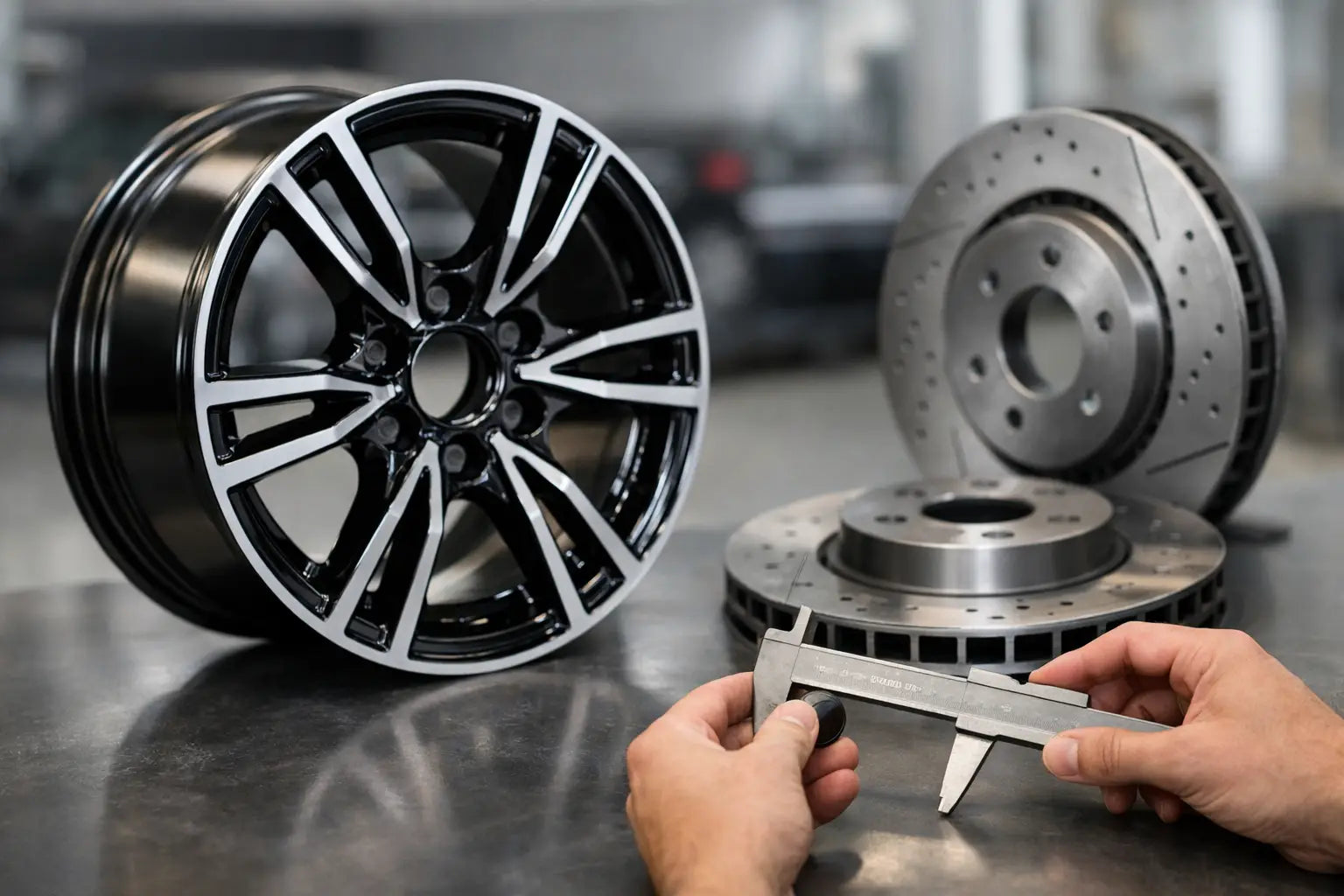
A wheel can look perfect on paper and still fit terribly once it is bolted on. That usually comes down to offset. If you are working out how to select wheel offset, you are really balancing three things at once - inner clearance, outer position, and how the car will actually be used.
Get it right and the car sits properly, clears the suspension and brakes, and drives as it should. Get it wrong and you end up with rubbing, poke, scrub issues, or a wheel that sits miles too far inboard. Offset is not styling trivia. It is core fitment.
What wheel offset actually means
Wheel offset is the distance between the wheel's mounting face and its centreline. It is usually shown as ET followed by a number in millimetres. ET35 means the mounting face sits 35 mm out from the centreline towards the road side of the wheel.
A higher positive offset pulls the wheel further into the arch. A lower offset pushes it further out. Go negative and the wheel moves out even more, which is more common on some older 4x4 or wide-body applications than modern performance hatchbacks and saloons.
That sounds simple, but offset never works alone. Width matters at the same time. An 8J ET35 and a 9J ET35 do not sit in the same place because the wider wheel adds material to both the inner and outer side.
How to select wheel offset without guessing
The easiest mistake is to shop by diameter only. A 18-inch wheel tells you almost nothing about fitment on its own. To select offset properly, start with the full wheel spec: diameter, width, PCD, centre bore, and intended tyre size. Then compare that package against your current setup or a known working fitment for your platform.
The practical way to think about offset is this: where do you want the inner lip and outer lip of the new wheel to sit compared with the current one? Inner movement affects strut, spring perch, upright and brake clearance. Outer movement affects arch clearance, poke, and how aggressive the fitment looks.
If the new wheel is wider and has a lower ET, it will move outward fast. That can be exactly what you want on a track car with proper camber and rolled arches. On a daily road car with standard suspension, it can become a headache quickly.
Start from your current wheel setup
If your current wheels fit well, use them as the baseline. Note the width and offset, then calculate the difference with the new wheel.
For example, if you run 8J ET45 and want to move to 8.5J ET35, the new wheel will sit closer to the suspension on the inside by a small amount, but it will push further towards the arch on the outside much more noticeably. That is why wider, lower-offset wheels often look great in product shots but need more than wishful thinking to work in the real world.
If you do not know your current specs, check the stamping on the rear of the wheel or the manufacturer's data.
The clearances that matter most
Inner clearance comes first. If the wheel contacts the strut, coilover spring, inner arch liner or brake hardware, the job is dead before you even think about stance. Outer arch clearance is the one people see, but inner clearance is the one that decides whether the wheel can physically run.
Brake clearance deserves special attention. Offset is only part of the story here because spoke design matters just as much as the ET number. Two wheels with the same width and offset can behave very differently over a big brake kit. Concave faces, spoke curvature and barrel shape all affect caliper clearance.
That is why platform-specific fitment matters. A wheel spec that clears standard brakes on a Golf GTI may not clear an aftermarket six-pot setup on the same car. If the car runs upgraded brakes, always check a brake template or proven fitment before buying.
Suspension changes alter the answer
Lowering the car changes the game. Coilovers, springs, camber arms and top mounts all influence what offset works. A setup that clears at standard ride height can rub once the car is lowered and loaded into compression.
Camber can buy clearance, but it is not a magic fix. A touch more negative camber may help tuck the top of the tyre under the arch. Too much for the sake of bad wheel fitment can compromise tyre wear and road manners, especially on a fast road car.
Common offset scenarios enthusiasts run into
On many modern front-wheel-drive and rear-wheel-drive performance cars, factory wheels tend to sit fairly conservative. That leaves room for an aftermarket wheel with a slightly lower offset to improve stance without causing problems. The key phrase is slightly.
Drop 5 to 10 mm in effective offset and the result is often tidy and usable. Drop far beyond that on a standard-arch car and you are likely into rolling arches, trimming liners, running more camber, or accepting occasional rubbing.
Wider wheels can also let you support a better tyre for grip and steering response, but again there is a trade-off. More width with the wrong offset can make the steering feel heavier, increase tramlining, or put the tyre too close to the arch under load.
For track builds, slightly more aggressive offset can make sense when paired with the right tyre, alignment, and suspension package. For a daily-driven road car, a more conservative fitment usually delivers the better result because it keeps clearance, geometry and practicality in check.
How to read fitment changes properly
There is no universal best offset. The right ET depends on your exact car, wheel width, tyre size, brake setup and ride height.
As a rule, if you increase wheel width without changing offset, the wheel moves inward and outward equally from the centreline. If you lower the ET number, the whole wheel moves outward. Stack both changes together and the outer lip can end up much further out than expected.
Tyre choice also changes the real fitment. Not all 235 tyres measure the same. Some brands run square, some stretch slightly on a given wheel width, and some have a chunky rim protector that effectively steals clearance. That matters when your setup is already close.
Spacers are not the same as choosing the right offset
A spacer reduces effective offset by pushing the wheel outward. A 10 mm spacer on an ET45 wheel effectively gives you ET35. That can be useful for fine-tuning, but it should not be the first plan for fixing a badly chosen wheel.
Spacers can help clear suspension or brakes, but they can also push the outer edge into the arch. If you use them, they need to be high quality and correctly matched with longer bolts or suitable hardware. Treat them as a measured adjustment, not a shortcut.
Mistakes to avoid when selecting wheel offset
The biggest one is copying another car's fitment without checking the full spec. "It fits on Instagram" is not data. You need the actual wheel width, offset, tyre size, suspension setup, alignment and whether the arches have been modified.
Another common mistake is focusing only on flush fitment. A wheel that sits perfectly with the car parked can rub badly over bumps, with passengers, or on lock. Static photos hide a lot.
The other trap is ignoring scrub radius and steering feel. On some platforms, pushing the wheel too far outward can change how the steering behaves under braking and over rough roads. That may be acceptable on a dedicated build. On a fast road car, it often just feels worse.
A sensible process for choosing the right offset
Start with a known fitment for your exact model. Then decide what the car needs from the new setup. If the goal is sharper track performance, you may accept a more aggressive wheel and tyre package with supporting alignment changes. If the goal is a clean road fitment, stay closer to proven offsets and avoid chasing the edge of the arch.
From there, compare the new wheel against the current one and look at both inner and outer movement. Check brake clearance, check suspension clearance, and think about tyre dimensions as part of the package, not an afterthought.
If you are buying for a modified car, be honest about the modifications. Lowered suspension, larger brakes and arch work all change what works. A proper fitment decision is always vehicle-specific.
At Torque Lab, this is exactly why platform-led fitment matters more than generic wheel shopping. The best setup is not the most aggressive one on paper. It is the one that clears properly, suits the way you drive, and still looks right when the car is being used as intended.
Wheel offset is one of those details that separates a build that only photographs well from one that actually works. Choose with a tape measure and a clear goal, not just with your eyes.