
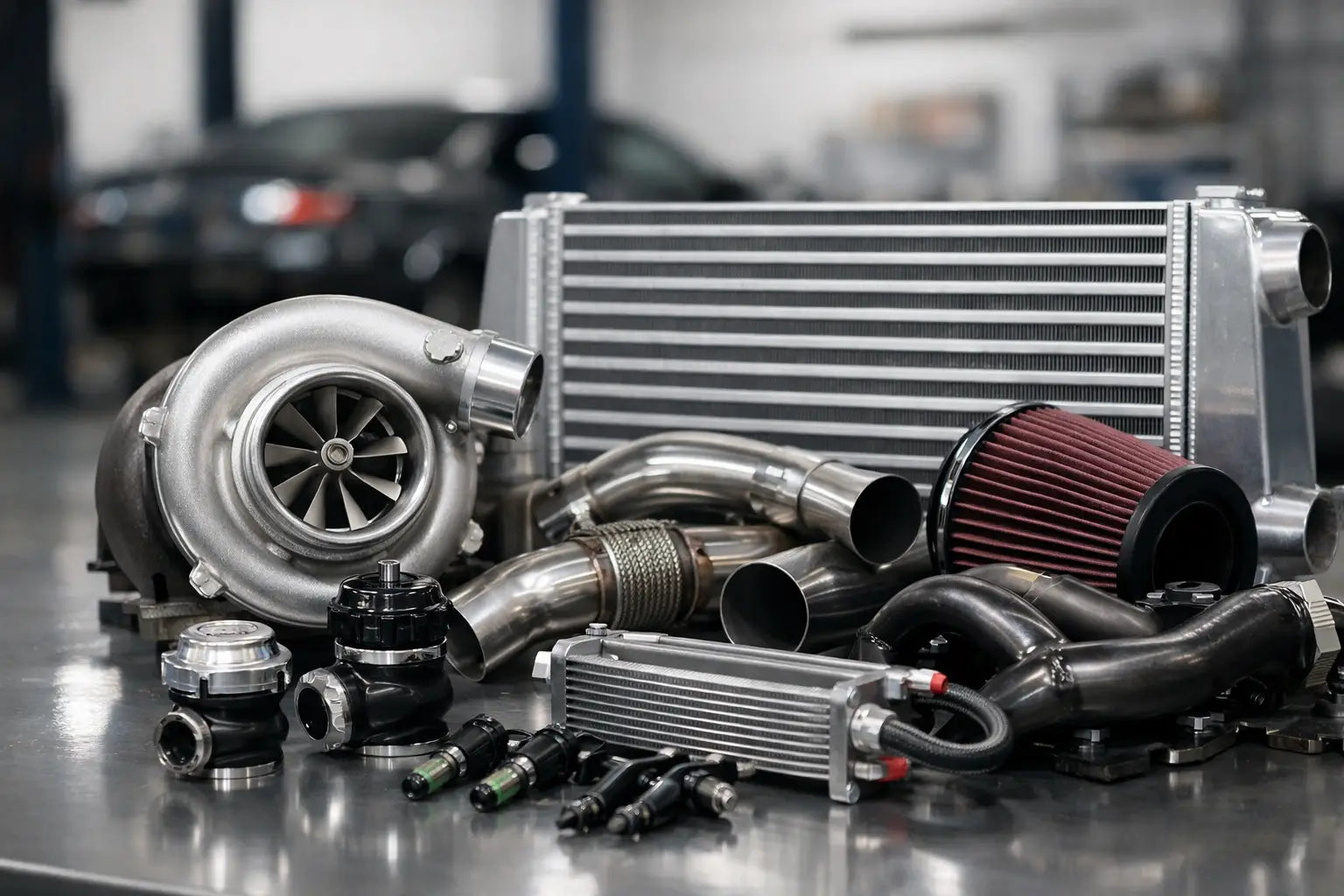
A bigger turbo is the easy bit. Keeping the car alive, driveable and actually fast afterwards is where most builds are won or lost. A proper turbo supporting mods guide is not about throwing random parts at the car - it is about matching airflow, fuel, heat control and drivetrain strength to a realistic power target.
That matters whether you are freshening up a street car for a mild Stage 2-style setup or planning a forged, track-driven build that will spend long sessions on boost. The best results come from choosing parts as a package, not as isolated upgrades.
What a turbo supporting mods guide should really cover
Too many people treat supporting mods as the boring spend behind the headline power figure. In reality, these are the parts that decide whether the car feels sharp, repeatable and trustworthy, or whether it turns into a heat-soaked, slipping, misfiring headache.
At minimum, your supporting setup needs to cover fuelling, intake and exhaust flow, charge air cooling, engine cooling, drivetrain capacity, braking and a calibration that ties it all together. Depending on platform, you may also need to think about PCV upgrades, engine mounts, differential health, oil control and even wheel and tyre choice. There is no universal shopping list because a turbocharged EA888, B58, K20, 4B11 or 1.8T all have different weak points.
The right question is not just, what parts do I need for more boost? It is, what parts does my specific car need to make that boost usable?
Start with a power target, not a parts cart
If you skip this step, you usually buy twice. A sensible 320 bhp road build needs a different budget and different priorities from a 500 bhp drag-biased setup or a 380 bhp circuit car that must survive repeated heat cycles.
Be honest about how the car is used. A daily-driven Golf GTI or Audi S3 needs clean cold starts, stable fuel trims and good manners in traffic. A weekend Civic or Yaris track car may accept more noise, firmer mounts and shorter service intervals. A rear-wheel-drive BMW build might get away with more power on stock internals than a smaller-capacity hot hatch that becomes traction-limited well before the dyno figure looks impressive.
Once the target is clear, supporting mods become easier to prioritise. You stop buying for internet bragging rights and start buying for a build that works.
Fuel system upgrades make or break boosted power
This is the first place many builds run out of headroom. More air only works if the engine can deliver enough fuel with proper control. On modern turbo platforms, that may mean a higher-flow low-pressure pump, an upgraded high-pressure fuel pump, larger injectors or a mix of those depending on the engine.
Direct-injection motors often hit high-pressure limitations earlier than owners expect. Older port-injection engines may need injectors and pump upgrades sooner, especially if ethanol blends are involved. If you plan to run E30, E50 or full ethanol where supported, assume fuelling demand will rise sharply. Ethanol can be excellent for knock resistance and charge cooling, but it is not a free power cheat. The system has to support it.
There is also a drivability angle. Proper fuelling upgrades do not just protect the engine at full load. They help the tuner maintain consistent lambda control, which matters for smooth part-throttle operation and reliability.
Airflow matters, but not every intake part adds value
Your turbo setup needs to breathe efficiently before and after the compressor. That usually means a well-designed intake, a less restrictive inlet path and a freer-flowing exhaust system with appropriate downpipe sizing for the power level.
But this is where platform-specific thinking matters. Some factory airboxes are surprisingly capable with only a better panel filter and inlet hose. Other cars respond well to a full intake and turbo inlet upgrade because the stock path is genuinely restrictive. The same applies to cat-back systems. They can improve sound and flow, but not every car sees a meaningful performance gain from the rear section alone.
The downpipe and turbine outlet tend to matter more on many builds, especially once boost and turbine speed go up. If the goal is power per pound spent, focus on the points of greatest restriction rather than the loudest part in the catalogue.
Intercooling is not optional once boost rises
Heat is the enemy of repeatable performance. A car that feels quick for one pull and then drops timing for the next three is telling you the intercooler is out of its depth.
A stronger front-mount or upgraded stock-location intercooler lowers intake temperatures, improves consistency and gives the tuner more stable conditions to work with. On a road car in a cool climate, the factory setup may survive a mild tune. On track, during summer use, or on a hybrid turbo car, it often will not.
The same logic applies to boost pipework and hose quality. If couplers are weak or the routing is poor, you end up chasing leaks instead of enjoying the car. Supporting mods should reduce problems, not create new ones.
Engine cooling and oil temperature control
Extra cylinder pressure creates extra heat everywhere. Coolant temperature, oil temperature and under-bonnet heat all become more critical as power rises.
Some platforms cope well with stock radiators and oil cooling at modest gains. Others start showing high oil temperatures after only a small bump in power, especially on circuit. An upgraded radiator, oil cooler or better ducting can be worth more than another few bhp. It is not glamorous, but neither is lifting off every third lap because temperatures are climbing.
The tune is the centre of the build
A turbo supporting mods guide that does not put calibration first is missing the point. The tune decides how all the hardware works together - boost targets, ignition timing, fuel delivery, torque shaping, throttle behaviour and safety strategies.
A poor map can make excellent hardware feel awful. A good map can make a modest setup feel sharp, responsive and reliable. That is why it makes little sense to buy parts without knowing what your tuner wants to see on the car. Some calibrators have clear preferences on intercooler design, injector data, wastegate control or fuel pump combinations because they know what delivers predictable results.
If you are buying in stages, speak to the tuner before the first order goes in. It saves money and avoids the classic pile of mismatched parts that looked right on a forum thread.
Drivetrain upgrades are usually needed earlier than people think
More torque exposes weak links fast. On manual cars, the clutch is often first in line. A stock clutch that feels acceptable at factory torque may start slipping once mid-range boost comes in properly. The fix is not always the most aggressive paddle setup available. For a road car, clutch choice should balance torque capacity, pedal effort and engagement quality.
DSG, DCT and ZF automatic platforms bring different considerations. Gearbox software, clutch pack capacity and fluid condition become important. Extra engine torque without the right transmission calibration can leave performance on the table or shorten component life.
You should also look at engine mounts, gearbox mounts and driveshaft condition. Stiffer mounts can improve shift feel and control drivetrain movement, but they do add vibration. Again, it depends on whether the car is a commuter, a weekend toy or a dedicated track machine.
Traction, brakes and chassis are supporting mods too
There is no point making another 80 bhp if the car just lights the tyres in second and runs out of braking confidence at the first hard stop. This is where mature builds separate themselves from pub-talk builds.
A quality tyre upgrade often changes the car more than another small power increase. The same goes for brake pads, fluid and discs matched to how the car is used. For fast road work, a decent pad and fresh fluid may be enough. For repeated circuit abuse, you may need a more serious brake package with proper heat capacity.
Suspension also deserves a place in any turbo supporting mods guide. If the car squats excessively, struggles for traction or becomes nervous at speed, power is no longer the main issue. Dampers, springs, alignment and bush condition all influence how effectively the car can use the extra output.
Don’t ignore the differential
On front-wheel-drive and rear-wheel-drive platforms alike, a limited-slip differential can transform how the car deploys power. It improves corner exit traction and makes the added torque far more usable.
It is not the first mod every build needs, but once power climbs and driving gets more serious, it often becomes one of the smartest ones.
Reliability upgrades depend on the platform
Every engine family has known weak spots. Some need better PCV control. Some benefit from catch cans. Some have coil pack, spark plug or diverter valve issues that show up under increased boost. Others are famous for weak rods, ring land sensitivity or marginal factory cooling.
That is why buying by brand reputation alone is not enough. Fitment and proven platform compatibility matter just as much. Torque Lab’s catalogue approach makes sense here because enthusiasts usually search by vehicle and intended use, not by random generic parts.
The smartest builds fix known weaknesses before they become failures. It is cheaper to upgrade deliberately than to rebuild reactively.
Build in phases if you need to, but build with a plan
Not every project gets done in one hit. That is normal. The key is choosing a sequence that avoids dead-end spending. Fuelling, intercooling, exhaust flow and tuning strategy should be mapped out from the start, even if you buy across several months.
If your end goal is a larger turbo, do not spend heavily on parts that will become bottlenecks later. If your real goal is a quick, dependable road car, do not overspec everything and ruin the way it drives day to day. Fast is good. Fast and enjoyable is better.
The best turbo builds are rarely the ones with the longest parts list. They are the ones where every component supports the same job. Pick a realistic target, choose proven hardware for your platform, and let the supporting mods do what they are supposed to do - make the power feel easy.