
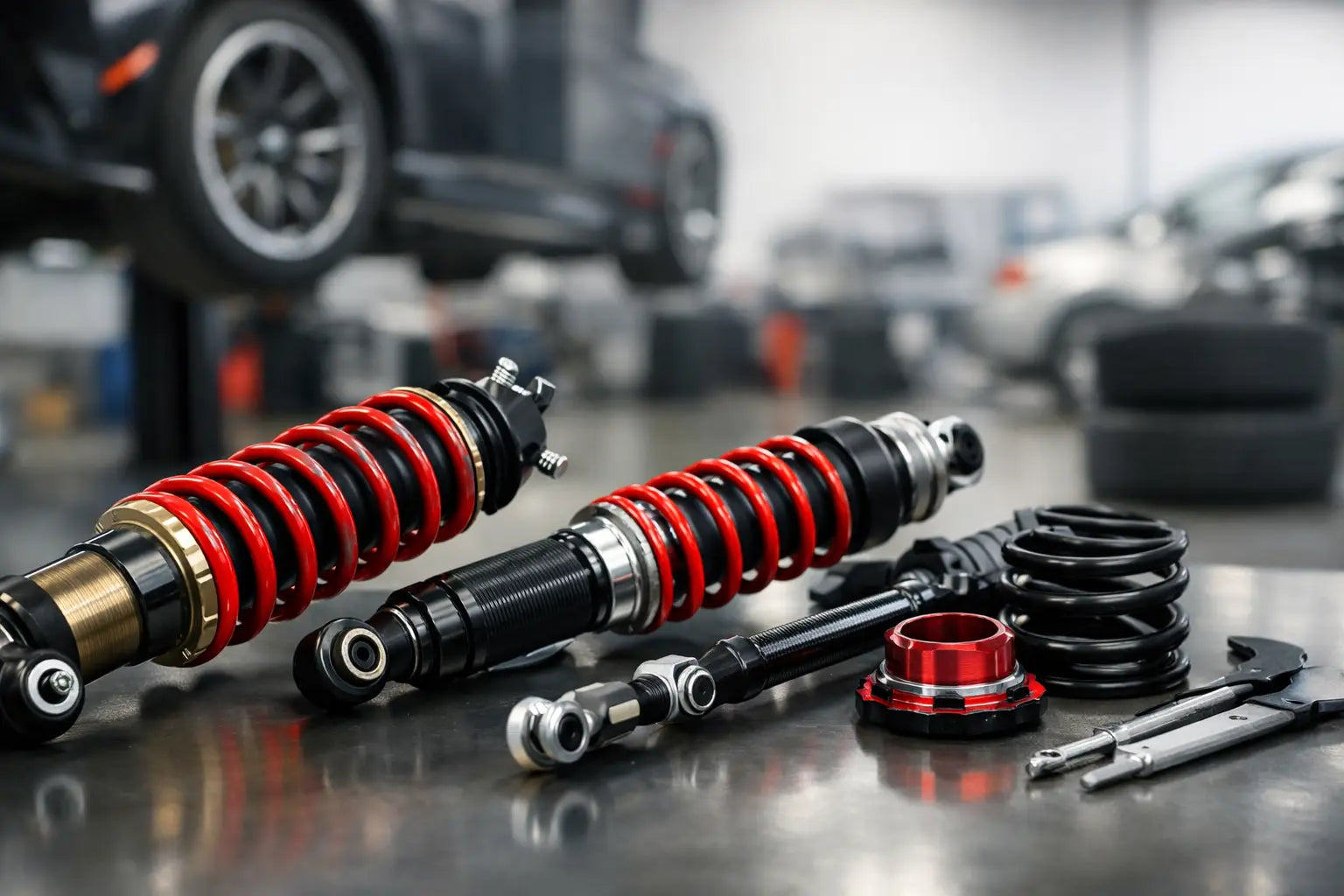
A car that feels quick in a straight line can still be frustrating everywhere else. If it skips across B-roads, washes wide on turn-in, or feels nervous under braking, the problem often sits in the chassis setup rather than the power figure. This performance suspension tuning guide is built for enthusiasts who want sharper handling without guessing their way through springs, damping and alignment.
What suspension tuning is really trying to fix
Suspension tuning is not about making a car as hard as possible. That mistake still catches plenty of people out. A fast setup keeps the tyre in contact with the road, manages weight transfer, and gives the driver confidence to lean on the car.
That means the "best" setup depends on where the car lives. A daily-driven hot hatch on rough roads needs compliance. A track MX-5 or Civic running semi-slicks can accept more spring rate and a more aggressive alignment. A heavy turbo BMW with occasional circuit use needs something different again, especially if it sees motorway miles between events.
The core job is simple - balance grip, control and usability. The hard part is that every change affects something else.
Start with the right hardware before you tune
No amount of adjustment can rescue poor-quality parts or a badly matched setup. Before touching clicks and spanners, make sure the basics are sorted. Worn top mounts, tired bushings, damaged dampers, cheap tyres or uneven tyre pressures will make tuning pointless.
If you are upgrading, think in systems rather than single parts. Coilovers, springs, top mounts, anti-roll bars and alignment all work together. Fitting a very stiff spring and leaving an underdamped shock to cope with it is a classic way to end up with a car that feels dramatic but is slower and less composed.
For most enthusiasts, quality branded dampers and coilovers from proven manufacturers are a better investment than chasing the cheapest adjustable kit on the market. Fitment accuracy matters as much as headline spec. A platform-specific kit designed around your car's weight distribution and geometry gives you a proper starting point.
Performance suspension tuning guide to the key adjustments
Spring rates
Spring rate controls how much the car resists compression. Stiffer springs reduce body movement and can improve response, but only up to the point where the tyre starts losing contact over bumps and kerbs.
On the road, overly stiff spring rates usually make a car worse. The body may roll less, but grip on broken surfaces can drop away. On track, stiffer rates can pay off if the tyre, damper and surface support it. The right answer depends on vehicle weight, tyre sidewall, aero load if any, and how smooth the surface is.
Front-to-rear balance matters as much as outright stiffness. More front spring relative to rear can calm an oversteery car but may increase understeer. More rear rate can help rotation, though it can also make the rear less settled under power on a front-wheel-drive car.
Damping
Damping controls the speed of suspension movement. It does not hold the car up - springs do that. This is where a lot of adjustment goes wrong.
If rebound damping is too soft, the car can feel floaty and slow to settle after direction changes. If it is too firm, the suspension may not return quickly enough between bumps, effectively "jacking down" and reducing grip. Compression damping shapes how the car deals with impacts and weight transfer. Too soft and the chassis feels lazy. Too firm and the car becomes skittish.
If your kit has combined damping adjustment, make changes in small steps and test properly. One or two clicks can be enough to feel. Randomly winding everything to the hard end because it feels more "race" usually leads nowhere useful.
Ride height
Lower is not always better. Lowering the centre of gravity helps, but once you go too far you start sacrificing bump travel, upsetting geometry and increasing the chance of rubbing or bottoming out.
A road and track setup often works best with moderate lowering rather than a slammed stance. You want enough travel left for the damper to work, enough clearance for real roads, and sensible driveshaft and steering arm angles. On some platforms, aggressive lowering introduces bump steer and poor camber gain that no amount of wishful thinking will tune out.
Anti-roll bars
Anti-roll bars change roll stiffness without directly changing ride quality in the same way springs do in a straight line. They are useful, but they are not magic.
A stiffer front bar typically reduces roll but can also increase understeer. A stiffer rear bar can wake a car up on corner entry and mid-corner rotation, especially on front-wheel-drive setups, but go too far and the rear can become nervous in wet conditions or on bumpy exits. Bars should support the spring and damper package, not patch over a poor base setup.
Alignment
Alignment is where a good suspension package turns into a properly sorted one. Toe, camber and caster all change how the car responds.
Negative camber helps keep the tyre square to the road in corners, especially with sticky tyres and higher cornering loads. Too little camber often shows up as outer shoulder wear and vague front-end grip. Too much on a road car can hurt braking, straight-line stability and tyre life.
Toe has a big effect on feel. Front toe-out can sharpen turn-in, but too much makes the car twitchy. Rear toe-in adds stability, though excessive rear toe can make the car feel reluctant to rotate. Caster improves straight-line stability and dynamic camber gain, but not every platform offers easy adjustment.
Build a baseline before chasing lap time
A proper performance suspension tuning guide has to say this clearly - do one thing at a time. If you change ride height, damping and anti-roll bar position together, you will not know what fixed the car or made it worse.
Start with tyre pressures set correctly and evenly. Confirm ride heights side to side. Make sure corner weights are sensible if you have adjustable coilovers and access to scales. Then get a proper alignment matched to the car's use.
From there, evaluate symptoms rather than feelings alone. If the car understeers on entry, that points you towards braking stability, front grip and weight transfer. If it pushes on exit, look at power application, diff behaviour, rear support and front tyre overload. If it feels unstable over crests or kerbs, damping and travel need attention before anything else.
Road setup versus track setup
This is where expectations need to stay realistic. One setup can cover both jobs, but it will always be a compromise.
A road-biased fast road car should prioritise compliance, predictable breakaway and tyre wear. That usually means moderate spring rates, sensible ride height and an alignment that sharpens response without tramlining everywhere. You want confidence on wet roads and poor surfaces, not just a nice parking stance.
A track-biased setup can lean harder into camber, spring support and sharper transient response. If the car travels to track days, you can still keep it civilised, but there is a line where comfort and refinement start to disappear. Honest tuning means accepting that not every car needs full race stiffness to be enjoyable or quick.
Common mistakes enthusiasts make
The first is copying someone else's settings without matching their tyres, wheel widths, ride height, surface or driving style. A Nürburgring-inspired setup on one car can be miserable on UK roads.
The second is treating stiffness as performance. If the tyre is bouncing, the body control may feel dramatic, but grip is not improving.
The third is ignoring the rest of the package. Suspension tuning cannot cover for weak brakes, poor tyres, worn bushings or a bad driving position. The fastest chassis parts in the world will still feel average if the contact patch and geometry are not right.
The fourth is buying purely on features. More adjustment does not automatically mean a better result. Plenty of drivers are quicker on a well-developed fixed or simpler adjustable setup than on a highly adjustable kit they do not understand.
When to get specialist help
If you have reached the point where the car is close but not quite right, specialist setup work is worth the money. That is especially true for cars running mixed-use duties, aftermarket arms, wider wheels, limited-slip differentials or motorsport tyres. Those combinations can transform a chassis, but only when the geometry and damping are working together.
For buyers choosing parts, the smart move is to start with proven brands and platform-specific kits rather than generic promises. That saves time, protects tyre budget and gives you a usable baseline. Torque Lab's catalogue approach suits this part of the process well because enthusiasts can narrow parts by vehicle, brand and category instead of trying to force a universal solution onto a very specific build.
The real goal is not a setup sheet that looks serious on paper. It is a car that tells you what the front axle is doing, puts power down cleanly, and stays composed when the road gets messy. Get that right, and every other upgrade starts working harder for you.