
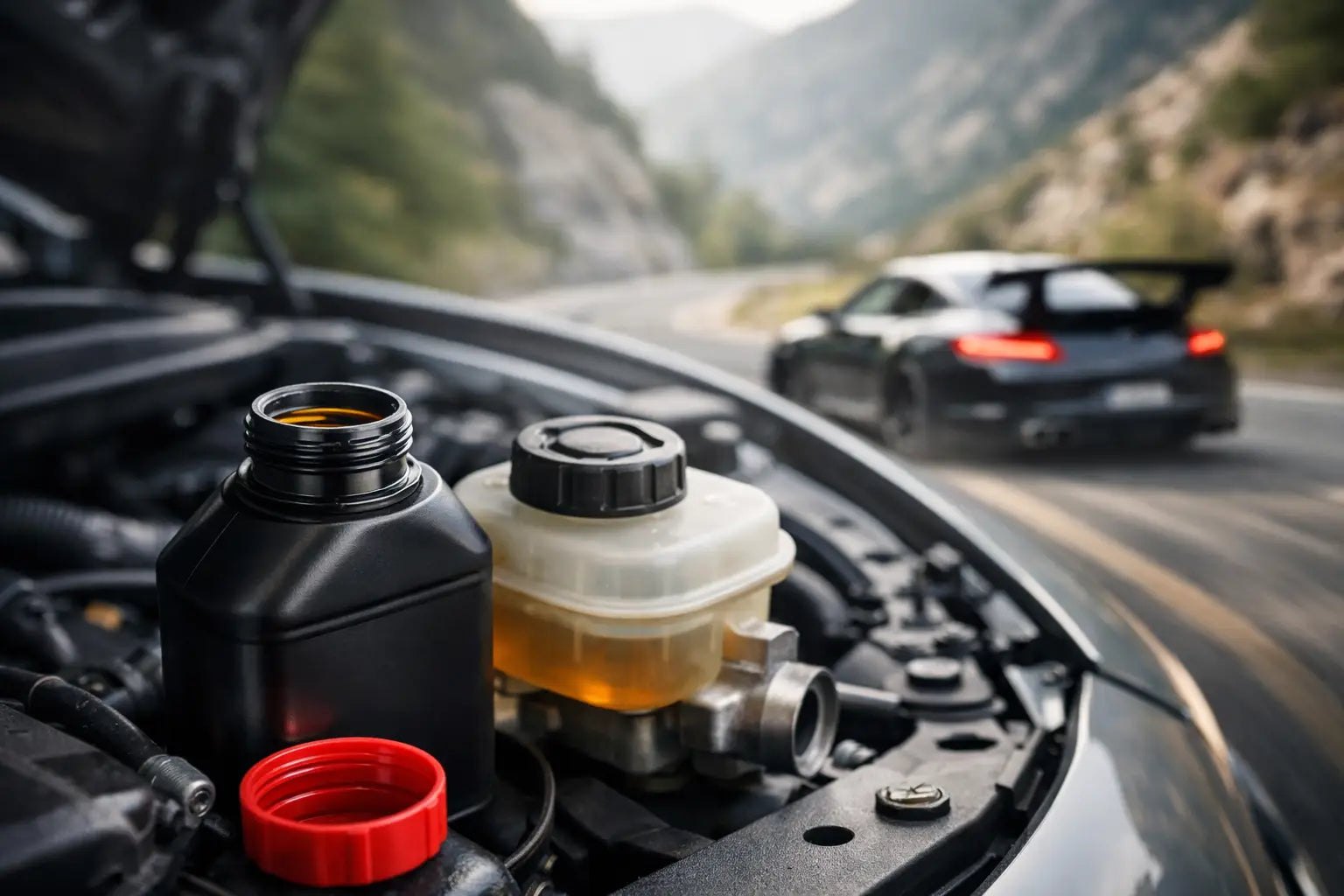
You usually notice bad brake fluid at the worst possible moment - halfway through a fast B-road descent, deep into a track session, or after the third heavy stop when the pedal suddenly feels longer than it did ten minutes ago. If you are looking for the best brake fluid for spirited driving, the real question is not which bottle has the boldest branding. It is which fluid matches your car, your brake temperatures, and how often you are willing to service the system.
What actually matters in spirited driving
For normal commuting, almost any fresh OEM-spec fluid will do the job. Spirited driving changes the equation because heat climbs quickly, and brake fluid lives or dies by heat management. Once fluid gets too hot, it starts to boil. That creates vapour in the system, and vapour compresses. Your pedal goes soft, braking consistency disappears, and confidence leaves with it.
That is why the best brake fluid for spirited driving is usually the one with a strong boiling point profile and a realistic maintenance interval for your use. Dry boiling point matters because it tells you how the fluid performs fresh out of the bottle. Wet boiling point matters just as much, and often more, because brake fluid absorbs moisture over time. A fluid that looks heroic on paper when fresh can be less impressive months later if its wet performance drops hard.
Pedal feel is part of the conversation too, but it is often overstated. Fluid alone will not transform a weak brake setup into a great one. Pads, disc temperatures, cooling, hose condition, and overall system health all play a part. Still, the right fluid can absolutely make the difference between a firm, repeatable pedal and a session cut short by fade.
DOT ratings are only the starting point
Most enthusiasts end up comparing DOT 4, DOT 5.1, and sometimes DOT 5. It is worth clearing this up early. DOT 5 is silicone-based and generally not what you want for performance road or track use in a typical ABS-equipped car. It is not compatible with the same way as glycol-based fluids and is rarely the right answer for a modern spirited driving setup.
That leaves DOT 4 and DOT 5.1 for most performance applications. Both are glycol-based and both can work very well. A quality racing-oriented DOT 4 often outperforms a generic DOT 5.1. That catches people out because they assume the higher number must mean higher performance. It does not work like that.
In practice, plenty of the best-known performance brake fluids for fast road and track-day use are premium DOT 4 products. The label matters less than the actual dry and wet boiling points, plus how the fluid behaves over time in the real world.
The types of brake fluid that make sense
If your car is mainly a fast-road machine with the occasional mountain run or weekend blast, a high-quality performance DOT 4 is usually the sweet spot. It gives you a meaningful jump over basic OEM fluid without forcing a race-team maintenance schedule.
If you do regular track days, especially in a heavier car or something with sticky tyres and big braking loads, you should lean towards a motorsport-focused fluid with very high dry and wet boiling points. That is where the stronger products from recognised braking brands earn their place. They cost more, but so does cooking a set of pads because the pedal went long halfway through a session.
If your car is a dual-purpose build that sees road miles and repeated circuit use, choose with your service interval in mind. Some ultra-high-performance fluids are excellent when fresh but need changing more often. That is a fair trade if your car is a dedicated weekend or track machine. It is less appealing if the car covers a lot of daily mileage through winter.
Dry boiling point versus wet boiling point
A lot of buyers fixate on the biggest dry boiling point number they can find. That makes sense on first glance, but it is only half the story.
Dry boiling point is your best-case scenario. Wet boiling point is closer to how the fluid performs after it has spent time in the system absorbing moisture. Because brake fluid is hygroscopic, moisture contamination is normal, not exceptional. That means a fluid with a strong wet boiling point can be a smarter choice for an enthusiast road car than a race fluid that only shines when it is freshly bled and changed frequently.
For a track-day regular, maximum dry performance may still be the priority. For a fast-road car, balance is usually better. The best brake fluid for spirited driving on the road is not always the most extreme fluid on the shelf. It is the fluid that keeps performing after real use, in real weather, with realistic maintenance.
Brand reputation matters here
Brake fluid is not the place to get creative with unknown brands. This is a category where proven manufacturers matter. Companies with strong braking pedigree tend to publish proper specifications and have a track record in road and motorsport use.
That does not mean the most expensive option is automatically best. It means you should buy from brands that enthusiasts and track drivers already trust. In the performance aftermarket, names with established braking expertise generally offer more predictable results than bargain fluids with vague claims.
If you are already choosing from recognised performance brake brands, the decision becomes easier. Look at your use case, compare actual boiling point data, and be honest about maintenance. That will get you further than chasing hype.
Road, road-and-track, or full track use
Fast road
For a quick road car that sees hard driving but not repeated lap-after-lap punishment, a quality high-performance DOT 4 is usually ideal. You want better resistance to heat than standard fluid, good cold behaviour, and service intervals that do not become a chore. For most hot hatch, coupe, and saloon builds, this is the sensible upgrade.
Road and track
This is where fluid choice gets more serious. Cars used for both road miles and track work need a fluid that can handle heat spikes without becoming a maintenance headache after every event. A premium motorsport DOT 4 often fits best here. Pair it with pads designed for the same duty cycle, because strong fluid with road-biased pads can still leave you with inconsistent braking.
Full track or competition
If the car lives for circuit work, hill climbs, or sprints, then choose fluid the way you would choose tyres or pads - for the job, not convenience. High boiling points and frequent replacement become part of the package. At that point, chasing outright performance makes sense because the car is being used hard enough to justify it.
The common mistake - blaming fluid for everything
Brake fluid is critical, but it is not magic. If your pedal is poor because the pads are overheating, the calipers need a rebuild, the discs are cracked, or there is air in the system, better fluid will not fix the root issue.
A lot of drivers upgrade fluid after one bad session and expect the whole system to come alive. Sometimes that works because the original fluid was the weak point. Sometimes it does not, because the car really needs a broader brake package review. On heavier, faster, or more aggressively driven cars, fluid, pads, discs, hoses, and cooling need to make sense together.
How often should you change it?
More often than most owners do. For standard road use, manufacturers often set long intervals, but spirited driving shortens that window. If you drive hard on the road, annual changes are a sensible baseline. If you attend track days, fresh fluid before the season or before major events is cheap insurance.
If the pedal starts to feel inconsistent under repeated heavy braking, do not keep guessing. Inspect the whole system and consider a fluid change early. Compared with tyres, discs, or pads, brake fluid is one of the least expensive ways to protect braking performance.
So what is the best brake fluid for spirited driving?
There is no single answer that fits every car. For most enthusiasts, the best choice is a premium performance DOT 4 from a trusted braking brand, with strong dry and wet boiling points and a service interval you will actually stick to. That covers a huge percentage of fast-road and occasional track-day cars.
If your setup sees repeated hard laps, sticky tyres, and proper brake temperatures, move up to a motorsport-focused fluid and accept that maintenance becomes part of the deal. If the car spends most of its life on the road, do not overbuy for bragging rights. Fresh, appropriate fluid beats neglected race fluid every time.
Think about the whole package, not just the bottle. Match the fluid to your pads, your driving style, and how much heat your car really generates. That is how you end up with braking you can trust when the road opens up and the pace rises.