
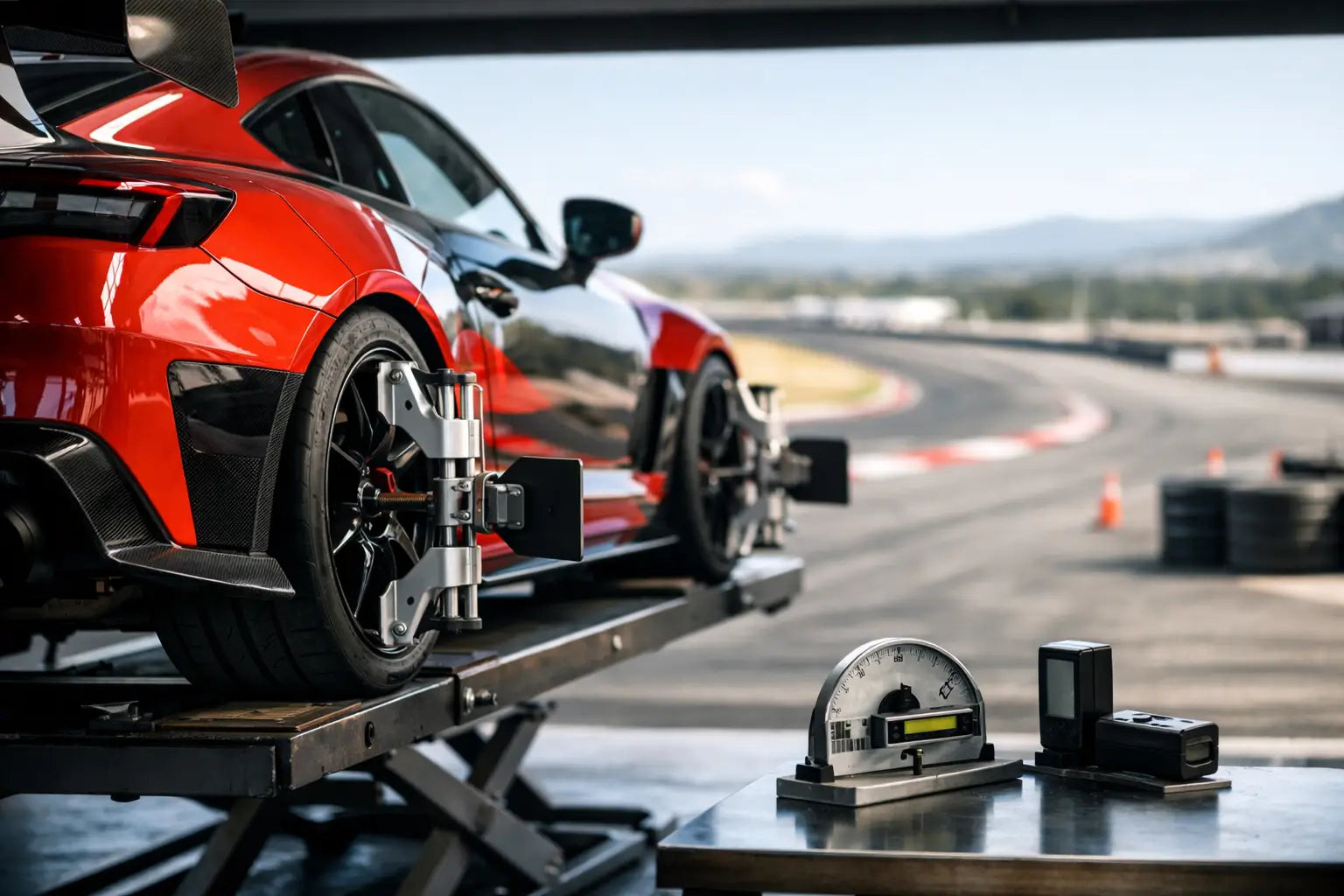
A car that feels vague on turn-in or chews through its front tyres after one hard day usually is not crying out for more power. It is asking for geometry. This track alignment settings guide is built for drivers who want a car that turns cleanly, holds a line under load and stops wasting tyre and brake budget on a setup that is wrong for circuit work.
Track alignment is one of the highest-value changes you can make because it affects everything at once - entry stability, mid-corner grip, traction on exit and tyre temperatures. The catch is simple: there is no magic alignment that suits every car, every tyre and every driver. A front-wheel-drive hatch on semi-slicks needs something very different from a rear-wheel-drive coupe on fast road rubber.
What a track alignment settings guide should actually help you do
A good setup does not chase numbers for the sake of it. It gives you a baseline, explains what each setting changes and helps you make adjustments with a reason behind them. That matters because plenty of enthusiasts bolt on coilovers, top mounts and arms, then book an alignment using road specs that leave performance on the table.
For track use, you are balancing three things: grip, stability and tyre life. Push too far towards grip and the car may become nervous under braking or on straights. Chase stability too hard and it may refuse to rotate. The right answer depends on your chassis, spring rates, tyre construction, diff setup and how aggressively you drive kerbs.
The three settings that matter most
Camber
Camber is usually the first adjustment enthusiasts think about, and for good reason. Negative camber helps keep the tyre contact patch flatter when the car rolls into a corner. On track, that generally means more front-end bite and better consistency through loaded turns.
Most performance cars benefit from more negative camber than factory road settings allow. Factory alignment tends to protect tyre wear and straight-line manners, not maximise lateral grip after repeated hot laps. If your outer front shoulders are getting scrubbed while the inner half still looks fresh, you almost certainly need more front negative camber.
There is a limit. Too much negative camber can reduce braking performance and traction, particularly on road tyres that do not like extreme angles. It can also make the car feel nervous in a straight line if paired with unsuitable toe settings. That is why a number that works on a lightweight track build may feel awful on a heavier dual-use road car.
Toe
Toe has a huge effect on how alive or lazy the car feels. Front toe-out usually sharpens turn-in and helps the car react faster to steering inputs. That is why many track-focused front-wheel-drive and rear-wheel-drive setups use a small amount of front toe-out.
The downside is increased tyre scrub and a car that can feel more darty on motorways. Too much toe-out can make braking zones busy and unpleasant. Front toe-zero is often a strong compromise for dual-use cars, while a mild toe-out setting suits drivers who want a more aggressive front end.
Rear toe is your stability tool. A touch of rear toe-in generally helps keep the car settled on entry and under power. Remove too much of that and the rear may rotate more freely, which can be useful on some chassis but can also turn confidence into guesswork very quickly.
Caster
Caster does not get talked about enough because many cars have limited adjustment, but it matters. More positive caster usually improves straight-line stability and increases dynamic camber gain as you steer. In plain terms, that can give you better front-end support in corners without relying only on static camber.
On cars with adjustable top mounts or control arm options, caster can be a valuable tuning tool. The trade-off is heavier steering effort and, in some cases, packaging limits around the arch or chassis. If your platform gives you caster adjustment, use it sensibly rather than maxing it out because the internet said so.
Baseline track alignment settings by drivetrain
These are not universal specs. They are starting points that need checking against tyre wear, temperatures and driver feedback.
Front-wheel drive
Most front-wheel-drive track cars want strong front negative camber, neutral to slight toe-out at the front and a stable rear with mild toe-in. These cars work the front axle hard because it handles steering, braking and power delivery. Without enough front camber, they lean onto the outer shoulder and wash wide.
If your hot hatch still pushes at apex after brake and line improvements, geometry is a likely culprit. A decent front camber increase often transforms the car more than another engine mod ever will.
Rear-wheel drive
Rear-wheel-drive setups usually need a more balanced approach. Front camber remains critical for turn-in, but rear geometry becomes just as important because traction and rotation are both in play. Too little rear support and the car becomes nervous on power. Too much rear toe-in and it may feel planted but reluctant to rotate.
A fast rear-wheel-drive track car is not always the one with the wildest alignment. Often it is the one that lets the driver lean on the rear predictably while keeping the front responsive enough to place accurately.
Four-wheel drive
Four-wheel-drive cars can mask poor alignment better than other layouts, but that does not mean alignment matters less. In fact, they often respond really well to geometry changes because the extra traction lets you exploit a better setup earlier on corner exit.
Many all-wheel-drive platforms carry weight and need careful management of front-end grip. Extra front camber and sensible front toe can help them resist understeer, while rear settings need to keep the car secure under heavy loading. The temptation is to make them too safe. That can leave a lot of corner speed untapped.
Tyres change the answer
A proper track alignment settings guide has to talk about tyres because geometry and tyre construction are tied together. A road tyre with a softer sidewall often needs a different approach from a semi-slick with stronger shoulder support. The same car can want different camber and pressure targets depending on the compound.
If you switch from a fast road tyre to a track-biased tyre and keep the same alignment, you may not be using the tyre properly. The contact patch, shoulder support and temperature window all shift. This is where tyre pyrometer readings and wear patterns become far more useful than chasing forum specs.
Why your suspension hardware matters
Alignment targets are only worth chasing if the hardware can hold them. Worn bushes, tired ball joints, soft factory top mounts and bent arms will undo a perfect alignment sheet the moment the car sees kerbs or heavy braking.
This is where quality parts matter. Coilovers with consistent damping, adjustable top mounts, camber arms and solid suspension components make the difference between a setup that works for one session and one that stays repeatable. If your car is seeing regular circuit use, geometry upgrades are not vanity parts. They are what make proper alignment possible.
How to tune from driver feedback
Numbers matter, but feedback closes the loop. If the car understeers on corner entry, you may need more front grip, less rear stability or a change in driving technique. If it rotates on entry but pushes at apex, the issue could be front camber, pressures or diff behaviour rather than one simple toe adjustment.
Pay attention to where in the corner the problem happens. Entry, apex and exit point to different causes. That is how you stop random setup changes and start building a car that makes sense.
A smart process is to make small adjustments and test again. One change at a time. If you alter front camber, front toe and tyre pressure all at once, you will not know what fixed the issue or made it worse. Fast setup work is methodical, not flashy.
Common mistakes that cost grip
The biggest mistake is using factory road alignment on a track-driven car with upgraded suspension and sticky tyres. Another is chasing extreme numbers without understanding what the car is doing. More camber is not always better. More toe-out is not always faster. Aggressive settings can impress on paper and still produce a car that is slower, harder to drive and expensive on tyres.
The other trap is ignoring rear alignment. Plenty of drivers focus entirely on front-end bite, then wonder why the car feels unstable on braking or inconsistent through high-speed direction changes. Rear geometry is not background detail. It shapes confidence, and confidence is lap time.
When to get a fresh alignment
If you have fitted coilovers, top mounts, lower arms, anti-roll bars, different wheels or track tyres, book an alignment. If the car has clipped a kerb hard or had suspension apart for any reason, book an alignment. If tyre wear suddenly looks odd, steering feels off-centre or the car has become inconsistent, book an alignment.
Geometry is not a one-time job. As your parts, tyres and driving pace change, the setup should move with them.
The best track cars are not always the most powerful or expensive. They are the ones that make proper use of what they have. Get the alignment right, and every braking point, steering input and tyre pound starts working harder for you.