
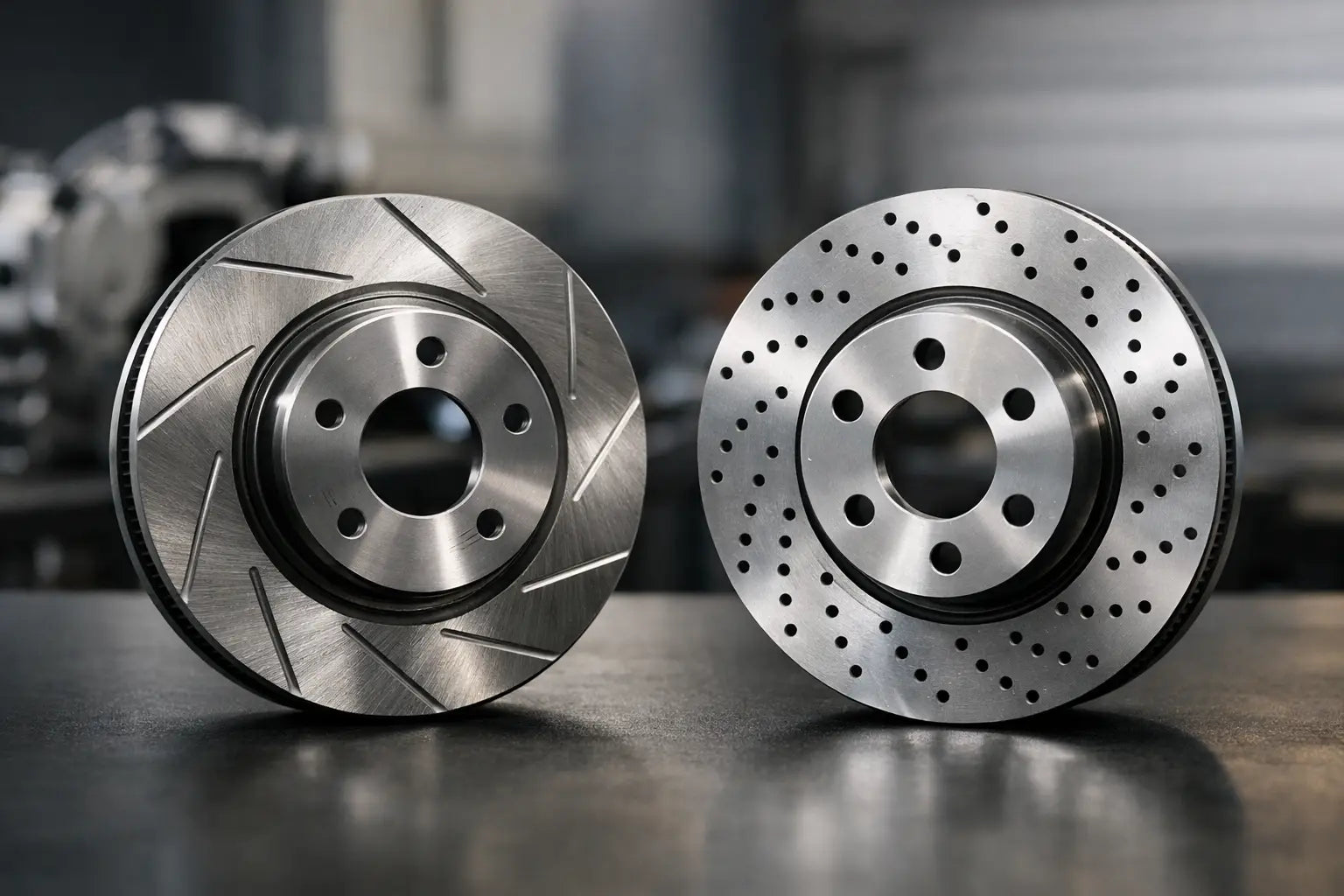
You feel it most at the end of a fast session - the pedal’s still there, but confidence starts to go soft. That is usually where the slotted vs drilled rotors debate stops being internet noise and starts becoming a proper buying decision. If you are upgrading brakes for a tuned road car, a weekend track build or a heavier fast-road setup, rotor design matters - but not always in the way people assume.
The short version is this: neither option is automatically better. The right choice depends on vehicle weight, pad compound, tyre grip, brake temperatures and how hard you actually use the car. A rotor that looks perfect behind a wheel can still be the wrong part for repeated hard stops.
Slotted vs drilled rotors: the real difference
Both designs change how the disc manages heat, gases, dust and pad contact, but they do it in different ways.
Slotted rotors use machined grooves across the friction surface. Those slots help clear pad material, dust and gases while continually refreshing the pad face. That usually gives a sharper initial bite and a more consistent feel under repeated braking. On a fast road car or track-day setup, that consistency is often the reason enthusiasts choose them.
Drilled rotors use holes through the friction surface. Originally, drilling had a stronger case when older pad compounds produced more gases under heavy heat. Modern pad materials do not rely on that in the same way, but drilled designs still offer some benefits. They can reduce unsprung mass slightly, help with water dispersion in wet conditions and deliver the look many owners want on a street-focused build.
Where things get more serious is durability. Any hole in a rotor creates a stress point. With quality cast or properly engineered drilled discs from reputable manufacturers, this is managed far better than with cheap or poorly made options. Even so, when temperatures climb and the car sees repeated hard use, drilled rotors are generally more vulnerable to cracking than slotted ones.
Why slotted rotors suit harder use
If your car sees mountain roads, repeated high-speed stops or regular circuit work, slotted rotors usually make more sense.
The big advantage is consistency. Slots keep the pad face cleaner and stop the friction surface glazing over as easily. That means more dependable bite lap after lap, especially when paired with the right performance pad. They also tend to cope better with aggressive compounds, which matters once you move beyond mild fast-road pads into something more track-focused.
There is a trade-off. Slotted discs typically wear pads faster than plain rotors, and sometimes a bit faster than drilled ones too. That is not a fault - it is part of how they maintain fresh pad contact. If you care more about outright braking repeatability than getting every last mile from a set of pads, it is usually a fair exchange.
Noise can increase as well. Some setups produce a light rasping sound under braking, especially with harder compounds. Most enthusiasts can live with that. If anything, it tends to feel like the system is doing a job rather than just looking the part.
Where drilled rotors make sense
Drilled rotors are not just a styling choice, even if looks are part of the appeal.
For a road-driven performance car that sees spirited use but not sustained track heat, drilled discs can work well. They often perform nicely in wet weather because the holes help clear surface water quickly, giving a cleaner first brake application in poor conditions. For daily-driven hot hatches, quick saloons and weekend cars that spend most of their life on public roads, that is a real-world benefit.
They can also offer a slightly lighter feel due to reduced material, though in practice this is rarely the deciding factor for most builds. The bigger issue is that they are usually less tolerant of repeated thermal abuse. A heavy BMW, Audi or fast estate doing hard laps on sticky tyres will expose that weakness much sooner than a light road car on occasional B-road runs.
If you want drilled rotors, buy quality. Proper metallurgy, casting and finishing make a huge difference. Cheap drilled discs are where the horror stories usually start.
Slotted vs drilled rotors for track days
For track use, the answer is usually slotted.
That does not mean every drilled rotor will fail the moment it sees a circuit, but sustained heat cycles are brutal. Heavy braking zones, short cool-down periods and grippier tyres all raise disc temperature and stress. Slotted rotors handle that environment better because they keep more structural integrity in the friction ring.
Track drivers also tend to run more aggressive pads. Those compounds generate more friction and more heat, and slotted discs are generally better matched to them. If your plan includes proper track pads, high-temp fluid and repeated hard sessions, drilled rotors become harder to recommend unless the manufacturer specifically engineered them for that use.
For mixed road-and-track builds, slotted rotors sit in the sweet spot. You get strong bite, better resistance to heat-related issues and fewer concerns about cracks starting around drill holes after repeated abuse.
What matters more than the hole or slot pattern
Rotor style gets plenty of attention, but it is only one part of the braking package.
Pad compound matters at least as much, often more. A premium pad on a plain or slotted disc will usually outperform a poor pad on an expensive drilled disc. Fluid matters too. If the pedal goes long because the fluid has overheated, rotor design is not your main problem. The same goes for cooling. Ducting, backing plates, wheel design and airflow can have a bigger effect on repeatability than people expect.
Vehicle use is the real filter. A 300 bhp front-wheel-drive hatch with occasional enthusiastic road driving has very different brake demands to a stripped Civic at track days or a heavy diesel saloon that tows and carries speed. Buy for the actual job, not the most aggressive-looking option.
Common myths that confuse buyers
One of the oldest myths is that drilled rotors are always higher performance because they appear on exotic cars. In reality, OE choices are shaped by noise, comfort, cost, weight, wet-weather manners and styling as much as outright abuse tolerance. What works on a premium road car is not always ideal for a modified track toy.
Another myth is that slots make a rotor run dramatically cooler. They can help manage the braking surface and maintain consistency, but they are not magic. Rotor mass, internal vane design and airflow do far more for heat management.
There is also a tendency to assume any crack on a drilled rotor means immediate disaster. Small heat-check marks can appear on hard-used discs, but visible cracking that links holes or spreads across the friction face is a clear sign the rotor is done. Inspection matters, especially if the car is used hard.
Which rotor should you buy?
If your car is mainly road-driven, you want a sharper look behind the wheels and your braking use is spirited rather than extreme, drilled rotors can be a solid choice - provided you stick with a reputable brand.
If your build is aimed at fast-road driving, repeated hard stops, mountain passes or regular track days, slotted rotors are usually the smarter buy. They are more consistent under heat, better suited to performance pads and less likely to become a durability headache once you start pushing properly.
If you are still undecided, think about how honest your use case really is. Many owners buy as if every Sunday drive is a qualifying lap. In practice, the best setup is the one matched to your car, your pad choice and the temperatures you will actually generate.
That is why serious brake upgrades should be chosen as a package, not as a cosmetic add-on. Rotor pattern matters, but the right answer is the one that keeps the pedal firm, the braking stable and your confidence intact when the speed rises.