
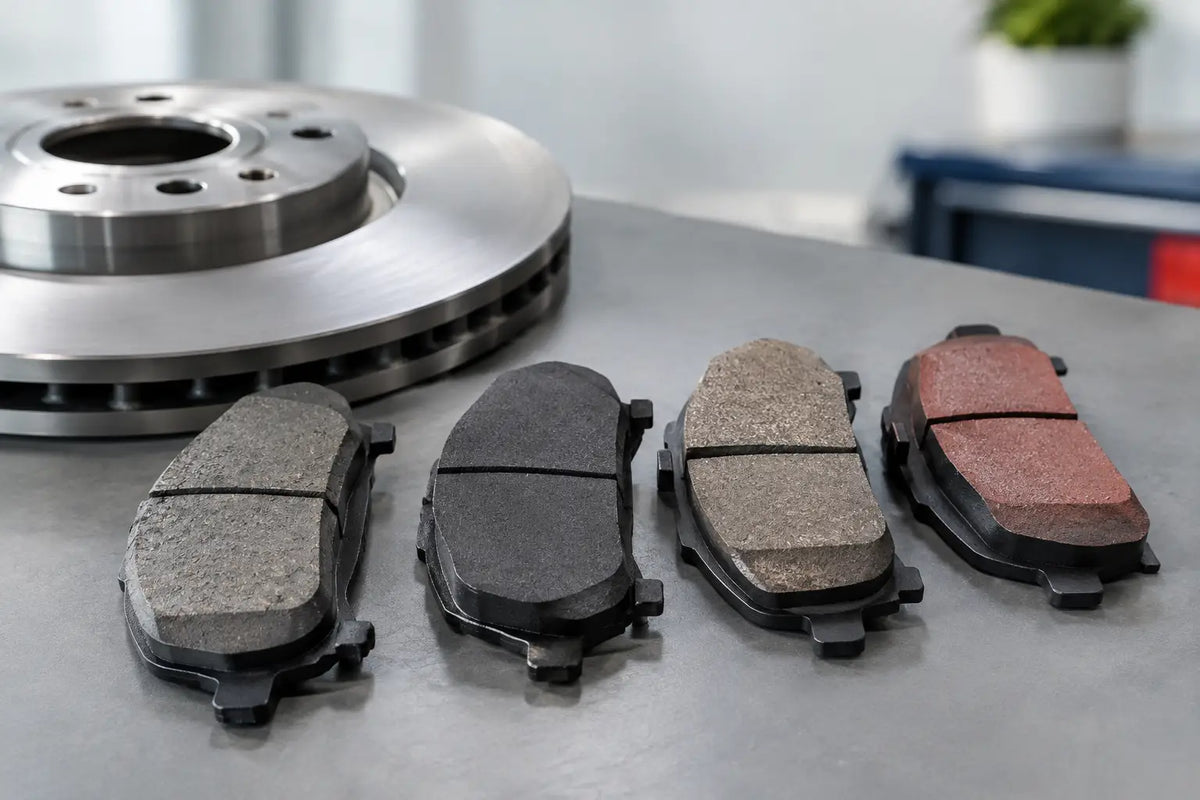
A brake pad can look like a simple service item until the first hard stop from motorway speed, a steep downhill section, or a late-braking lap exposes the difference. Understanding what brake pad compound means is how you avoid fitting pads that feel wooden on the road, fade after a few laps, or turn your wheels black every other day.
The compound is not a marketing footnote. It is the friction material bonded to the pad’s backing plate, and it has a major say in pedal response, operating temperature, fade resistance, noise, dust and disc wear. The right choice depends on how you use the car, not just how much power it makes.
What brake pad compound means in practice
A brake pad compound is a controlled blend of materials designed to create friction against the brake disc. Depending on the pad, that blend can include fibres, resins, abrasives, metallic particles, lubricants and ceramic materials. Manufacturers tune the recipe to give a particular friction level and a usable temperature range.
When you press the pedal, the pad converts the car’s kinetic energy into heat. A good compound maintains predictable friction as that heat builds. A poor match may work acceptably on a short commute, then lose bite when pushed. That loss of performance is commonly called brake fade, though it is worth separating pad fade from overheated fluid or other brake-system issues.
Compound also shapes how the brake pedal feels. Some pads give a sharp initial bite with light pedal pressure. Others need more pressure but are easier to modulate at the limit. Neither is automatically better. A fast-road BMW, a turbo Honda used for track days and a stripped-out sprint car do not need the same response from the pedal.
The trade-offs behind brake pad materials
There is no universal best pad compound. More friction and more temperature capacity often bring compromises in noise, dust, rotor wear and cold performance. That is why a full race pad can be a poor upgrade for a daily-driven car, even if its headline specifications look impressive.
Organic and non-asbestos organic pads
Organic or non-asbestos organic compounds usually prioritise quiet operation, low disc wear and decent cold response. They can suit normal road use, lighter vehicles and drivers who value refinement. Their weakness is heat capacity. Repeated hard stops can overwhelm them quickly, especially on a heavier car, a modified turbo car or a vehicle running sticky tyres.
For a standard daily driver, that can be a sensible compromise. For anyone regularly attacking B-roads, carrying extra power or booking track time, it is often the first limitation in the brake package.
Semi-metallic and low-metallic compounds
Semi-metallic pads use a higher proportion of metal content. They generally handle heat better than organic compounds and provide a firmer, more consistent response when driven hard. They are a familiar choice for fast-road use because they offer a useful middle ground between daily usability and spirited performance.
The cost is usually more dust, more potential noise and, in some cases, increased disc wear. Low-metallic formulations aim to retain much of that heat capability while refining noise and feel, but the exact behaviour varies hugely from one manufacturer’s recipe to another. Do not assume every pad labelled semi-metallic will perform alike.
Ceramic compounds
Ceramic pads are often associated with clean wheels and quiet braking. Many are excellent for premium road cars where comfort, low dust and stable everyday performance matter. They can be an attractive option for a clean OEM-plus build, particularly if the car sees commuting and longer road trips rather than repeated high-energy stops.
Ceramic does not automatically mean track-ready. Some ceramic road compounds lack the high-temperature resilience required for proper circuit work. Equally, certain performance ceramic formulations are far more capable. Check the specific product’s stated use and operating range rather than buying the category name.
Track and race compounds
Track-focused pads are designed to work when disc temperatures rise well beyond normal road levels. They tend to resist fade, offer strong repeatable friction and give the driver a more dependable pedal across a session. That consistency matters when braking points get later and speeds build lap after lap.
The compromises are real. Many race compounds need heat before they feel their best, can squeal at low speed, generate aggressive dust and wear discs faster. On a cold wet morning, a pad built around a high operating window may feel less reassuring than a quality fast-road option. A dedicated track car can live with that. A daily car usually cannot.
Choose for the car’s actual job
A lightly modified Volkswagen GTI that covers commuting, weekend blasts and the occasional spirited road trip normally benefits most from a fast-road compound. You want confident cold bite, good wet-weather behaviour and enough thermal headroom for repeated hard stops without accepting race-car noise every time you pull up at the lights.
For a heavier Audi, BMW or SUV with extra power, brake demand rises quickly. Kerb weight, tyre grip and speed all increase the energy the brakes must manage. A higher-capacity fast-road pad, better fluid and quality discs may be a smarter package than jumping straight to an extreme pad compound.
If the car sees regular track days, select around session length, vehicle weight, circuit speed and driver pace. A low-power lightweight hatchback on a tight circuit may be fine with a strong track-day compound. A powerful, heavy car on a fast circuit may need a more serious pad, uprated fluid, improved cooling and possibly larger brakes to remain consistent.
For competition use, pad selection becomes more specific still. Sprint, hillclimb, endurance and drifting each create different temperature patterns and demands. Endurance drivers may favour control, longevity and disc life over the initial bite a short-session sprint driver wants.
Brake pad compound is only one part of the system
Fitting an aggressive compound will not fix tired discs, boiling fluid, seized caliper sliders or old rubber hoses. Nor will it overcome tyres that cannot put braking force into the road. Braking performance is a system, and the pad needs to work with the disc, caliper, fluid, cooling and tyre setup.
Disc choice matters particularly with high-friction compounds. Most quality pads are designed for iron or steel brake discs, but some are more abrasive than others. A pad that delivers brilliant stopping consistency may consume discs faster, which is an acceptable trade-off for a track build but unnecessary expense on a road car.
Bedding-in matters too. New pads and discs need a controlled heat cycle to establish an even transfer layer on the disc face. Skipping that process can create uneven deposits, vibration and inconsistent feel that people mistakenly blame on the pad itself. Follow the bedding procedure supplied for the exact compound, then allow the brakes to cool properly.
What to check before buying
Product descriptions should tell you more than whether a pad fits your caliper. Look for the intended use, operating temperature range, cold performance and whether the compound is road legal for your market. If a manufacturer publishes a friction coefficient, treat it as one data point rather than the entire story. A high figure does not guarantee better modulation, lower fade or suitability for cold road use.
Also check whether front and rear compounds should be matched. In many builds, the front axle does most of the work and receives the upgrade first. However, radically changing rear friction can affect brake balance and stability. Use proven vehicle-specific combinations where possible, particularly on cars with electronic stability systems.
Finally, be honest about the noise and dust you will tolerate. A pad that survives a demanding circuit session but squeals through every town centre may make perfect sense on a weekend track car. It may be a miserable choice on the car you drive to work six days a week.
The strongest brake upgrade is rarely the most aggressive pad on the shelf. It is the compound that reaches its working range in your driving, remains consistent when you ask more of it, and fits the rest of your build without creating a new weak point. Build the system around the job, and every press of the pedal will make more sense.