
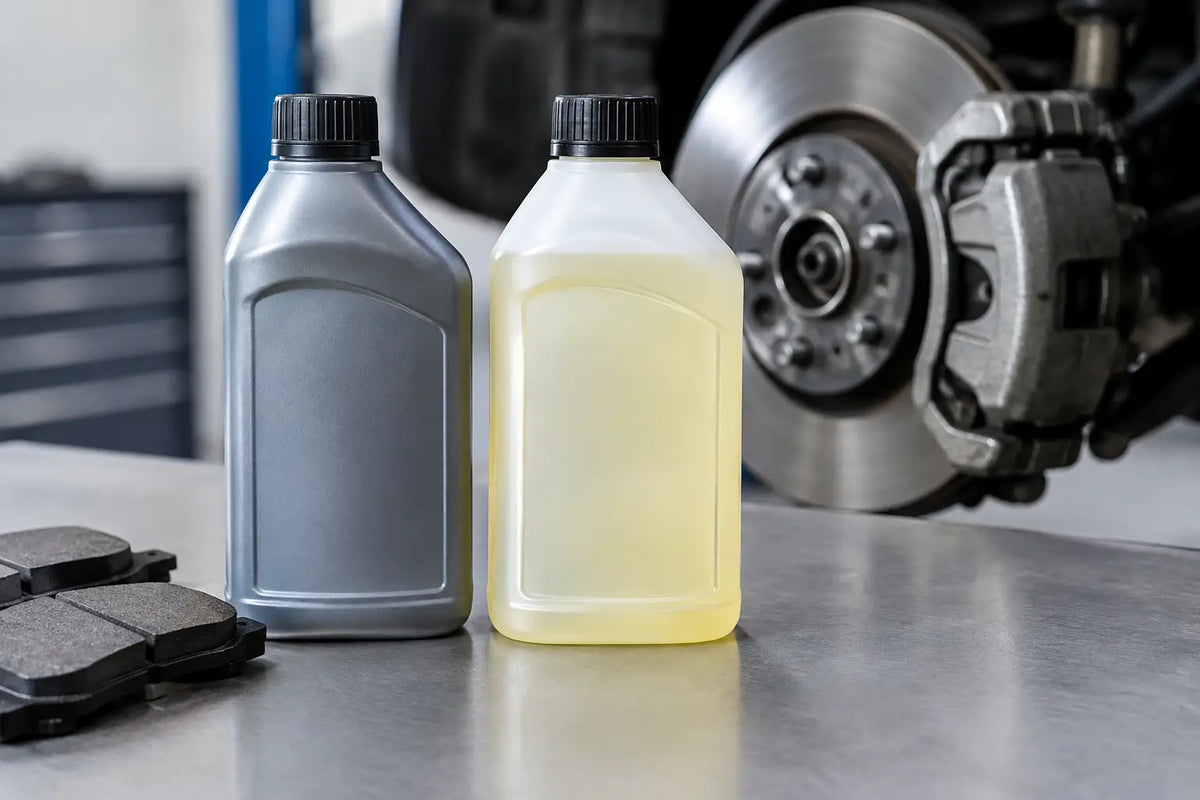
A soft pedal at the end of a hard downhill section is not the moment to find out that the bottle in your garage was the wrong choice. The dot 4 vs dot 5 debate is often reduced to a number on a cap, but these fluids have very different chemistry, compatibility rules and real-world uses. Pick the wrong one and you can create a costly braking-system problem. Pick the right one and your pedal stays consistent when the brakes are working hardest.
For most modified road cars, track-day builds and modern performance platforms, DOT 4 is the sensible starting point. DOT 5 has a valid place too, but it is primarily a specialist fluid for certain classic, stored or military-style applications - not an automatic upgrade.
DOT 4 vs DOT 5: the key difference
DOT 4 is a glycol ether-based brake fluid. It is hygroscopic, meaning it absorbs moisture from the atmosphere over time. That sounds like a weakness, but it is a known and manageable characteristic: moisture is distributed through the fluid rather than collecting in pockets, and regular fluid changes keep performance where it needs to be.
DOT 5 is silicone-based. It does not absorb water, it is generally kinder to paintwork, and it can be useful where a vehicle sits for long periods. But water that enters a DOT 5 system can settle in low points such as calipers or wheel cylinders. That creates a corrosion risk and, in freezing conditions, potential issues at exactly the places you do not want them.
Most importantly, DOT 4 and DOT 5 are not compatible. Do not mix them. Do not use DOT 5 as a top-up in a DOT 4 system. Converting a car from glycol fluid to silicone fluid means a full strip-down, cleaning and replacement of compromised seals or components where necessary. A quick flush is not enough.
DOT 5.1 is not the same as DOT 5
This is where plenty of otherwise careful enthusiasts get caught out. DOT 5.1 is glycol-based, despite its similar name. It is compatible with DOT 3, DOT 4 and other DOT 5.1 glycol fluids, subject to the vehicle manufacturer’s requirement. DOT 5 is silicone-based and sits in a separate category.
DOT 5.1 is often chosen for modern cars that need high boiling performance with a lower viscosity specification, particularly systems with fast-acting ABS and stability control hardware. If you drive a late-model BMW, Honda, Volkswagen, Audi or Toyota, check the handbook and reservoir cap before selecting fluid. The correct specification always wins over a higher number on the label.
Boiling point matters when you brake hard
Brake fluid lives close to serious heat. Heavy road use, repeated mountain descents, towing, spirited B-road driving and track sessions transfer heat from pads and discs through the caliper into the fluid. Once fluid boils, vapour forms. Vapour compresses; brake fluid should not. The result is a long, soft pedal or, in the worst case, dramatically reduced braking force.
Fluid specifications refer to dry and wet boiling points. Dry boiling point is measured with fresh fluid. Wet boiling point reflects fluid after it has absorbed a defined amount of moisture, which is far closer to the reality of a car that has been driven through a British winter and missed a service interval.
A basic DOT 4 meets a minimum dry boiling point of 230°C and wet boiling point of 155°C. Quality performance DOT 4 fluids can go considerably higher, especially on dry boiling point. That is why a high-temperature DOT 4 is commonly the right call for track-day cars: it offers the thermal headroom hard braking demands while retaining compatibility with the vast majority of modern hydraulic systems.
DOT 5 has a high minimum dry boiling point too, but that alone does not make it the better track fluid. Pedal feel, moisture behaviour, ABS compatibility and serviceability matter just as much. A serious circuit build is usually better served by a reputable high-performance DOT 4, changed at sensible intervals, than a silicone conversion based on a headline number.
When DOT 4 is the right choice
DOT 4 is the default for the overwhelming majority of performance road cars and modified builds. It is compatible with the factory systems fitted to most European and Japanese platforms, widely available, and offered in formulations ranging from dependable OE-level fluid to genuine motorsport-grade products.
For a fast road car, use a quality DOT 4 that meets or exceeds the manufacturer’s specification and replace it regularly. If the car sees track work, choose a fluid with strong dry and wet boiling-point figures, then match your maintenance schedule to how hard the car is used. A car doing several track days a year should not be treated like a commuter that only sees motorway miles.
Pedal feel is also a practical reason to stay with DOT 4. Silicone fluids can retain tiny air bubbles more readily, which may make bleeding more difficult and can contribute to a less positive pedal. On a car with braided lines, performance pads, bigger brakes and sticky tyres, there is little point chasing every other improvement only to compromise consistency at the pedal.
When DOT 5 makes sense
DOT 5 can be a good fit for a carefully restored classic, a show vehicle or a machine that spends long periods parked. Its resistance to paint damage is attractive during restoration work, and its low moisture absorption can suit an application where preserving a freshly rebuilt hydraulic system is the priority.
That does not mean it is maintenance-free. Water can still enter through hoses, seals, reservoir vents and poor workshop practice. Because DOT 5 does not absorb it, inspections remain essential. It is also not generally recommended for vehicles with ABS unless the manufacturer explicitly specifies it. ABS valves cycle fluid rapidly and need predictable viscosity and bubble control; silicone fluid is not the casual alternative for these systems.
If you are restoring an older vehicle and considering DOT 5, make the decision before assembly. Build the entire system around it, use compatible components and keep the fluid completely separate from your glycol-fluid tools and containers.
Compatibility: treat the reservoir cap as the rulebook
Brake fluid is not an area for assumptions, internet folklore or mixing what happens to be on the shelf. Start with the owner’s manual, workshop information and the marking on the reservoir cap. Some vehicles require a specific low-viscosity DOT 4 or DOT 5.1 fluid for their electronic braking systems. Others specify conventional DOT 4. Follow that requirement first.
In simple terms, DOT 3, DOT 4 and DOT 5.1 are glycol-based and are broadly mixable in an emergency, though mixing reduces the overall fluid to the performance level of the weakest product. That is a temporary solution, not a tuning strategy. DOT 5 must never be mixed with any of them.
Also avoid judging fluid condition by colour alone. Fluid can look reasonably clean and still have absorbed enough moisture to lower its wet boiling point. A proper brake-fluid tester can help, but time-based changes remain the dependable approach. For an enthusiast car, a biennial flush is a sensible baseline. For regular track use, annual changes or more frequent servicing may be appropriate depending on temperature, session length and fluid choice.
Build the brake system, not just the shopping basket
Brake fluid is one part of a package. If you are getting fade, inspect pad compound, disc condition, cooling, caliper health and hose condition as well as fluid. A high-boiling-point DOT 4 will not cure glazed pads or a sticking caliper, and fresh fluid will not compensate for tyres that cannot support the braking load.
For most Torque Lab customers building a capable road-and-track car, the direction is clear: choose a proven performance DOT 4 that matches the vehicle specification, flush the system properly and service it before the pedal tells you it is overdue. Save DOT 5 for the specialist classic application it was designed to serve - and keep the two fluids well away from each other.
The best brake-fluid choice is rarely the bottle with the biggest number. It is the one that suits your car’s hydraulic system, your braking temperatures and the way you actually use the car.