
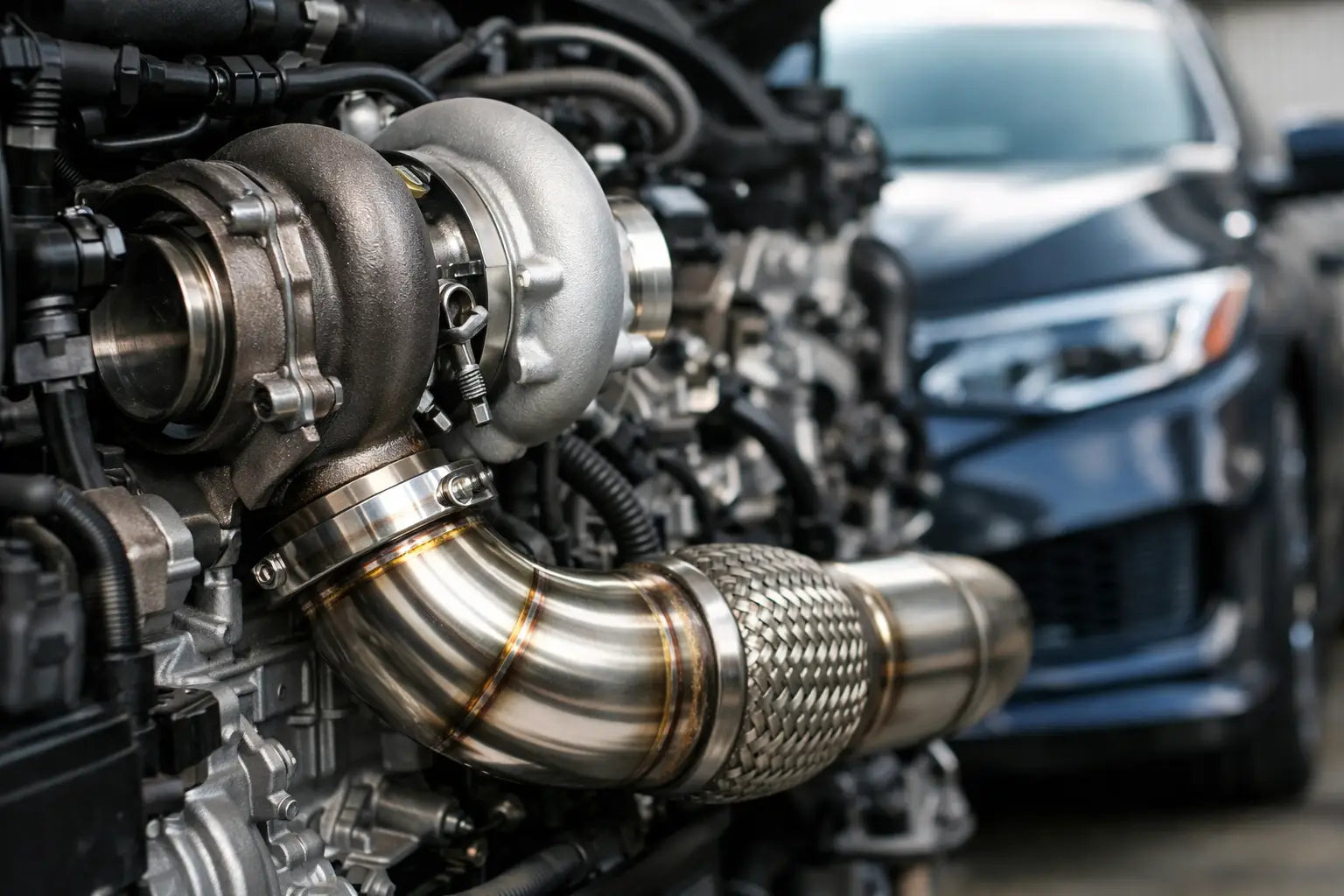
Ask any turbo car owner where the exhaust starts to matter, and the answer usually comes fast: right after the turbo. That is exactly why people ask, what does a downpipe do? On a modern performance build, the downpipe is one of the first exhaust sections after the turbocharger, and it has a direct effect on how efficiently the engine can push exhaust gases out. That matters for spool, power, sound, and how the car responds under load.
A downpipe is not some magic bolt-on that transforms every car overnight. But on the right platform, especially a turbocharged one, it can remove a major restriction in the exhaust path. That is why it shows up so often on tuning roadmaps for VW GTI, Audi S and RS models, BMW turbo platforms, Toyota GR cars, and plenty of boosted Hondas and Subarus.
What does a downpipe do?
In simple terms, a downpipe routes exhaust gases away from the turbocharger and into the rest of the exhaust system. Factory downpipes often include tight bends, smaller pipe diameters, and restrictive catalytic converters designed to balance emissions, noise, packaging, and production cost. That setup works fine for stock power levels, but it can become a bottleneck once you start asking more from the engine.
An aftermarket downpipe is designed to improve exhaust flow. By reducing backpressure after the turbo, it helps the turbine move exhaust gases more efficiently. On a turbo car, that can lead to quicker spool, stronger midrange, and improved top-end performance. The exact gain depends on the engine, turbo size, tune, and the rest of the setup.
If your car is naturally aspirated, the conversation changes. Some non-turbo cars still have a front pipe section that people casually call a downpipe, but the biggest performance impact is usually seen on turbocharged applications.
Why the downpipe matters on turbo setups
Turbo systems live and die by airflow. The turbocharger is driven by exhaust energy, so anything that slows down exhaust leaving the turbine creates resistance. More resistance means the turbo has to work harder to achieve the same result.
A freer-flowing downpipe reduces that resistance. The turbo can shed exhaust gas faster, which improves efficiency. In real-world terms, that usually means the car feels less choked up as boost builds. Throttle response can sharpen, the powerband can feel more eager, and the engine may pull harder through the midrange where street and track drivers spend a lot of time.
This is also why a downpipe is so often paired with ECU tuning. The hardware improves flow, but the calibration is what lets the engine fully take advantage of it. On many platforms, a tune is not just recommended after a downpipe upgrade - it is the difference between a part that works and a setup that works properly.
How a downpipe affects power
Most enthusiasts are really asking one thing: does it make more power? Usually, yes, if the car is turbocharged and tuned to suit.
The biggest gains tend to come on boosted engines that leave the factory with very restrictive catalytic converters or smaller-diameter tubing. A better-flowing downpipe can help lower exhaust backpressure and improve turbo efficiency, which creates more headroom for boost and timing adjustments in the tune.
That said, results vary. A Stage 2-style setup on a common turbo platform might show a noticeable increase in horsepower and torque, while another platform may show more modest gains unless the rest of the exhaust and intake side are upgraded too. If the turbo itself is small or the factory setup is already decent, the improvement may be more about response than headline dyno numbers.
The honest answer is that a downpipe supports power rather than creating it in isolation. Think of it as removing a restriction so the engine and turbo can do their job with less effort.
What does a downpipe do for sound?
It usually makes the car louder, sharper, and more aggressive. How much louder depends on the design of the downpipe, whether it uses a catalytic converter, and what cat-back exhaust is already on the car.
A catless downpipe will generally produce the biggest change. Expect more turbo whistle, more crackle on overrun if the tune allows it, and a rawer exhaust note overall. A high-flow catted downpipe still changes the sound, but it is usually a bit more controlled and less harsh.
For some builds, that is exactly the goal. For others, especially daily drivers, too much volume or drone gets old fast. A setup that sounds great on a quick pull can become annoying on the highway. This is one of those upgrades where your use case matters just as much as the part itself.
Catted vs catless downpipes
This is where the trade-offs get real.
A catted downpipe uses a high-flow catalytic converter to improve exhaust flow while still offering some emissions control. For many enthusiasts, it is the best middle ground. You typically get stronger performance, a more aggressive sound, and fewer downsides in terms of smell and overall street manners.
A catless downpipe removes the catalytic converter entirely. That usually maximizes flow, but it also increases exhaust odor, raises emissions concerns, and often makes the car significantly louder. On many street-driven vehicles, it can also trigger check engine lights and create inspection or registration issues depending on local laws.
From a pure performance angle, catless often flows best. From a real-world ownership angle, high-flow catted setups are usually easier to live with. If the car sees regular street miles, that matters.
Tuning, check engine lights, and drivability
A downpipe is not a random bolt-on you install and forget about. On many modern turbo cars, changing the downpipe alters how the engine management system sees exhaust flow and catalyst efficiency. That can trigger a fault code or check engine light.
More importantly, the ECU may not be optimized for the new flow characteristics without recalibration. A proper tune can adjust boost targets, fueling, ignition, and other parameters to match the upgraded hardware. That is where the full benefit usually shows up.
Without tuning, some cars will still run, but you may leave performance on the table or deal with inconsistent behavior. If you are planning the upgrade seriously, budget for the software side too.
Is a downpipe worth it?
If you own a turbocharged performance car and want more from the factory setup, a downpipe is often one of the highest-impact exhaust upgrades you can make. It tends to make the most sense for drivers building around tune-based power gains, quicker spool, and a more aggressive sound.
If your priorities are subtlety, emissions compliance, and OEM-level quietness, it may not be the right first move. In that case, intake, intercooler, suspension, or brake upgrades might deliver a better overall result for how you use the car.
It also depends on the build path. A downpipe makes more sense when it is part of a package, not just a single part installed because the internet said it adds power. Matching it with the right tune, fuel quality, and supporting hardware is what turns it into a smart upgrade instead of a noisy compromise.
What to look for when buying a downpipe
Fitment comes first. A quality downpipe should be built specifically for your platform, engine, and turbo configuration. Small differences in chassis layout, oxygen sensor placement, transmission type, and emissions equipment can matter more than people think.
Material and construction matter too. Stainless steel is common for a reason - it holds up well to heat and corrosion. Clean welds, proper flanges, and accurate sensor bungs save headaches during install. Brand reputation matters here because poor fitment can turn a simple upgrade into a frustrating one.
It is also worth thinking about your actual goals. If the car is a daily, a high-flow catted option is often the smarter call. If it is a dedicated track build in a place where regulations allow it, your decision may look different. Torque Lab customers usually know that the best parts are not just about peak numbers - they are about choosing components that suit the platform and the way the car is driven.
What does a downpipe do compared to a cat-back?
A cat-back changes the exhaust system after the catalytic converter or downpipe section. It mostly affects sound, with some performance gains depending on the setup. A downpipe, especially on a turbo car, usually has a bigger effect on flow and performance because it deals with exhaust restriction much closer to the turbo.
That is why a cat-back alone may make the car sound faster, while a downpipe and tune combination is more likely to make it actually feel faster. Ideally, the two work together, but if you are choosing based on performance per upgrade, the downpipe often carries more weight on turbo applications.
The smartest builds are usually the ones with a clear plan. If you are chasing usable gains, not just noise, a properly matched downpipe is one of the parts that can change how the whole car comes alive under boost.