
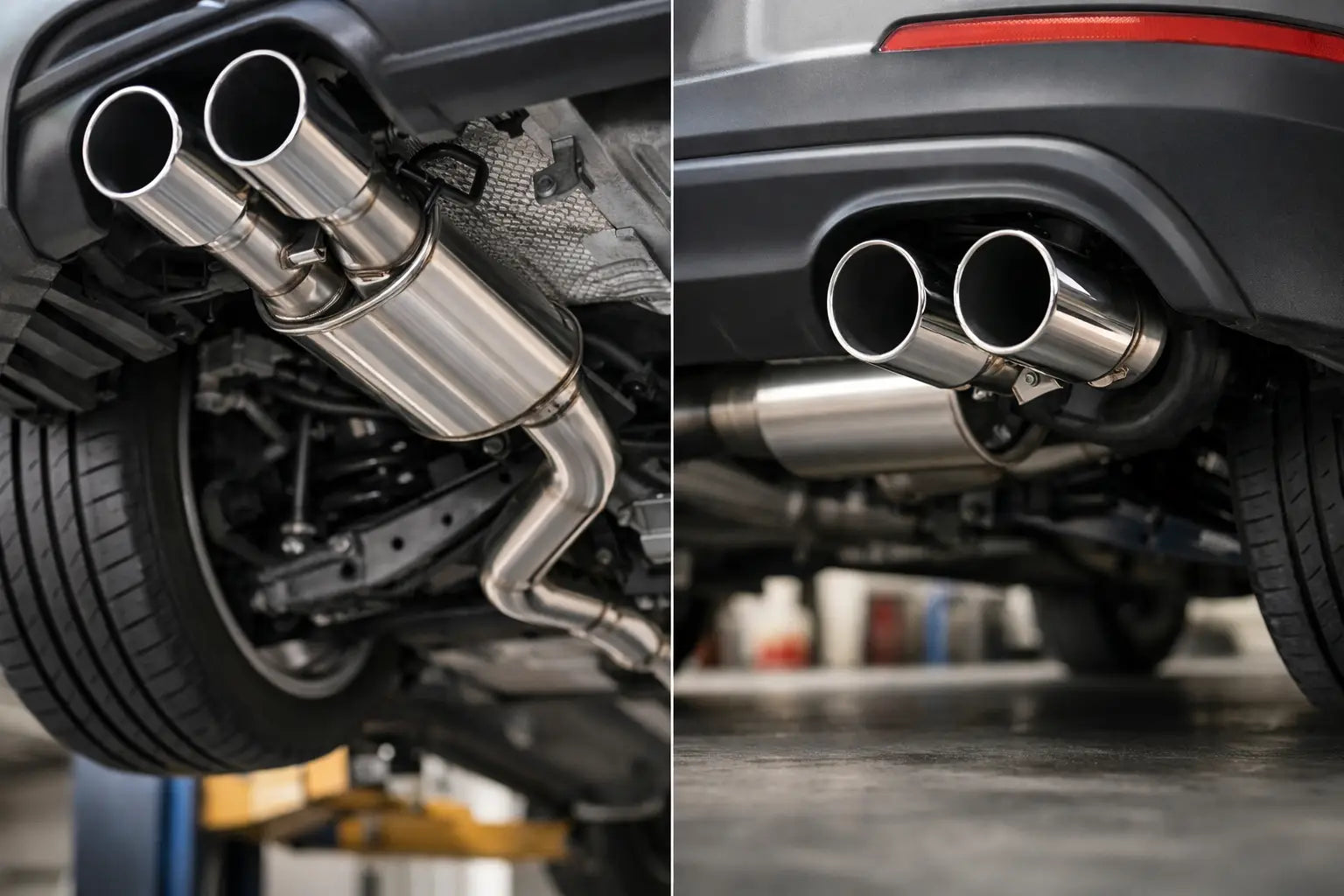
You hear it the first time a car rolls out of the paddock or leaves a stoplight with the right exhaust note - sharper throttle response, cleaner tone, less factory muffling. That is usually where the catback vs axle back exhaust decision starts. Not with dyno charts, but with a simple question: do you want a mild change, or do you want to reshape the whole character of the car?
For most enthusiasts, this is not just about volume. It is about where the system changes, how much restriction you remove, what the cabin sounds like on the highway, and whether the upgrade matches the rest of the build. A daily-driven GTI, a weekend BRZ, and a track-prepped Civic Type R do not need the same answer.
Catback vs axle back exhaust: the real difference
An axle-back exhaust replaces the section behind the rear axle. In most applications, that means the rear muffler or mufflers, the tips, and sometimes short connecting pipes. It is the simpler change, usually the cheaper one, and usually the one people buy when they want a more aggressive rear-end look and a noticeable sound increase without reworking the full system.
A cat-back exhaust replaces everything from the back of the catalytic converter to the tips. That usually includes the mid-pipe, resonator section, mufflers, and tips. Because it swaps a lot more pipework, it has a bigger effect on exhaust flow, tone, overall volume, and weight.
That difference matters because the muffler is only part of the story. Mid-pipe diameter, resonators, bends, and merge design all shape how the car sounds and how efficiently it moves exhaust gas. If you are deciding between catback vs axle back exhaust, you are really deciding how far downstream you want to change the system.
When an axle-back makes more sense
Axle-back setups are ideal for owners who like their car mostly as it is but want more personality. If the stock system already flows reasonably well, an axle-back can deliver the exact kind of upgrade many street cars need - more sound, better tips, and minimal hassle.
This route works especially well on newer turbo platforms where the factory system is not always as restrictive at the rear as people assume. On some applications, the biggest bottlenecks sit farther forward, so swapping only the rear section gives you the sound upgrade you want without spending cat-back money for modest extra gains.
It is also the better fit if you are trying to keep cabin comfort in check. A well-designed axle-back can add bark on throttle while staying livable during commuting. That matters if the car sees long freeway miles, early morning starts, or passengers who do not share your enthusiasm for cold-start theatrics.
The trade-off is simple. You are not changing enough of the system to expect major performance gains. Some cars respond well to the improved rear section, but most axle-back gains are modest. If your priority is flow, not just tone, axle-back is usually not the endgame.
When a cat-back is the smarter buy
A cat-back is the more complete upgrade. If you want a noticeable shift in sound character, lower backpressure, and a better foundation for future mods, this is usually where you should be looking.
Turbo cars benefit from this more than many naturally aspirated setups, especially once tuning, intake upgrades, or downpipe changes enter the picture. The more you ask the engine and turbo to do, the more the full system matters. A quality cat-back helps support that package by improving flow after the catalytic section and reducing some of the compromises built into the factory exhaust.
On naturally aspirated cars, the gains can vary more by platform. Some engines respond well to a full cat-back with stronger top-end breathing and a cleaner, more motorsport-style note. Others gain less power than owners expect, but still improve in throttle feel, weight, and tone. That is why platform-specific fitment and proven brand engineering matter. Pipe diameter that looks impressive on paper can hurt drivability if it is oversized for the setup.
A cat-back also gives you more control over the final sound. Resonated and non-resonated options, valved mufflers, straight-through designs, and dual-mode layouts let you choose between street-friendly and track-biased behavior. If you care about dialing in the result instead of just getting louder, cat-back gives you more room to do it properly.
Sound is where most buyers get it wrong
A louder exhaust is not automatically a better exhaust. The real target is usable sound.
Axle-back systems often increase volume at the rear and sharpen the car at idle and part throttle, but they can leave some of the factory character intact because the center section stays unchanged. That can be exactly what you want on a daily. It can also leave you feeling like the car is only halfway upgraded.
Cat-back systems tend to create a fuller change. They can deepen the tone, reduce some of the stock rasp, or on certain applications introduce more of it if the setup is non-resonated. They also have more potential to create drone if the manufacturer gets the resonator and muffler balance wrong.
This is where experienced enthusiasts start looking past marketing words. “Aggressive” means nothing by itself. You want to know whether a system drones at 2,500 rpm, whether it booms in the cabin under load, and whether it gets raspy with a downpipe or headers later. The best exhaust is the one that still sounds right after the rest of the build catches up.
Performance gains: real, but not equal
If you are chasing every last horsepower, cat-back usually wins. It replaces more restrictive factory sections, often uses smoother mandrel bends, and typically increases pipe diameter through the full rear half of the system. On tuned turbo cars, that can be part of a worthwhile package.
Axle-back systems can still help, but their gains are usually secondary to the sound and styling change. In many cases, any power increase is small enough that you would not choose axle-back for performance alone.
That does not make axle-back a bad buy. It just means you should be honest about your goal. If you want more emotion every time you start the car, axle-back can nail it. If you are building around intake, intercooler, tuning, and future exhaust changes, cat-back makes more strategic sense.
Cost, installation, and long-term value
Axle-back is easier on the budget. It uses fewer components, usually installs faster, and is often the lower-risk move for someone testing how far they want to go with noise and modification. If this is your first exhaust upgrade, axle-back keeps things simple.
Cat-back costs more up front, but it can be the better value if you already know the car is getting further mods. Buying an axle-back now and replacing it with a full cat-back later usually costs more in the long run than doing the full system once.
Installation depends on the chassis, but axle-back is generally more straightforward. Cat-back takes more time, more hardware, and sometimes more adjustment to get tip alignment right and avoid clearance issues. None of that is unusual, but it is worth factoring in if you are doing the install at home.
Material also affects value. T304 stainless is the enthusiast favorite for corrosion resistance and long-term finish. Lower-grade stainless can still work, but if the car lives in harsh weather or sees year-round use, material quality matters fast.
Which setup fits your build?
If your car is a daily driver and your main goal is stronger sound without turning every commute into a highway drone test, axle-back is often the right answer. It gives you the visual and acoustic upgrade with less cost and less commitment.
If the car is already moving beyond basic bolt-ons, cat-back usually fits better. It supports future changes, gives you a more complete tonal shift, and makes more sense for track day cars or serious street builds where the factory exhaust is clearly holding the package back.
There is also a middle ground. Some owners start with axle-back because they want to keep things calm, then step into a cat-back once they add a downpipe, tune, or other supporting mods. Others know from day one that they want a full system from a proven brand and would rather skip the halfway step. Neither path is wrong.
What matters is matching the exhaust to the car’s actual use. A street-driven M240i, a canyon-focused GR86, and a time attack Evo all have different priorities. Sound, flow, comfort, emissions compatibility, and future plans should all be on the table.
That is the right way to think about catback vs axle back exhaust. Not as a universal winner, but as a fitment and goals decision. Buy for the build you are creating, not the comment section. If you choose the system that matches how the car is driven now and where it is headed next, you will only install it once - and you will enjoy it every time you turn the key.