
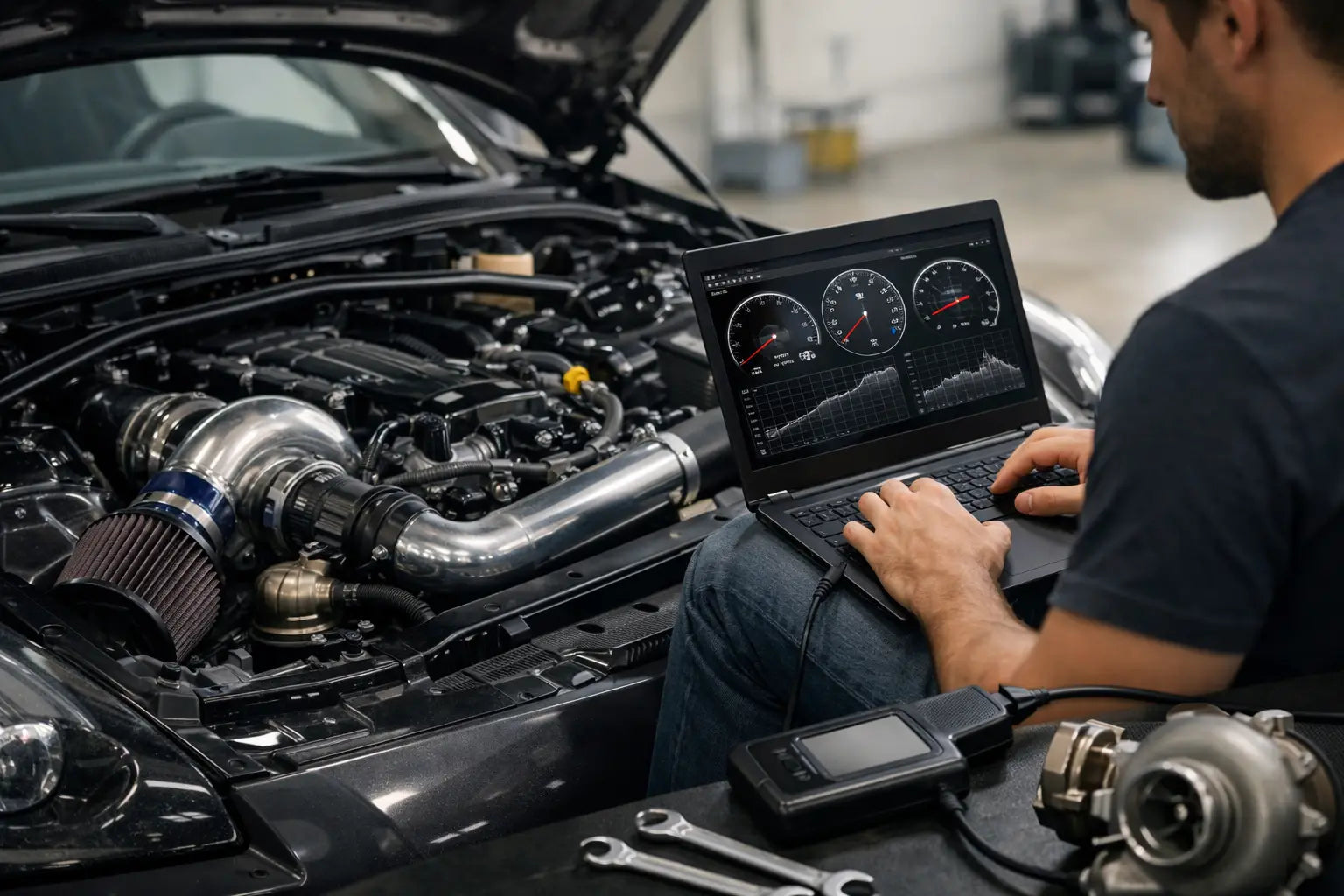
You feel it all the time in the aftermarket - someone adds an intake, cat-back, or downpipe, then asks the same question: do I actually need a tune? With ecu tuning for bolt ons, the real answer is not yes for every part and not no for every car. It depends on what you changed, how smart the factory calibration is, and whether you want the car to simply run or actually run right.
That distinction matters. A modern ECU can often adapt around small changes. But adaptation is not the same thing as optimization. If you are building a car with clear goals - sharper response, stronger midrange, cleaner power delivery, or safer fueling under load - the calibration becomes part of the hardware package, not an optional extra.
What ECU tuning for bolt ons actually changes
A bolt-on part changes airflow, temperature, pressure, or restriction somewhere in the system. The ECU's job is to interpret those changes and control fueling, ignition timing, boost, throttle behavior, cam timing, torque targets, and a long list of limiters and compensations. When you install parts that let the engine move more air, the stock tune may leave power on the table or respond in ways that feel inconsistent.
That is why ECU tuning for bolt ons is rarely about peak dyno numbers alone. On a street car or track-day build, the gains often show up in the places you notice most - better throttle response, smoother torque delivery, improved part-throttle behavior, and fewer flat spots after adding intake or exhaust hardware. A good tune also helps the car make sense of the parts you just paid for.
The biggest misconception is that every bolt-on part automatically needs tuning. A panel filter or axle-back exhaust usually will not demand immediate recalibration. A high-flow downpipe on a turbo car is a different story. So is larger fueling hardware, a bigger intercooler setup with altered boost behavior, or an intake that changes how the MAF sensor reads airflow. The farther you move from stock airflow and emissions behavior, the more important the tune becomes.
Which bolt-ons usually need a tune
The short version is simple: the more a part changes measured airflow or turbo efficiency, the more likely tuning is required.
On naturally aspirated cars, intakes, headers, and full exhaust systems often benefit from tuning, but the gains can vary a lot by platform. Some factory ECUs are conservative and responsive to calibration changes. Others are already close to optimized for stock cams, compression, and fuel quality, so bolt-ons alone produce modest results. In those cases, the tune can improve the way the car drives more than the headline power figure.
On turbo cars, the equation changes fast. A freer-flowing intake, inlet, intercooler, charge piping, and especially a downpipe can alter boost control and airflow enough that the stock calibration no longer makes the best use of the setup. Sometimes the car will still run acceptably. That does not mean it is calibrated correctly. You may see boost overshoot, torque intervention, uneven throttle mapping, or air-fuel behavior that is safe but messy.
If you move into upgraded injectors, high-pressure fuel pump changes, flex fuel components, or turbo upgrades, tuning is not optional. At that point, the ECU must be told exactly what hardware is installed and how to control it.
Parts that often work fine on a stock tune
Cat-back exhausts, drop-in filters, and some basic intercooler upgrades can often be installed without immediate tuning. That said, "fine" is not the same as ideal. Some cars will pick up consistency and response from recalibration even when the hardware itself does not force the issue.
Parts that commonly justify tuning
Downpipes, full intake systems with MAF housing changes, headers, larger throttle bodies on certain platforms, fueling upgrades, ethanol-capable setups, and any turbo-related airflow changes are usually where tuning starts to matter quickly.
Why the stock ECU does not always "learn" enough
Enthusiasts hear a lot about closed-loop correction and long-term fuel trims, so it is easy to assume the ECU will sort everything out on its own. Factory control systems are clever, but they operate within limits. They are designed to protect the engine, satisfy emissions strategy, and deliver consistent behavior across temperature, fuel quality, altitude, and maintenance conditions. They are not designed to fully exploit every aftermarket combination.
That means the ECU may compensate for some changes while still targeting factory torque models, factory boost curves, and factory load calculations. On many platforms, that creates a car that feels better in one area and worse in another. You might gain top-end flow but lose transient response. You might reduce exhaust restriction but trigger odd boost control behavior. You might install an intake and end up with skewed load readings that hurt drivability.
A proper tune aligns the ECU with the hardware instead of forcing the hardware to live inside stock assumptions.
The real gains: drivability, consistency, and safety
Most experienced builders stop chasing brochure numbers pretty quickly. The stronger value in a well-sorted tune is how the car behaves every day and every lap.
Drivability is a big one. A tuned bolt-on setup can deliver smoother cold starts, cleaner tip-in, more predictable torque, and better part-throttle modulation. That matters on the street, on a back road, and especially at the track where confidence in the pedal is worth more than a number at redline.
Consistency matters too. Heat, repeated pulls, and varying ambient conditions expose weak calibrations fast. A car that feels strong for one run and soft for the next often has a calibration issue, not just a hardware issue. The right tune can stabilize boost control, manage ignition more effectively, and make the setup repeatable.
Then there is safety. More airflow and more boost without matching calibration can push fueling and ignition into territory you do not want. Some factory safeties will intervene. Some will intervene too late. Good tuning respects the limits of the fuel system, the turbo, the charge temps, and the engine itself.
Off-the-shelf tune or custom tune?
This is where platform, goals, and budget all come into play. Off-the-shelf maps can work very well on common setups. If your car has a known package - say intake, intercooler, and downpipe on a popular turbo platform - an established OTS calibration from a reputable tuner can be a strong option. It is usually faster, cheaper, and built around combinations people run every day.
Custom tuning makes more sense when the hardware combo is less typical, the fuel quality varies, the car sees serious track use, or you want the calibration refined around your exact setup. That is especially true once you step into upgraded turbos, fueling changes, or ethanol blends.
Neither route is automatically better. A mediocre custom tune is worse than a proven OTS map. A good custom tune is usually the better tool for a more complex build.
Common mistakes with ECU tuning for bolt ons
The biggest mistake is treating tuning like a final cosmetic step after the "real" mods are done. The calibration should be part of the plan from the start. If you know you are adding a downpipe and intake now, then ethanol or turbo hardware later, build a path instead of paying twice for mismatched stages.
Another mistake is buying parts by brand hype rather than by fitment and system balance. A car with a huge intake, weak intercooling, and stock fueling is not a smart combo. Neither is aggressive tuning on low-quality fuel just because the dyno chart looked exciting.
Data matters more than opinions. Log the car. Watch fuel trims, boost behavior, ignition correction, intake air temps, and lambda if the platform supports it. The right tuner or parts supplier will care about those details because that is where reliable performance comes from.
Build the package, not just the parts pile
The best bolt-on cars are not random collections of popular mods. They are matched packages where intake, exhaust, cooling, fueling, and software support each other. That is the difference between a car that feels sharp and one that feels like it is constantly working around itself.
For enthusiasts shopping platform-specific upgrades, that is where a specialist catalog matters. Brands, fitment, and intended use all need to line up. Torque Lab's kind of parts-first approach makes sense here because tuning results depend heavily on the hardware actually matching the car and the goal.
If you are planning ecu tuning for bolt ons, think beyond the peak number. Ask whether the car will start cleanly, pull consistently, manage heat, and stay happy on the fuel you can actually buy. When the tune matches the hardware, the whole setup feels finished - and that is when a modified car starts to feel genuinely fast.