
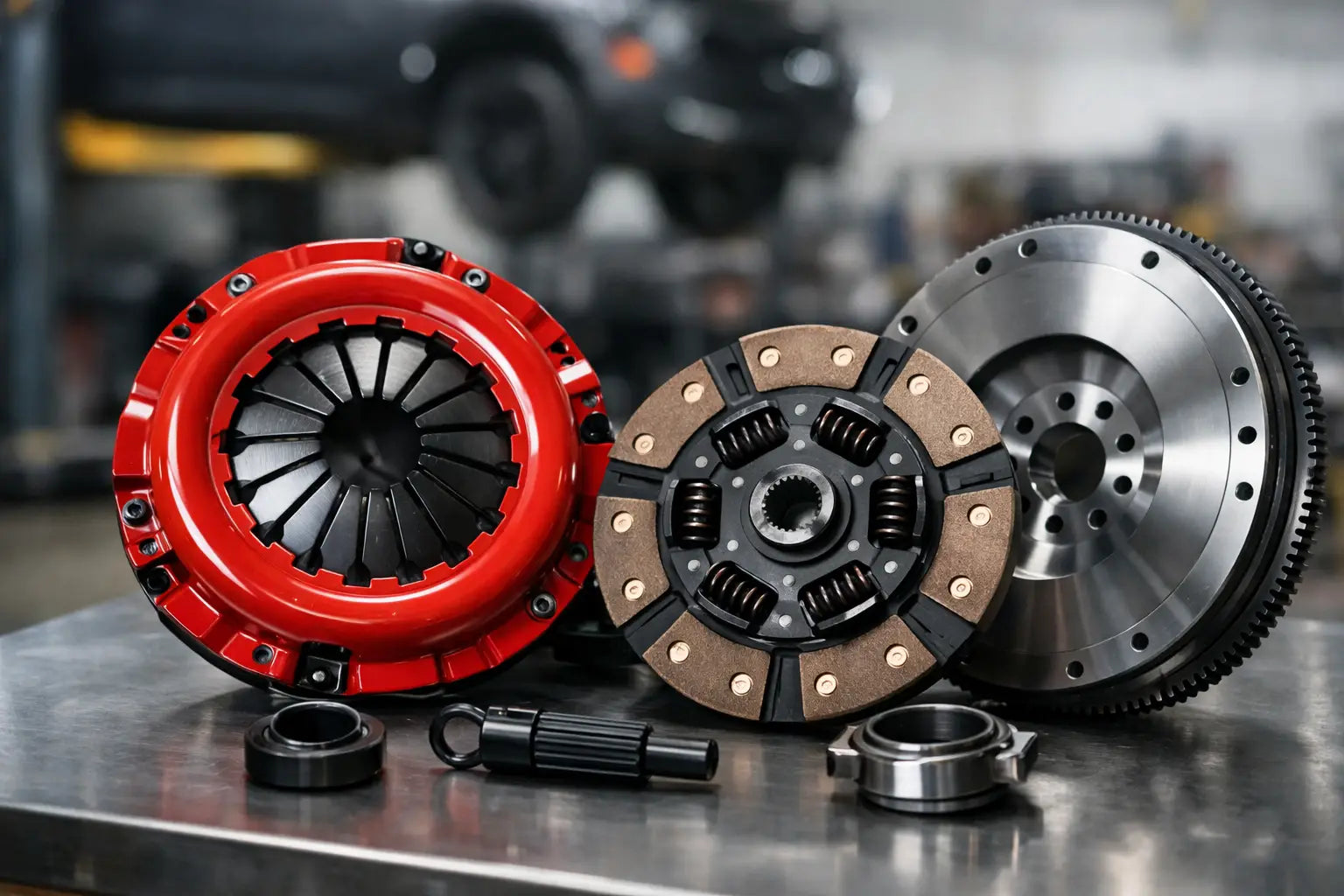
That moment when stock clutch slip shows up is usually not subtle. Maybe the revs flare between gears on a tuned GTI, maybe your Civic starts protesting hard launches, or maybe your track car comes back from a session with a pedal that feels different than it did that morning. That is where performance clutch kits stop being a nice-to-have and start being a necessary upgrade.
A clutch is easy to overlook when people focus on power mods, but it is one of the most important links in the drivetrain. If it cannot hold the torque, the rest of the setup does not matter much. The right kit does more than stop slip. It changes how the car engages, how it feels in traffic, how confidently it handles repeated abuse, and how much headroom you have for future mods.
What performance clutch kits actually change
Compared with a standard replacement clutch, performance clutch kits are built to handle higher torque loads, more heat, and more aggressive use. That usually means different friction materials, stronger pressure plates, and in some cases a revised flywheel package. The goal is not always to create an on-off race car feel. A good street performance clutch can still drive cleanly while giving you a meaningful increase in holding power.
The first thing most enthusiasts notice is engagement. Some kits feel sharper and more immediate, while others stay close to OEM with better clamping force in the background. Pedal weight can also increase, though that depends heavily on the brand and design. Not every upgraded clutch turns daily driving into leg day. Some modern kits are surprisingly civilized for the torque they hold.
Heat tolerance is another big factor. A stock clutch may survive occasional spirited driving, but repeated launches, hard pulls, and track sessions can expose its limits fast. Performance-oriented friction materials and pressure plate designs are built for that environment. That matters whether you are chasing lap times or just running a tuned street car that sees regular abuse.
Choosing performance clutch kits for your build
The biggest mistake buyers make is choosing for the number on the box instead of the way the car is actually used. More aggressive is not always better. A clutch that feels perfect in a stripped track car can be annoying in a daily-driven Audi or BMW that sits in traffic every week.
Start with torque, not horsepower. Clutches care about torque load, and they need a safety margin. If your car already makes more torque than stock, or you plan to add boost, fueling, or mapping soon, buy for the end goal rather than the current setup. It is usually smarter to install one clutch that supports the full build path than to replace a borderline setup twice.
Then think honestly about use case. A street car with occasional pulls and back-road driving needs a different balance than a launch-heavy drag build or a track car that sees repeated high-rpm shifts. Street setups usually prioritize smooth engagement and manageable pedal effort. Drag-focused setups often lean harder into clamp load and bite. Road course cars need consistent heat management and repeatable engagement lap after lap.
Organic, ceramic, and mixed friction materials
Friction material changes the character of the clutch more than many buyers expect. Organic discs tend to be the most street-friendly. They usually engage more smoothly, chatter less, and make sense for mild to moderately tuned cars that still spend most of their lives on the road.
Ceramic or cerametallic discs generally offer more bite and better heat resistance, but they can be less forgiving. Engagement is often more abrupt, and low-speed drivability can suffer if the rest of the setup is too aggressive. For some builds that trade-off is worth it. For others, especially daily drivers, it gets old fast.
Mixed-material or segmented designs try to split the difference. These can work well for enthusiasts who need more torque capacity than a basic organic setup but still want reasonable manners. The exact result depends on the manufacturer, pressure plate design, and flywheel pairing, so it is worth looking at the whole kit rather than one spec line.
Full-face vs puck-style discs
Full-face discs usually offer smoother engagement and broader street appeal. They are the safer choice for most dual-purpose cars. Puck-style discs, including 4-puck and 6-puck designs, generally increase bite and reduce rotational mass, but they often come with harsher engagement and more chatter.
That does not make puck clutches bad. They simply suit a narrower type of build. If the car sees motorsport use, frequent launches, or high torque spikes, the compromise may be justified. If it is a daily that occasionally visits a track day, full-face is often the smarter move.
Don’t ignore the flywheel
Many performance clutch kits are sold with or designed around a specific flywheel, and that choice matters. A lighter flywheel can help the engine rev more freely and sharpen response, which suits a lot of performance builds. It can also make takeoffs less forgiving and increase noise or vibration depending on the platform.
For some cars, a single-mass flywheel conversion is part of the appeal. It is simple, durable, and more direct. For others, especially where refinement matters, staying closer to a dual-mass style feel may be the better fit. There is no universal answer here. It depends on the platform, the driver, and how much NVH you are willing to accept.
Resurfacing or replacing the flywheel at the same time is usually not where you want to cut corners. Even a quality clutch can perform badly if it is paired with a worn or heat-spotted flywheel surface. If you are already pulling the transmission, it makes sense to handle the full system properly.
Supporting parts matter more than people think
A clutch kit is not an isolated upgrade. Release bearings, pilot bearings, slave cylinders, master cylinders, and clutch lines can all influence how the final setup feels and performs. If any of those parts are tired, a new clutch may not solve the whole problem.
Hydraulic issues can mimic clutch problems or shorten the life of a fresh install. The same goes for poor adjustment where applicable, contaminated surfaces, or break-in that gets ignored. Enthusiasts love talking about torque ratings, but a lot of clutch complaints come down to installation quality and supporting hardware, not the clutch itself.
If the car makes enough power to threaten the stock clutch, it is also worth checking the rest of the drivetrain. Engine mounts, transmission mounts, axles, and differential condition all play into how well the power gets to the ground. A stronger clutch can expose weakness elsewhere.
How to avoid buying the wrong clutch
The safest approach is to match the kit to the real build stage and to the platform. A lightly tuned street Honda does not need the same clutch strategy as a big-torque turbo BMW. Front-wheel-drive cars that see hard launches can be especially demanding on the clutch, while heavier all-wheel-drive platforms may need more holding capacity simply because of the way they put power down.
Brand quality matters here. Pressure plate design, friction material quality, balance, and consistency all separate proven manufacturers from bargain parts that look good in a product photo. This is one category where buying on price alone can cost more later, especially when labor is involved.
Fitment accuracy is just as important. Performance parts buyers already know that one engine code, transmission variant, or model-year split can change everything. Clutches are not the place for guesswork. Buying from a performance-focused retailer with platform coverage and proper catalog detail saves time and avoids the kind of mismatch that turns a straightforward install into a garage floor headache.
When a performance clutch kit is worth it
If your stock clutch is slipping, the answer is easy. If you are tuning the car soon, it also makes sense to get ahead of the problem. Beyond that, the value comes down to whether you want more holding power, better durability under abuse, or a different engagement feel that suits the way you drive.
Not every car needs a highly aggressive setup. Plenty of enthusiasts are happier with a well-chosen Stage 1 or street performance kit than with something race-focused. The sweet spot is a clutch that supports your torque target, survives your use case, and does not make the car miserable when you are not chasing lap times.
That is the real goal. Build the drivetrain around the car you actually drive, not the version of it you imagine for five minutes on a product page. Get that right, and performance clutch kits stop being a compromise and start feeling like one of the smartest upgrades on the car.