
You usually notice weak brakes at the worst possible moment - the third hard stop on a fast B-road, a long downhill section, or halfway through a track session when the pedal suddenly goes soft. That is exactly where a proper aftermarket brake upgrade guide earns its keep. Brakes are not about buying the biggest kit you can afford. They are about matching parts to weight, tyre, speed, heat and how you actually drive the car.
Too many builds get this wrong. People fit aggressive pads on tired discs, bolt huge front calipers onto a car with budget tyres, or chase visual impact when what they really needed was better fluid and fresh lines. The result is often more noise, worse balance, and money spent in the wrong place. If you want sharper stopping, better consistency and more confidence, the smart route is a matched setup.
What this aftermarket brake upgrade guide starts with
Start with the problem, not the catalogue. A daily-driven hot hatch that sees the odd spirited run needs a very different brake setup from a heavy fast road saloon or a track-prepped Civic on semi-slicks. If your brakes feel weak from cold, that points to pad choice. If the pedal goes long after repeated hard stops, heat management and fluid are likely the issue. If the car stops well once but not repeatedly, your system is probably running out of thermal capacity.
There is also no point upgrading brakes in isolation if the rest of the car cannot support them. Tyres set the ceiling for available grip. Suspension condition affects stability under braking. Alignment changes how the car loads the front axle. Brakes do not create grip from nowhere - they help you use what the chassis and tyres already offer.
The best first upgrades are rarely the flashiest
For most road cars, the biggest improvement per pound comes from better pads, high-quality fluid and healthy discs. That sounds less exciting than a painted multi-piston kit, but it works. OEM systems are often mechanically capable enough for fast road use when fitted with components that can cope with more heat.
Pads are the heart of the feel. A stronger fast road compound gives you better bite, more temperature tolerance and improved consistency without changing the entire system. The trade-off is that some compounds create more dust, more noise, and can feel harsher when cold. That is normal. The right choice depends on whether your car spends more time in traffic, on B-roads or on circuit.
Fluid matters just as much. Old or low-spec fluid boils earlier, and that is where the soft pedal appears. Fresh high-temperature brake fluid is one of the simplest upgrades on any performance car. Braided lines can then improve pedal consistency by reducing line expansion under pressure, though they will not mask poor pad choice or overheated fluid.
Pads, discs and fluid - how to choose properly
Brake pads should be chosen around operating temperature and intended use. A mild fast road pad suits an enthusiastic daily because it works from cold and handles occasional hard use. A more track-biased pad copes with repeated heavy braking but may squeal, dust heavily and feel underwhelming on the school run. That is not a flaw - it is a compromise.
Discs are next. A good quality plain or lightly grooved disc is often the sensible option. Grooves help clear gases and debris, and they can sharpen initial bite, but they may wear pads faster and add noise. Drilled discs look purposeful, yet on hard-used track cars they can be more prone to cracking if the design or quality is poor. For many enthusiasts, a quality vented disc with the right pad compound is the sweet spot.
Fluid should never be treated as an afterthought. Look at dry and wet boiling points, and be realistic about service intervals. Some high-performance fluids work brilliantly but need changing more often. If your car sees regular track time, maintenance discipline matters as much as the product itself.
When a big brake kit actually makes sense
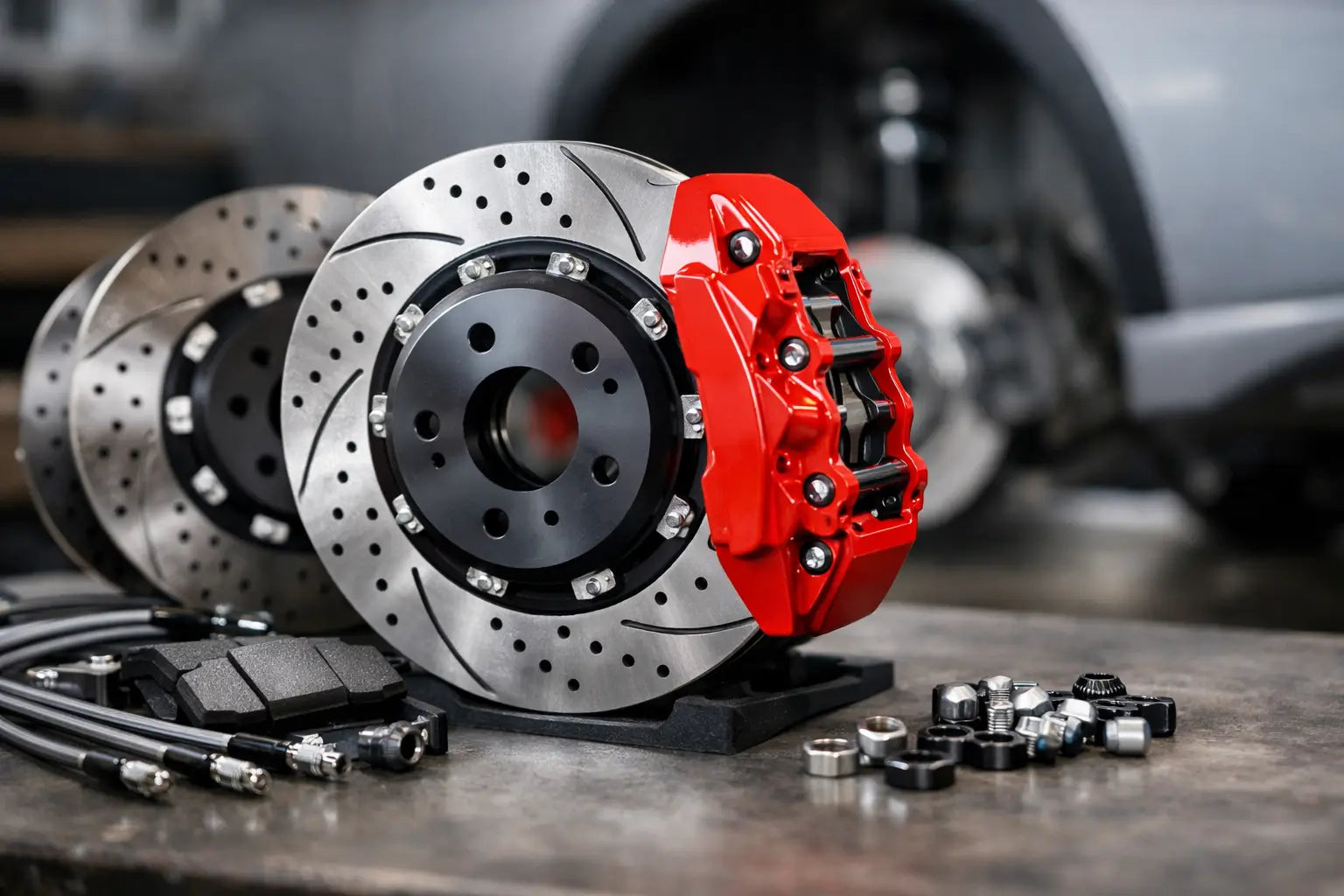
A big brake kit is not just about shorter stopping distances. In many cases, a BBK is mainly about thermal capacity, repeatability and pedal confidence. Larger discs increase leverage and give the system more mass to absorb and shed heat. Multi-piston calipers can improve pad support and modulation, while better hardware usually means stronger consistency under heavy use.
That matters most on heavier cars, high-power builds, or anything doing repeated hard stops on track. If you have added power, grip and speed, the factory brake package may simply be out of its depth. In that situation, stepping up to a properly engineered kit makes sense.
But there are catches. Big brake kits add cost not only at purchase, but later when replacing discs and pads. Wheel clearance becomes a real issue, especially on smaller diameter wheels or certain spoke designs. Front-only upgrades can also shift brake balance if the setup is badly chosen. The goal is not maximum front brake. It is a setup that works with the car.
An aftermarket brake upgrade guide for road, fast road and track use
For a normal road car with occasional spirited driving, stick with premium replacement discs, a quality fast road pad, fresh fluid and a full system inspection. That usually transforms pedal feel and confidence without turning the car into a noisy compromise.
For a fast road build or a heavier performance model, braided lines and more temperature-tolerant pads become worthwhile. This is the zone where many enthusiasts find the best balance. You keep decent manners on the road but gain a system that does not give up after a few hard miles.
For track-day cars, priorities shift. Heat capacity, consistency and serviceability matter more than refinement. Track-biased pads, race-grade fluid, proper cooling and, in many cases, a larger disc or full BBK are the logical move. If the car regularly comes in with cooked pads, cracked discs or boiling fluid, you have already outgrown a basic upgrade path.
Don’t ignore the rear brakes, cooling and tyres
Most braking work happens at the front, but that does not mean the rear can be neglected. Rear pads and discs still affect balance, stability and handbrake performance on some platforms. Going too aggressive at the rear can upset the car. Going too mild can leave the system feeling front-heavy and inefficient. Matching front and rear behaviour matters.
Brake cooling is another overlooked area. If your car sees circuit work, simple ducting and airflow management can make a major difference to disc and pad life. Cooling will not fix a bad component choice, but it can stop a good setup from being overwhelmed.
Then there are tyres. You cannot out-brake a poor contact patch. If you are still on bargain rubber, a huge brake upgrade may only reveal how little grip you really have. Good tyres and sensible brake upgrades work together. One without the other leaves performance on the table.
Fitment, bias and brand quality matter
Not all brake parts are equal, even when the size looks right on paper. Piston area, pad shape, disc construction, hat design and caliper stiffness all affect how the car feels. Fitment accuracy matters as well. A brake package should clear the wheel properly, work with the master cylinder, and suit the vehicle’s weight and use case.
This is where buying from recognised aftermarket brands pays off. Established names tend to offer better compound development, stronger manufacturing control and clearer fitment data. That matters far more than chasing the cheapest listing with the most dramatic product photos. If you are comparing options, think in systems, not single parts.
For enthusiasts shopping platform-specific upgrades, that is also why a specialist retailer such as Torque Lab makes more sense than a generic parts site. The right brake setup is not just about what fits the hub. It is about what fits the car’s purpose.
What to check before you order anything
Before upgrading, inspect the existing system properly. Check pad wear, disc condition, fluid age, slider movement, caliper seals, wheel bearing play and tyre condition. A surprising number of "brake upgrade" problems are actually maintenance problems. Fresh hardware on a neglected system will still disappoint.
Also be honest about future plans. If coilovers, lighter wheels and sticky tyres are coming soon, buy with that end goal in mind. If the car will stay a road car, avoid overbuilding it. The smartest setup is the one that delivers confidence every time you hit the pedal, not the one that wins a forum argument.
A good brake upgrade should make the car feel calmer, sharper and easier to trust when the pace rises. If you choose parts around real use rather than hype, you will spend less, drive harder, and get a result that feels right from the first proper stop.