
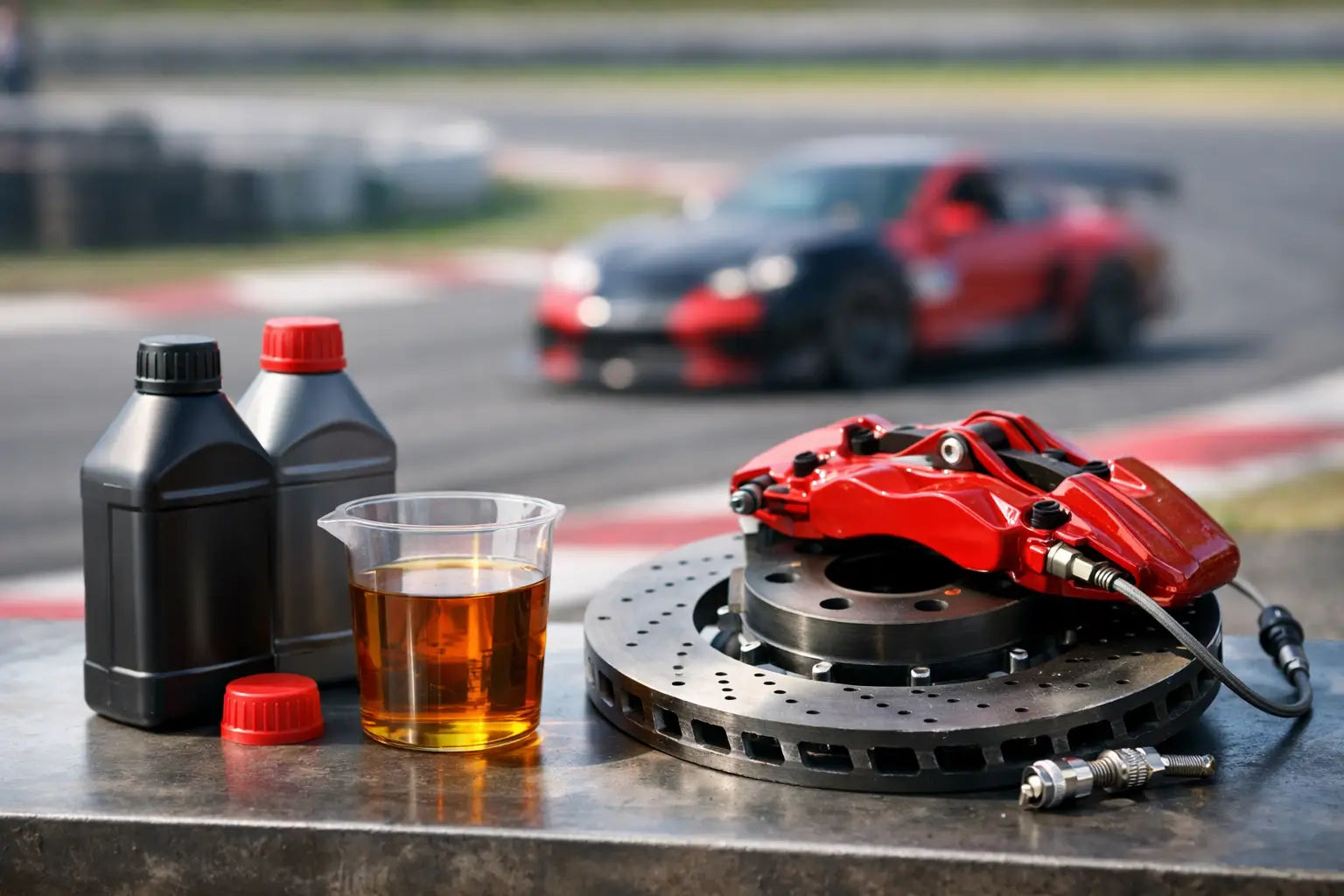
You usually notice bad brake fluid at the worst possible moment - halfway through a hard session, pedal getting longer, confidence disappearing one braking zone at a time. Choosing the best brake fluid for track use is not about buying the most expensive bottle on the shelf. It is about matching temperature performance, service life and maintenance habits to the way your car actually gets driven.
What actually makes the best brake fluid for track use?
For track work, brake fluid lives and dies by heat. Every heavy stop dumps energy into the discs, pads, calipers and fluid. Once fluid gets hot enough to boil, it creates vapour in the system. Vapour compresses. Fluid does not. That is when the pedal starts to feel soft, long or inconsistent.
The headline numbers most drivers look at are dry boiling point and wet boiling point. Dry boiling point refers to fresh fluid straight from a sealed container. Wet boiling point reflects fluid after it has absorbed moisture in service. Both matter, but for different reasons.
If you are chasing lap times and changing fluid often, dry boiling point carries more weight. If your car does road miles between events and you are not bleeding the system every other weekend, wet boiling point matters just as much, sometimes more. That is where a lot of buyers get caught out. A fluid with a huge dry number can still be a poor fit if it degrades quickly once it is in the car.
Pedal feel matters too, although it is not a spec printed clearly on every label. Some fluids maintain a firmer, more consistent pedal at repeated high temperatures. Others can feel fine for a few laps, then lose sharpness once the system is heat-soaked. On track, consistency is performance.
DOT ratings are only the starting point
A lot of enthusiasts assume DOT 5.1 automatically beats DOT 4. That is not how it works. For most track cars, high-performance DOT 4 fluid is still the standard choice because many specialist racing fluids sit well beyond ordinary road-car DOT 4 requirements.
DOT 3 is generally out of its depth for serious circuit use. Standard DOT 4 can be acceptable for light track days in a modestly powered car, but it often reaches its limit once pace rises or sessions get longer. DOT 5.1 can offer strong performance, but you still need to look at the actual boiling point data rather than the label alone.
DOT 5 is the one to avoid in most performance road and track applications. It is silicone-based, not compatible with the glycol-based fluids used in the vast majority of braking systems, and it is not what you want for a typical tuned hatch, saloon or coupe seeing track time.
The fluid types that suit different drivers
There is no single winner for every build. The best brake fluid for track use depends on whether your car is doing two novice days a year, ten hard sessions a month, or full competition use.
For occasional track days
If your car is mainly road-driven and sees a few circuit days each year, a strong performance DOT 4 fluid is usually the sweet spot. You want a worthwhile step up from standard fluid, but without moving into a product that demands constant servicing. In this bracket, balance is everything. A fluid with a strong wet boiling point and sensible replacement interval often makes more sense than an all-out racing fluid that needs frequent attention.
For fast road and regular circuit use
Once the car starts doing repeated hard days, semi-slick tyres, aggressive pads and late braking, you need more thermal headroom. This is where premium motorsport-oriented DOT 4 fluids come into their own. They cope better with sustained heat, repeated ABS cycling and heavier cars that punish the brake system.
If you drive to the circuit, run hard all day and drive home, do not ignore maintenance practicality. A very high-performance fluid is great, but only if you are prepared to flush it often enough to keep that performance.
For dedicated track or race cars
For stripped builds, sprint cars, endurance toys and proper competition use, maximum dry boiling point becomes a much bigger factor. These cars often get fluid changes as part of routine prep, so the shorter service life of more aggressive racing fluids is less of a concern. In that environment, buying for outright heat resistance makes sense.
Which brands and fluids are usually in the conversation?
Among enthusiasts and motorsport drivers, a few names keep coming up for good reason. Motul RBF 600 is a long-time favourite because it offers strong boiling points, broad availability and proven track performance. It suits a huge range of cars from warm hatchbacks to heavier M cars and fast Audis.
Motul RBF 660 pushes the dry boiling point higher again, making it attractive for harder use, but it is not automatically the smartest choice for every driver. If your servicing is inconsistent, the trade-off may not always be worth it.
Castrol React SRF is often treated as the premium option. It is expensive, but the wet boiling point is exceptional, which is exactly why many serious track-day drivers and racers rate it so highly. If you want performance that lasts longer in service and you are tired of fluid fade after a few events, SRF earns its reputation.
ATE Typ 200 has long been a solid enthusiast choice for lighter track use and fast road cars. It does not chase headline numbers like some race fluids, but it has been trusted for years because it is dependable and sensible.
Liqui Moly, Ferodo, Endless and other specialist motorsport brands also offer strong options depending on your application and budget. What matters is not chasing internet hype. It is choosing a fluid with specs and service demands that match your car, your braking load and your maintenance routine.
Why heavier, faster and more modified cars need better fluid
A stock hot hatch on normal tyres can get away with less than a tuned turbo saloon on sticky rubber and big power. Grip and speed increase brake temperatures massively. Add repeated ABS intervention, larger wheel-and-tyre packages and a driver who brakes later each event, and standard fluid quickly stops being enough.
This is why brake fluid should never be chosen in isolation. Pad compound, disc size, cooling, caliper condition and driving style all feed into fluid temperature. If your pedal is going away on track, fluid may be the issue, but it may also be exposing another weak point in the system.
Common mistakes when buying brake fluid
The first mistake is buying on dry boiling point alone. That number looks great in product comparisons, but if the fluid absorbs moisture quickly and the car sees mixed road use, performance can fall off faster than expected.
The second mistake is ignoring age and storage. Once a bottle is opened, brake fluid starts absorbing moisture from the air. That half-used bottle sitting on a garage shelf since last season is not track prep. It is a gamble.
The third mistake is fitting premium fluid into a neglected system. Old rubber lines, sticky caliper pistons and overdue fluid flushes can ruin the benefit of a better product. Good fluid helps a healthy braking system perform. It does not mask poor maintenance for long.
How often should you change track brake fluid?
That depends on the fluid and the use case. For occasional track day cars, a full change before the season and periodic bleeding can be enough. For more serious use, many drivers bleed fluid after each event or replace it several times a season.
If you are running a premium racing fluid, treat it like a consumable, not a lifetime upgrade. Heat cycles and moisture contamination are part of the deal. The harder the car works, the shorter the useful service interval becomes.
A simple rule works well here. If the brakes matter enough for you to upgrade pads, tyres and cooling, fluid deserves the same attention. It is one of the cheapest performance upgrades on the car, and one of the easiest to overlook.
So what is the best brake fluid for track use?
For many enthusiasts, Motul RBF 600 sits in the sweet spot of price, performance and proven results. For harder-driven cars and drivers who want more temperature margin, RBF 660 is the next step. If budget is less of a concern and you want top-tier wet boiling performance with real staying power, Castrol React SRF is the standout choice.
That said, the best option for your car is the one that matches your actual use. A lightly modified Civic doing three track days a year does not need the same fluid strategy as a heavily tuned BMW on semi-slicks running repeated hot laps. Buy for the real job, not the fantasy spec sheet.
If you are building a car properly, treat brake fluid as part of the whole braking package, not an afterthought. Get the right fluid in, refresh it on time, and your pedal will keep backing up your braking points when the session gets serious.