
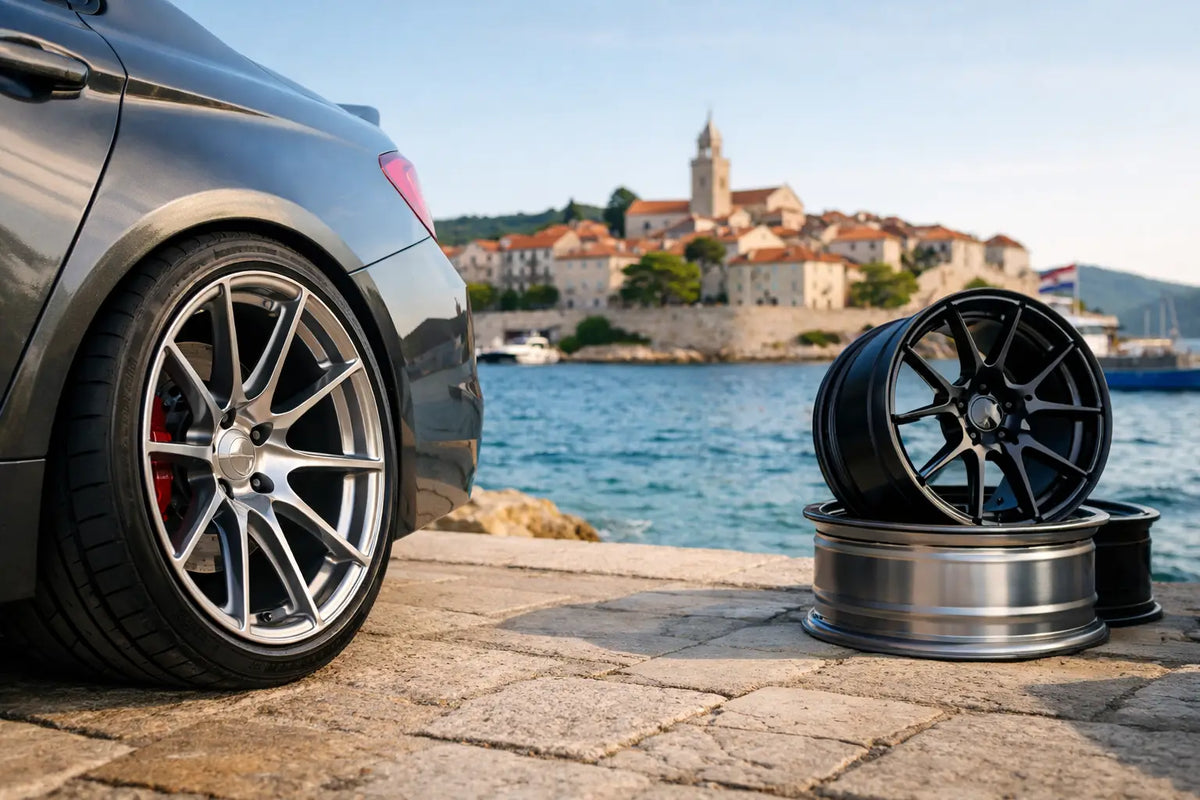
A wheel that looks perfect in a render can be a costly mistake once it meets a big brake caliper, a lowered arch or a Croatian technical inspection lane. Shopping for aftermarket wheels Croatia is not simply a case of choosing a diameter and finish. Proper fitment decides whether your car turns cleanly, tracks straight, clears its brakes and remains usable on real roads.
For a fast road build, weekend track car or clean OEM-plus setup, start with the hard numbers. Once the specification is right, you can choose the concave face, forged construction and tyre package that give the car the attitude it deserves.
Choosing aftermarket wheels in Croatia
The best wheel specification is platform-specific. A 18-inch wheel that works brilliantly on a Volkswagen Golf GTI may sit poorly on a BMW 3 Series, while an aggressive Honda Civic setup may demand arch work that is unnecessary on a standard car. Treat online fitment galleries as inspiration, not proof that a setup will work on your exact model.
Before ordering, confirm your car's PCD, centre bore, thread type, wheel bolt seat and factory offset. These are non-negotiable details. PCD describes the bolt pattern, such as 5x112 on many VAG platforms or 5x120 on various BMWs. It must match the hub exactly. Do not attempt to make an incompatible PCD work with improvised hardware.
Centre bore matters just as much. A wheel should be hub-centric, either through its correctly machined bore or high-quality spigot rings. Bolts or studs clamp the wheel to the hub, but the hub locates it. A poorly centred wheel can cause vibration that feels like an out-of-balance tyre, particularly at motorway speeds.
The mounting hardware also needs attention. Factory wheels may use ball-seat bolts, while many aftermarket wheels require tapered-seat hardware. Reusing the wrong bolts risks poor clamping and damage to the wheel seat. If you run wheel spacers, account for their thickness when selecting bolt length or stud conversion hardware.
Offset controls the stance and clearance
Offset, shown as ET, is where most wheel builds become either spot-on or problematic. Lower ET pushes the wheel further outward. Higher ET pulls it inward towards the suspension strut, spring perch and inner arch. A 10 mm change is meaningful, especially on a lowered car with wider tyres.
A wheel can clear the outer arch yet foul a coilover body on full lock. It can also clear the suspension but protrude past the bodywork, creating tyre rubbing and potential road-legality issues. Width and offset always work together, so a 9J ET35 wheel is not equivalent to an 8J ET35 wheel.
For a daily-driven car, leave sensible room for steering lock, suspension compression and passengers or luggage. A static driveway check does not replicate a rough B-road, a loaded boot or kerb compression on a track exit. The tightest possible fitment is rarely the quickest route to a dependable build.
Brake clearance is not optional
Large diameter does not automatically mean big-brake clearance. The spoke profile, barrel shape and wheel face design determine whether a wheel clears a performance brake kit. Two 18-inch wheels with the same width and offset can have very different caliper clearance.
This matters when fitting upgrades from brands such as EBC Brakes or Ferodo alongside larger calipers, two-piece discs or track-oriented pad compounds. Ask for a brake template where one is available, then test it against the exact wheel design. If no template exists, confirm clearance with the wheel manufacturer or a fitment specialist before committing.
Do not forget barrel clearance around the outer edge of the disc either. Some setups clear the face of the caliper but contact the inside barrel. A modest spacer can solve a spoke-clearance issue, but it also changes effective offset and may introduce arch clearance concerns. Use spacers as a calculated solution, not a shortcut for a guess.
Choose a wheel construction for the job
Cast wheels are often the sensible choice for a clean street build. They offer plenty of style and broad sizing at a more accessible price, leaving budget for tyres, alignment and brakes. The compromise is usually weight and ultimate impact resistance compared with higher-end designs.
Flow-formed wheels sit in a strong middle ground for enthusiastic road and track use. The manufacturing process can reduce weight and improve material properties around the barrel, helping steering response and suspension control without moving into full forged-wheel pricing.
Forged wheels are the premium option where low weight, strength and precise sizing matter most. They make particular sense for serious track cars, high-power builds and owners chasing unsprung-mass reductions. They are not automatically necessary for every car, though. A quality flow-formed wheel with the right tyre and alignment will outperform an expensive forged wheel wrapped in poor rubber.
Load rating is another figure worth checking, especially for heavier saloons, estates, SUVs and EVs. A wheel may fit physically but still be unsuitable for the vehicle's axle loads. Buy from established manufacturers that publish proper specifications rather than chasing an unknown design with no meaningful technical data.
Tyres complete the package
The wheel is only half the upgrade. Tyre width, sidewall profile and compound dictate much of the grip, steering feel and ride quality you will notice on the road. A stretched tyre might achieve a particular look, but it offers less rim protection and may not give the contact patch or sidewall support needed for hard driving.
Keep the overall rolling diameter close to the factory setup unless you have a specific reason to alter it. A major change can affect speedometer accuracy, gearing, traction-control calibration and arch clearance. If you are moving from 17-inch to 18-inch wheels, the tyre sidewall normally needs to shrink accordingly to keep the rolling radius in check.
For track days, a square setup can be a smart move where the platform allows it. Matching front and rear wheel widths lets you rotate tyres, control costs and tune balance through tyre pressures and alignment. Staggered setups can look superb and suit certain rear-drive cars, but they limit rotation and are not always the fastest or most economical option.
Tyre choice should match the weather and how you actually use the car. A focused semi-slick brings grip and sharper response in the dry, but can be noisy, wear quickly and feel compromised in standing water. For a Croatian road car that sees hot summers, rain and regular street mileage, a strong performance road tyre is often the more complete answer.
Set alignment after fitting the wheels
Wheels, tyres, springs and coilovers should be treated as one system. Once a new package is fitted, have the alignment checked. Lowering changes camber and toe, while a wider wheel can make poor geometry far more obvious through tramlining, uneven wear or a nervous rear axle.
For a road-focused build, prioritise stable braking, predictable turn-in and even tyre wear. A track setup may use more negative camber to protect the tyre shoulders in hard cornering, but excessive camber on a daily car can waste the inner edge of an expensive tyre. There is no universal alignment figure that suits every chassis, tyre and driving style.
Also torque wheel bolts or nuts to the manufacturer's specification with a calibrated torque wrench, then recheck them after the initial bedding-in period. It is basic workshop discipline, and it matters.
Documents and road use
Before choosing an aggressive wheel and tyre package, consider how the car will be used and inspected. Wheels must not interfere with steering or suspension movement, tyres should not contact the bodywork, and wheel-and-tyre fitment should remain appropriate for the vehicle. If a modification changes dimensions beyond the specifications recorded for the car, documentation may be relevant for technical inspection and insurance.
Keep invoices, wheel specifications and any approval documents supplied by the manufacturer. Where there is doubt, check the proposed setup with a local inspection station or qualified vehicle specialist before ordering. This is particularly worthwhile for significant diameter changes, spacers, wide-body work and tyres outside the listed factory sizes.
A proven wheel brand, correct hardware and a properly calculated specification cost less than buying twice. Torque Lab's approach is simple: shop by vehicle, verify the numbers and build the package around how the car is driven. Get fitment right first, then choose the wheel that makes you look back at the car every time you park it.