
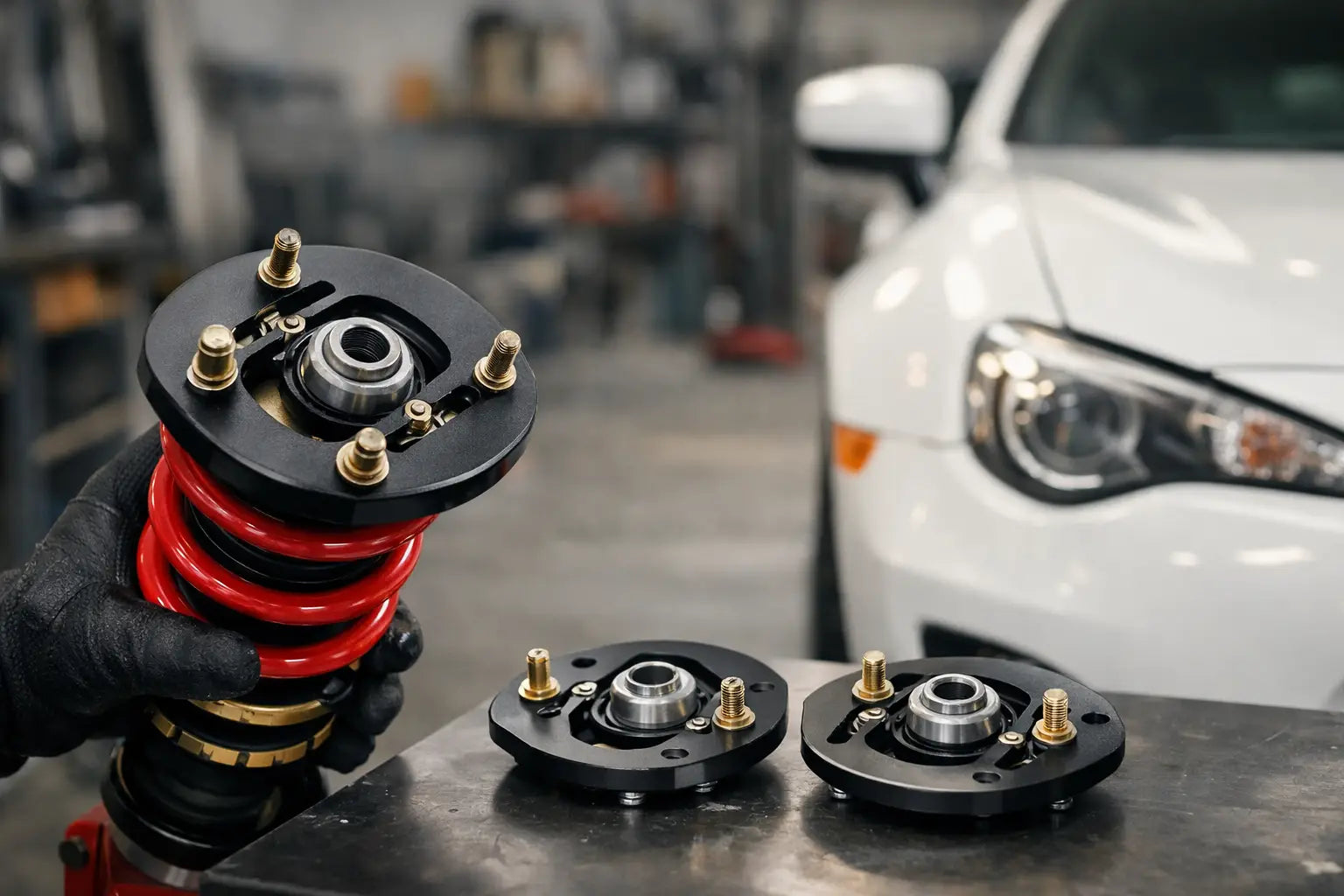
A lowered car that runs out of front camber halfway through a hard corner is not short of suspension parts. It is short of usable geometry. That is where adjustable top mounts enter the conversation. But are adjustable top mounts worth it for your car, or are they just another expensive track-style part that adds noise and complication?
For the right build, they are one of the most effective ways to make coilovers work properly. For the wrong build, especially a daily road car on fixed-height suspension, they can be money better spent on tyres, alignment or brake upgrades. The answer comes down to how the car is used, what adjustment is already available and whether you will actually set the geometry up properly afterwards.
What adjustable top mounts actually change
On a MacPherson-strut car, the top mount locates the upper end of the damper and spring assembly. An adjustable version uses a sliding or rotating plate, usually with a spherical bearing, to move that upper mounting point. This lets you alter wheel geometry where the factory arrangement may offer little or no meaningful adjustment.
The adjustment is normally camber. Moving the top of the strut inwards adds negative camber, which helps keep the tyre’s contact patch flatter when the car rolls in a corner. Some designs also allow caster adjustment, either through a separate setting or an offset bearing position. More positive caster can improve straight-line stability, steering weight and camber gain as the wheel is turned.
That sounds simple, but the benefit is not a generic ‘better handling’ claim. Adjustable mounts give an alignment specialist the range needed to set the car up for its tyres, ride height and intended use. They are a tuning tool, not a bolt-on lap-time button.
Are adjustable top mounts worth it for road driving?
For a lightly modified road car, often no. If the car retains standard springs or uses a mild lowering spring, the factory top mounts and available alignment adjustment may be perfectly adequate. A good fast-road alignment, quality tyres and healthy bushes will usually make a bigger difference to confidence than fitting camber plates by themselves.
The trade-off is refinement. Many adjustable top mounts replace the factory rubber isolator with a metal spherical bearing. That makes the steering response more immediate and keeps geometry more consistent under load, but it can also pass more tyre noise, suspension noise and vibration into the cabin. On rough B-roads, that extra sharpness can feel purposeful. On a motorway commute, it may become tiresome.
There is also tyre wear to consider. Negative camber does not automatically destroy tyres, but excessive negative camber combined with too much toe-out will wear the inner shoulders quickly. A sensible road setup can run modest extra camber and still deliver even wear. The problem starts when someone copies aggressive track numbers without considering road mileage, tyre construction or alignment accuracy.
If your car is a weekend toy, sees spirited driving and you value a direct front end, adjustable mounts can be worthwhile. If it is a daily driver that rarely reaches the limits of grip, standard-style mounts are usually the smarter choice.
Where they make a real difference: lowered and track-driven cars
Lowering a MacPherson-strut car commonly reduces available negative camber at the front. The car may look right and feel firmer, yet lean onto the outer shoulder of the front tyre during hard cornering. This is especially common on front-wheel-drive track cars, where the loaded outside front tyre does a huge amount of the work.
This is the point where adjustable top mounts earn their place. They can recover camber lost through ride height changes and create a setup that gives the tyre a fighting chance on circuit. Better front-end bite, more consistent turn-in and less outer-edge overheating are realistic gains when the rest of the package is right.
They are particularly useful on cars running coilovers with limited lower-mount adjustment. Many performance coilover kits include camber plates for this reason, while others retain a standard-type top mount to keep noise levels lower. Neither approach is universally better. The right choice depends on whether the car is being built for fast road use, occasional track days or regular competition.
A track-focused Honda Civic, Renault Clio, BMW E46 or Volkswagen Golf on sticky tyres will often benefit more from adjustable mounts than a standard-powered road car on ordinary tyres. As cornering loads rise, geometry control becomes much more valuable.
Camber is only useful when the tyre needs it
More negative camber increases grip in cornering only up to the point that suits the tyre and chassis. Add too much and braking performance, straight-line traction and inner-shoulder wear can suffer. A road-biased performance tyre may prefer a different setting from a semi-slick, even on the same car.
Tyre temperatures, wear patterns and driver feedback should guide the final setting. If the car has strong turn-in but feels nervous under braking, tramlines badly or lacks drive out of slower corners, the answer is not automatically more camber. Toe, tyre pressures, damping and anti-roll bar balance all matter.
Caster can be the overlooked advantage
Where a top mount offers caster adjustment, it can be just as appealing as the camber range. Increasing positive caster typically helps the wheel gain negative camber as you apply steering lock. It can also give the steering a more planted, self-centring feel.
However, caster changes can make steering heavier, particularly with wide tyres and no power assistance. Clearance must also be checked. Moving the strut position may affect wheel-to-arch or tyre-to-liner clearance at full lock, especially on lowered cars with aggressive wheel fitment.
The checks to make before buying
First, confirm the suspension design. Adjustable top mounts are mainly relevant to cars with strut-type front suspension. Double-wishbone and multi-link platforms may need different components to alter camber or caster effectively.
Next, look at the adjustment already built into your car and coilovers. Some platforms have camber adjustment at the hub, others use eccentric bolts, adjustable control arms or factory slots. If you can already reach the geometry targets you need, top mounts may add little beyond a more precise bearing arrangement.
Fitment matters as much as adjustment range. Check the mount is designed for your exact chassis, damper shaft diameter and spring arrangement. Some mounts are intended only for coilover springs, while others work with OE-style springs and separate dampers. Do not assume a similar-looking mount from another model will fit safely.
Finally, budget for a proper four-wheel alignment. Fitting adjustable mounts and leaving the car on a generic alignment is the fastest route to a disappointing result. The car should be set at its intended ride height, with tyres in good condition and suspension components free from play before geometry is measured.
Quality matters more than a huge adjustment range
A top mount lives in a harsh environment. It sees repeated steering movement, vertical loads, impacts and road contamination. Cheap plates with poor bearings can develop play, creak or seize, turning a handling upgrade into a frustrating maintenance job.
Look for a well-engineered kit from a recognised suspension manufacturer, with clear fitment information, durable bearings and realistic adjustment provision. For a road and track build, a quality mount with sensible range is usually preferable to an extreme race-style part that forces unnecessary compromises.
It is also worth checking whether replacement bearings are available. Spherical bearings are wear items, especially on cars driven through wet winters and poor road surfaces. Being able to refresh the bearing rather than replace the entire assembly makes long-term ownership easier.
Adjustable top mounts versus other suspension upgrades
If your dampers are tired, bushes are split or tyres are low quality, adjustable mounts are not the first purchase. Fix the fundamentals first. Good tyres, correctly functioning dampers, appropriate spring rates and a precise alignment create the baseline that lets geometry changes deliver results.
For a car that is already on capable coilovers and is being pushed harder, top mounts are a logical next step. They let you use the rest of the suspension package properly rather than accepting the compromised geometry that often follows a drop in ride height.
Torque Lab customers building fast-road and track setups should treat adjustable top mounts as part of a complete chassis plan: springs and damping, tyre choice, wheel fitment, brakes and geometry all need to agree. Fit the parts with a target in mind, then use alignment data and seat time to refine the car.
The best reason to buy adjustable top mounts is not that they look serious under the bonnet. Buy them when your current setup cannot achieve the camber or caster your tyres and driving demand - then let a careful geometry setup turn that adjustment into speed, consistency and confidence.