
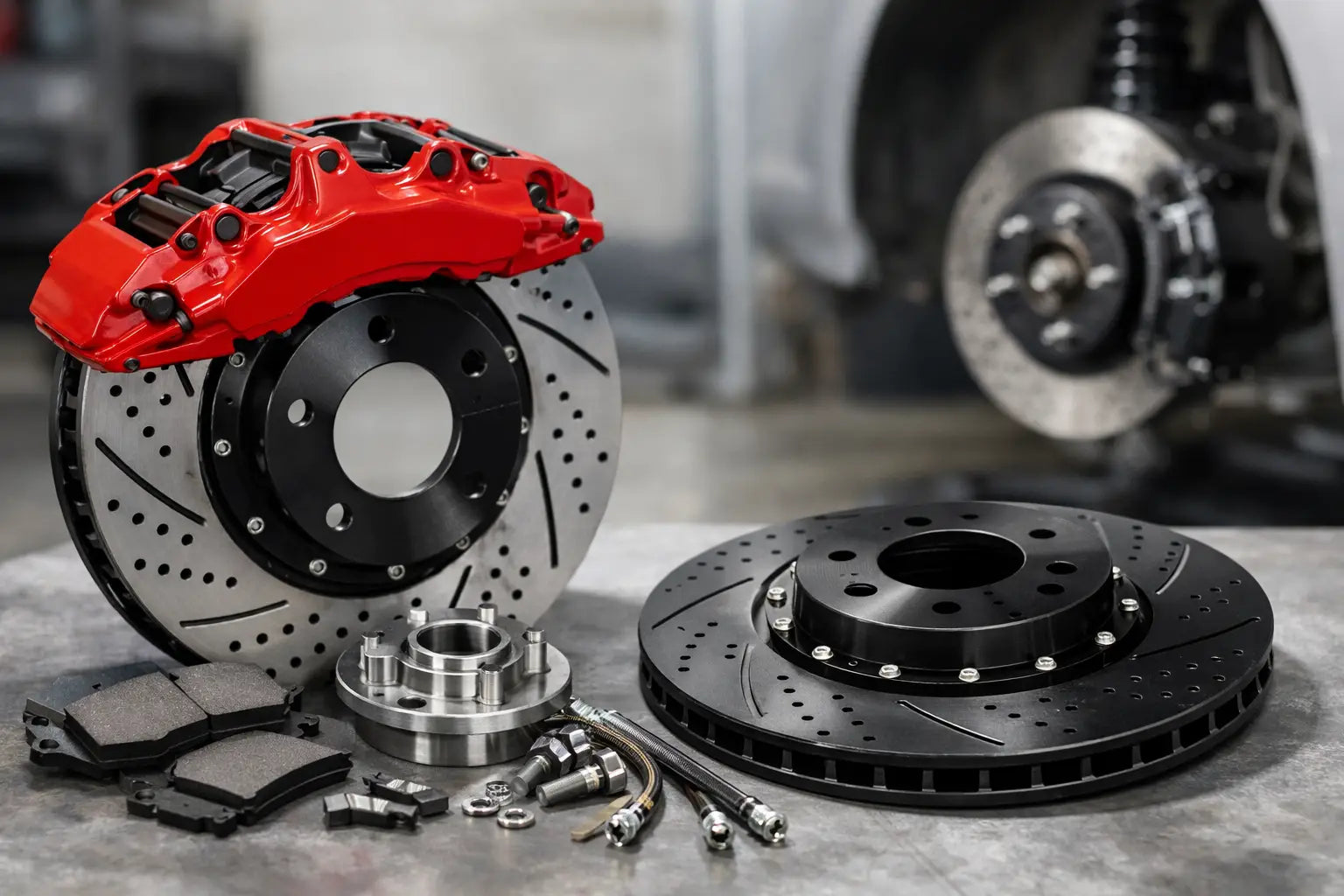
A 380 mm six-pot conversion might look right behind a set of 19-inch wheels, but that does not make it the right brake package for your car. Oversized brakes add cost, unsprung mass and wheel-fitment headaches. Undersized brakes can fade halfway through a hard session, chew through pads and leave the pedal long when you need confidence most. Knowing how to size a performance brake kit starts with the job the car actually has to do.
For a fast road car, the best answer is often a high-quality pad, fresh fluid, braided lines and a sensible two-piece disc upgrade. For a heavy, high-powered car that sees repeated track use, a complete big brake kit can be money well spent. The point is not to buy the biggest caliper available. It is to build a braking system that matches vehicle weight, speed, tyres, use case and available wheel clearance.
How to size a performance brake kit for your car
Start with honest numbers, not just the peak power figure. Kerb weight with driver, fuel load, passenger or track gear matters more than the brochure weight. So does the circuit or road you use. A 1,200 kg hot hatch on 200-treadwear tyres has very different braking demands from a 1,750 kg AWD saloon on sticky semi-slicks, even if their horsepower is similar.
A useful way to frame the decision is energy. Every heavy stop turns vehicle speed into heat, mainly at the discs and pads. Higher speed creates disproportionately more energy to manage, while repeated stops give the system less time to cool. A car that is fine on one spirited B-road stop may overwhelm its standard brakes after ten laps at a circuit with a long straight.
Your brake kit therefore needs enough thermal capacity to survive the worst realistic session, not just produce a strong first pedal. Disc diameter, disc thickness, internal vane design, pad volume and airflow all influence that capacity. A larger disc gives more material to absorb heat and moves the braking surface further from the hub, increasing mechanical leverage. A thicker disc generally holds more heat before temperatures climb too far. Neither benefit automatically means the largest rotor is best.
Match disc size to weight, speed and duty
Disc diameter is the number most buyers notice first. It affects brake torque and heat capacity, but it should be chosen in context. A modest increase from a 300 mm standard disc to a 330 mm performance disc can be a serious upgrade when paired with proper pads and cooling. Moving straight to a 370 mm setup may be justified for a heavier car, repeated high-speed stops or a demanding circuit, but it can be excessive for a light road-focused build.
Thickness deserves just as much attention. A 32 mm disc generally has more heat capacity than a 28 mm disc of similar diameter, and it may work with a larger pad. That is valuable on track, where stable temperatures protect both pad compound and fluid. The trade-off is added mass and, often, a bulkier caliper package.
Two-piece floating discs are especially worth considering when repeated hard use is on the agenda. Their aluminium bells can reduce rotating and unsprung weight compared with one-piece iron discs, while the floating hardware allows the iron ring to expand more freely as it gets hot. They cost more, but replacement rings can make sense over time for regular circuit drivers.
Caliper size is not caliper performance
More pistons do not automatically equal more stopping power. A well-designed four-pot caliper can outperform a poorly matched six-pot setup. What matters is caliper stiffness, piston area, pad shape, piston staggering, seal design and how the caliper works with your master cylinder and brake bias.
A stiff fixed caliper reduces flex and usually gives a firmer, more consistent pedal. Larger pads can spread heat over a greater area and provide more usable friction material for longer sessions. Motorsport-oriented calipers may also offer quick pad changes and better high-temperature hardware. These are real advantages, especially when track time is expensive.
But fitting calipers with substantially more piston area can increase hydraulic demand. Depending on the original system, the pedal may travel further or feel softer unless the master cylinder and brake servo arrangement are suitable. This is why a vehicle-specific kit from a proven manufacturer is safer than assembling random components because the dimensions look compatible.
Brake bias must stay under control
Front brakes normally do most of the work during hard deceleration because weight transfers forward. That does not mean you should fit the biggest possible front kit and ignore the rear. The front-to-rear balance must remain sensible across real braking conditions.
Too much front bias can make the front tyres lock or trigger ABS early, leaving rear braking underused. Too much rear bias can make the car unstable under heavy braking, particularly in wet conditions or while turning into a corner. On an ABS-equipped road car, poor bias can also make the electronic system work harder and produce inconsistent results.
A properly engineered front kit is usually designed around the factory rear setup, assuming the rear system is in healthy condition. If you are changing both axles, changing master cylinders or converting a track car to pedal boxes, brake bias becomes a calculation rather than a guess. Disc effective radius, caliper piston area, pad friction and tyre grip all play a part. This is not the place for forum maths alone.
Wheel clearance decides what will actually fit
A brake kit can clear a 19-inch wheel diameter and still hit the spokes. Inner barrel clearance, spoke profile, wheel offset and the caliper's radial position all matter. One 18-inch wheel may clear a 355 mm kit while another 18-inch wheel will not clear a smaller package.
Before ordering, confirm the exact wheel model, diameter, width and offset against the brake manufacturer's template. Print the template at 100 per cent scale, check the measurement reference and physically test it inside the wheel. Do not rely on a wheel being listed as 18-inch or 19-inch. That alone tells you almost nothing about spoke clearance.
Also consider whether spacers are required. A small spacer may solve a spoke-clearance issue, but it changes scrub radius and places different loads on wheel bearings. Use quality hubcentric hardware, ensure there is adequate stud or bolt engagement, and do not treat spacers as a universal fix.
Tyres set the ceiling for braking grip
Brakes create the clamping force, but tyres create the deceleration. If your current tyres are ordinary road rubber, fitting an enormous race-derived brake kit will not magically shorten every stopping distance. It may resist fade better, but maximum braking is still limited by the contact patch and road surface.
As tyre grip increases, braking demand rises too. Sticky road-legal track tyres or semi-slicks allow later, harder braking and transfer more heat into the system. This is why a brake setup that felt excessive on standard tyres can become completely sensible after a wheel-and-tyre upgrade.
Think of the car as a package: tyre compound, suspension control, alignment, brake pad and cooling all affect how hard and how often you can brake. A car that dives heavily or lacks front camber may overload the outside front tyre before the brake kit has reached its potential.
Do not overlook pads, fluid and cooling
The best hardware will disappoint with the wrong friction material. Choose pads by operating temperature, bite, modulation, noise tolerance and disc compatibility. An aggressive track pad can work brilliantly at high temperatures but be noisy, dusty and weak from cold on a daily-driven car. A fast-road pad may feel excellent on the commute and fade at a demanding circuit.
High-boiling-point brake fluid is essential for serious use. Fluid that has absorbed moisture can boil under sustained heat, causing a long or soft pedal even when the discs and pads are otherwise capable. Flush the system properly and service it at intervals that match how hard the car is driven.
Brake cooling is one of the highest-value upgrades for cars used on track. Correctly positioned ducts feed air into the centre of the disc, where internal vanes can pump it through the rotor. Cooling helps discs, pads, seals, fluid and wheel bearings live longer. It can allow a sensibly sized kit to outperform a larger setup with poor airflow.
A practical sizing route before you buy
First, inspect the existing system. If discs are cracked, pads are glazed, fluid is old or caliper slides are sticking, fix those faults before judging the need for a major upgrade. Then define the car's main use: quick road driving, occasional track days, regular circuit work, hillclimbs or competition.
Next, record vehicle weight, tyre specification, wheel details, likely circuits and your current brake issues. Fade, pad wear, cracked discs, poor pedal feel and wheel clearance point to different solutions. A kit that gives another 25 to 30 mm of disc diameter, thicker rotors, a stiff caliper and a larger pad may be ideal. In another build, a pad and cooling upgrade may deliver the smarter result.
Torque Lab's vehicle and brand-led catalogue structure makes it easier to narrow the options, but always check the individual kit's wheel template, axle application and stated requirements before committing. Fitment accuracy beats a flashy specification every time.
Buy enough brake for the heat your car creates, the tyres it runs and the miles or laps you genuinely drive. When the pedal stays consistent at the end of the hard stop, the car remains stable and the kit clears the wheels without compromise, you have sized it properly.