
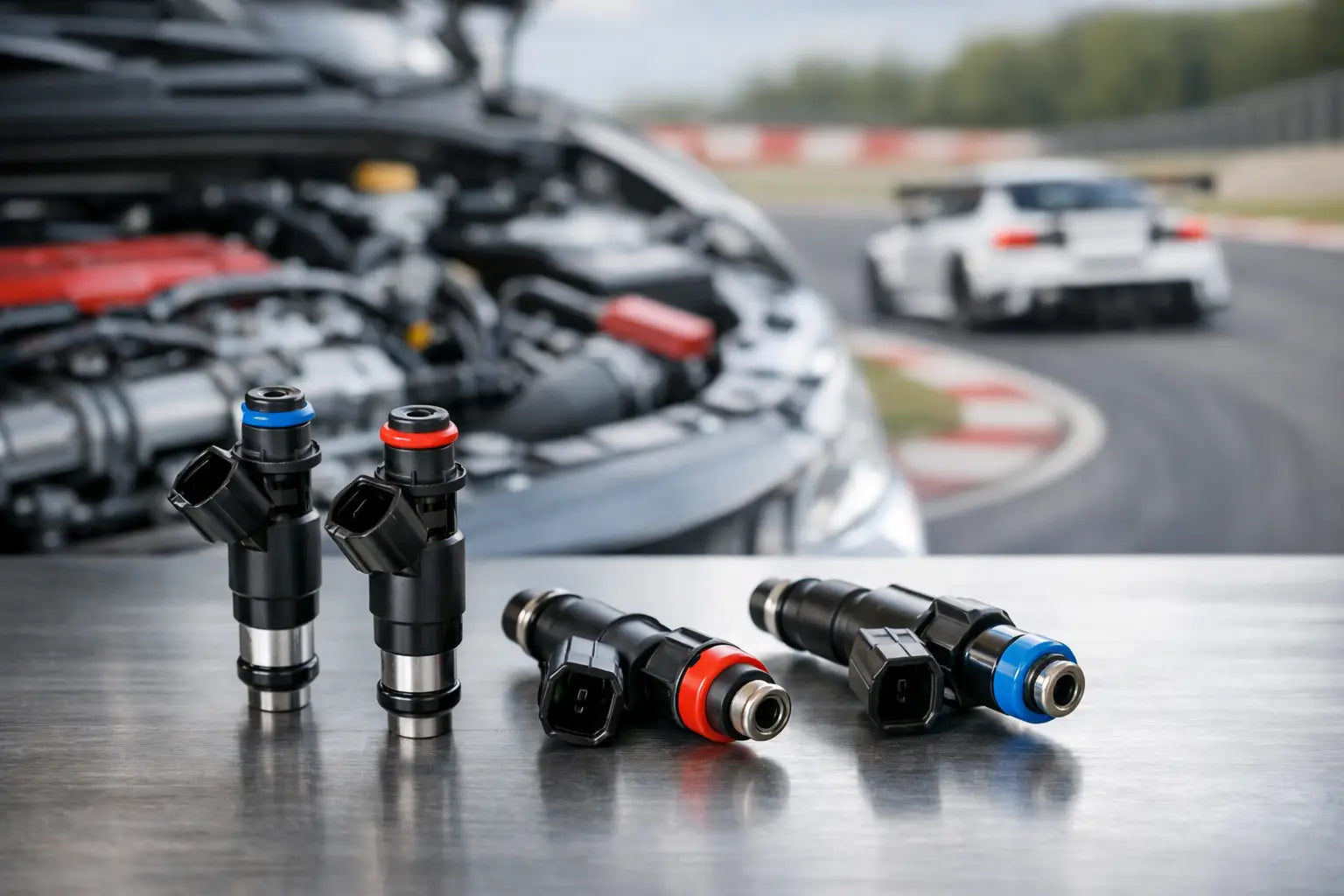
A bigger turbo, freer-flowing exhaust and aggressive map can make impressive numbers on a dyno sheet. They can also push a standard fuelling system past its safe limit. This fuel injector upgrade guide is for builders who want power that survives repeated pulls, hard road use and track sessions - not a car that runs lean when the boost comes in.
Injectors are not a headline modification. They are supporting hardware, but they decide whether your engine receives the fuel your calibration expects. Get the sizing, fitment and tuning right, and the car drives cleanly from cold start to redline. Get them wrong, and poor idle quality is the best-case outcome.
When does a fuel injector upgrade make sense?
An injector upgrade is usually required once the factory injectors reach a high duty cycle at your intended power level. Duty cycle is the percentage of available time an injector is held open during each engine cycle. Once injectors are consistently operating near their limit, there is little margin for high intake temperatures, fuel pressure variation or a richer safety target under boost.
Forced-induction upgrades are the obvious trigger. A turbocharged Golf GTI, Audi S3, BMW B58 or Honda Civic Type R can outgrow standard injectors quickly when boost, airflow and ethanol content rise. Naturally aspirated engines may need them too, particularly high-compression builds with larger cams, increased capacity, individual throttle bodies or sustained motorsport use.
Do not buy injectors solely because a forum build made a certain number. The required flow rate depends on your engine, target wheel or crank power, fuel type, fuel pressure, intended air-fuel ratio and the safety margin your tuner wants. Two cars with the same quoted horsepower can have very different fuelling needs.
Fuel Injector Upgrade Guide: Size for the finished build
The smart approach is to size injectors for the finished version of the car, not only the next modification. If a hybrid turbo, flex-fuel conversion and uprated fuel pump are planned over the next year, buying injectors that only cover the current stage often means paying twice for fitting and calibration.
That does not mean fitting the biggest injectors available. Oversized injectors can be perfectly manageable with a capable ECU and accurate data, but cheap large injectors may have poor low-pulse control. On a road car, that can mean a lumpy idle, rich cold starts, fuel smell and frustrating part-throttle behaviour.
Injector flow is often quoted in cubic centimetres per minute, such as 550cc, 750cc or 1,000cc, or in pounds per hour. Those figures are only meaningful at a stated fuel pressure. A 1,000cc injector rated at 3 bar does not flow the same amount at 4 bar, and increasing pressure makes the pump work harder. Treat flow ratings as a starting point, then verify the manufacturer’s test pressure and supplied calibration data.
For a straightforward petrol build on premium pump fuel, choose an injector with enough capacity to retain sensible headroom at peak load. For E85 or other high-ethanol fuels, step up substantially. Ethanol needs more fuel volume than petrol for the same power, so an injector package that is comfortable on 99 RON may be close to its limit after a flex-fuel conversion.
Choose injector quality, not just a cc number
Flow matching matters. A set of injectors should deliver closely matched fuel volumes, otherwise cylinder-to-cylinder mixtures can vary even when the overall lambda reading looks safe. This matters even more on boosted and high-cylinder-pressure engines, where one weak cylinder can become the expensive one.
Look for recognised injectors with published dead-time or latency data, flow data and connector information. Dead time is the delay between the ECU commanding an injector and fuel actually flowing. It changes with battery voltage and affects idle, cranking and low-load accuracy. Good calibration data gives the tuner a reliable foundation rather than forcing them to chase poor behaviour across the map.
Avoid anonymous high-flow sets sold only on headline capacity. They may physically fit the rail, but fitment alone is not performance. Repeatable flow, spray pattern and trustworthy data are what make an injector suitable for a properly calibrated road or track car.
Check the whole fuel system before ordering
An injector can only supply fuel that reaches it. If the in-tank pump, low-pressure lines, fuel filter, fuel pressure regulator or high-pressure pump cannot keep up, larger injectors will not solve the actual restriction.
Modern direct-injection engines need particular care. Many platform upgrades involve both port and direct injection, or an uprated high-pressure fuel pump rather than conventional port injectors. The strategy depends entirely on the engine and ECU. A port-injection kit can add valuable fuelling headroom on some turbo platforms, but it also adds rails, lines, controller options and calibration complexity.
On port-injected cars, establish whether the current pump can maintain commanded pressure at full load. A pressure drop near redline reduces actual injector flow and can make a setup lean out precisely when cylinder pressure is highest. For track use, consider fuel surge as well. A powerful car with a low tank can uncover the pickup through long corners, even with injectors and pump that look adequate on a dyno pull.
Your upgrade plan may need an uprated in-tank pump, a surge tank, a fuel pressure regulator, larger lines or a flex-fuel sensor. It depends on the platform, the power target and whether the car sees occasional spirited use or repeated high-G laps.
Match fitment beyond the plug
Injector compatibility is more than electrical connector type. Confirm the injector length, upper and lower O-ring dimensions, rail seating, intake manifold fitment and fuel type compatibility. Small dimensional differences can create leaks, poor seating or difficult installation.
Some vehicles accept a common injector body with adaptor harnesses and spacers. That can be a practical route, but it must be an engineered kit for the platform rather than a collection of universal parts. Fuel leaks in a hot engine bay are not a minor fitment issue.
Also check impedance. Most late-model standalone and factory ECU applications use high-impedance injectors, while some older systems use low-impedance units that need suitable driver circuitry or resistors. Do not assume an electrical adaptor changes the injector’s operating requirements.
If you are shopping by vehicle, start with your exact engine code and model year, then work backwards from the intended power and fuel. Torque Lab’s platform-led catalogue approach is useful here: fitment narrows the options, then the actual build specification decides the right flow rate and supporting parts.
Calibration is part of the injector upgrade
Never fit higher-flow injectors and continue driving on the old calibration. The ECU’s injector scaling, latency compensation, fuel pressure assumptions and load targets must match the hardware. Even if the engine starts and idles, it may be significantly rich or lean across parts of the map.
A professional calibration should include cold start, idle, cruise, transient throttle, full-load fuelling and safety strategies. On turbo cars, the tuner should also log boost, fuel pressure, lambda, ignition correction and injector duty cycle. A single wide-open-throttle run is not proof that the setup is sorted.
For flex-fuel cars, the tune must account for changing ethanol content. Filling up with a different blend without proper compensation can alter the fuel requirement enough to consume the headroom you thought you had. A sensor-based flex-fuel calibration is generally the cleaner solution for a car that sees varied fuel availability.
Common mistakes that cost engines
The usual errors are predictable: selecting injectors based on a peak-power claim, ignoring fuel pump capacity, using poor-quality copies, reusing damaged O-rings, and treating a base map as a finished tune. Another common mistake is assuming more fuel pressure is always the answer. Pressure can increase injector flow, but it can also expose pump limitations and worsen heat management.
Do not forget the practical checks after installation. Inspect for leaks with the system primed before starting, confirm the injectors sit squarely in the rail and manifold, and use fresh seals where the manufacturer specifies them. After mapping, keep an eye on fuel trims, pressure and any drivability change rather than assuming the job ends when the car leaves the dyno.
A correctly specified injector upgrade does not simply support a bigger power figure. It gives the calibration room to protect the engine when air temperatures climb, fuel quality changes or a track session runs longer than expected. Build the fuel system around the car you are aiming to finish, choose proven parts with real data, and let a proper calibration turn that hardware into dependable performance.