
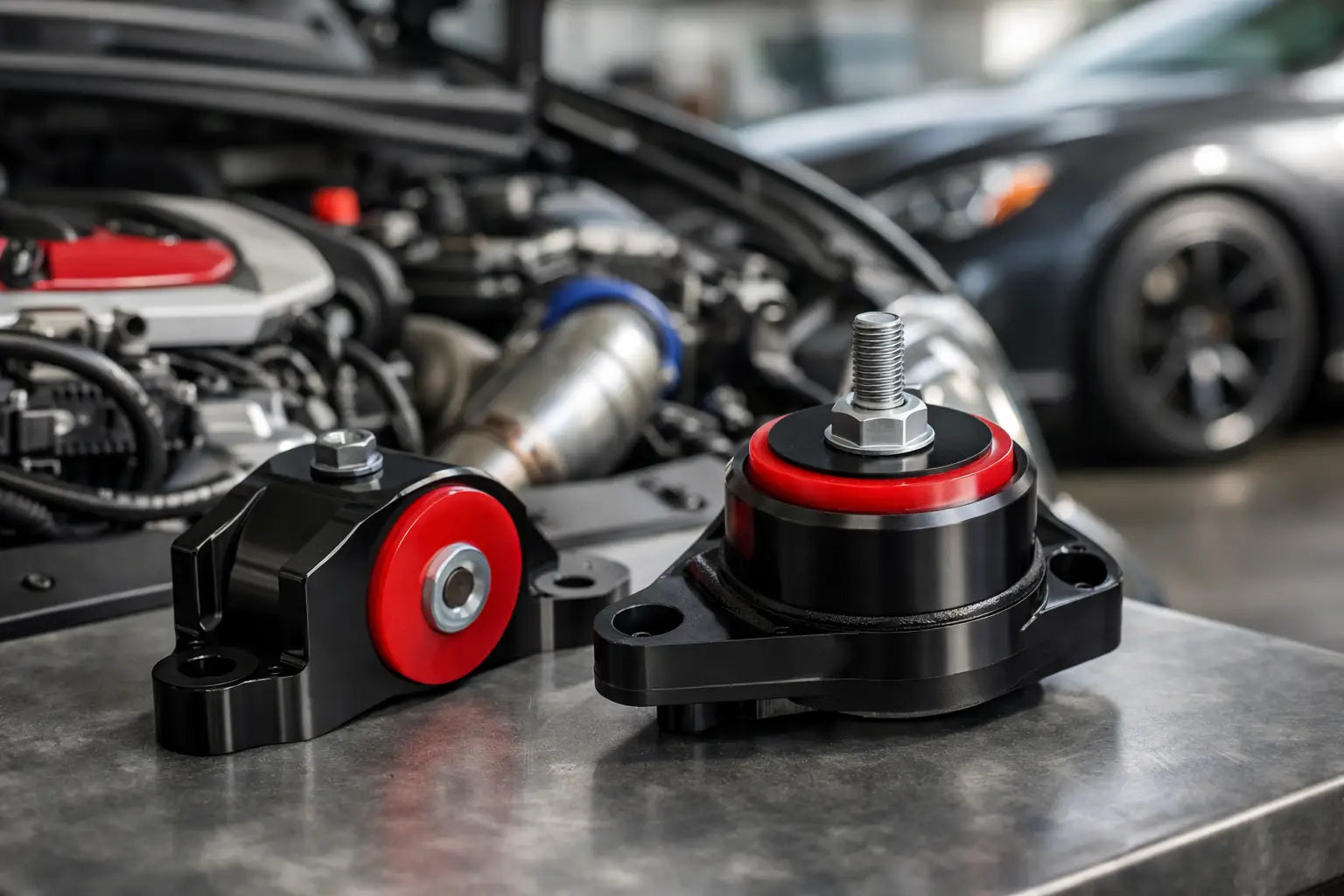
A hard launch, a fast 2-3 shift or a committed corner can show up tired factory mounts faster than any visual inspection. When people talk about uprated engine mounts benefits, they usually mean a drivetrain that feels more tied down, more immediate and less vague when the car is being driven properly. That is exactly what a good mount upgrade can deliver - but it also changes how much of the engine’s character reaches the cabin.
For a tuned road car, track-day build or dedicated competition vehicle, mounts are not a glamorous purchase. They are, however, one of the parts that can make the rest of the package work as intended. More power, stickier tyres, a firmer clutch and faster gear changes all put greater demands on the components that control engine and gearbox movement.
What uprated engine mounts actually do
Engine mounts support the weight of the powertrain while isolating vibration from the chassis. Standard mounts are designed around broad ownership priorities: refinement at idle, low cabin noise, durability over high mileages and acceptable movement during normal driving. On many modern cars, they may also be fluid-filled or electronically controlled to keep the cabin civilised.
An uprated mount uses a firmer rubber compound, polyurethane insert, billet housing, solid bush or a more motorsport-led construction to limit that movement. The goal is not simply to make the engine immovable. It is to control its movement under load, then return it consistently to the same position.
That matters because the engine, gearbox, driveshafts, exhaust, intake pipework and shifter linkage are all connected. If the drivetrain rocks excessively, each of those systems has to cope with it. A mount upgrade brings greater control to the whole assembly.
Uprated engine mounts benefits you can feel
The most noticeable gain is usually drivetrain response. With less engine movement when you open or close the throttle, the car feels more direct. There is less of the delayed, rubbery sensation that can make a tuned turbo car feel as though it takes a moment to settle between inputs.
Manual cars can benefit particularly strongly. Excessive engine movement can make gear engagement feel less precise, especially during fast shifts or when changing direction under load. On platforms with cable-operated shifters, a firmer lower torque mount or full engine mount set can reduce the load-induced movement that contributes to a vague or notchy shift. It will not repair worn synchros or a poorly adjusted linkage, but it can remove a surprising amount of drivetrain slop.
Wheel hop is another common reason enthusiasts fit uprated mounts. During a hard front-wheel-drive launch, the engine twists against its mounts. If the tyres repeatedly gain and lose grip while the powertrain rebounds, the result can be violent wheel hop. Better mount control helps reduce that oscillation, giving the tyres a more consistent chance of hooking up. It is especially relevant for high-torque turbo builds, cars on semi-slicks and vehicles that see drag-strip starts.
On rear-wheel-drive and all-wheel-drive platforms, the improvement often shows up as cleaner power delivery and less driveline shunt. The car can feel more composed as torque comes on, rather than allowing the engine and transmission to take up slack before the chassis responds.
There is also a durability angle. A drivetrain that moves less is less likely to pull aggressively on boost hoses, exhaust flex sections, downpipes, intercooler pipework and wiring. This is not a guarantee against failures, and overly stiff mounts can transfer more force elsewhere, but properly selected mounts can reduce repeated stress caused by uncontrolled movement.
The trade-off: NVH is part of the deal
NVH means noise, vibration and harshness. It is the reason manufacturers do not fit solid mounts to every road car, and it is the first thing to consider before adding the stiffest kit available to your basket.
Firmer mounts transmit more engine vibration into the bodyshell. Depending on the platform, you may notice a more pronounced idle through the steering wheel, pedals and seats. Some cars develop a cabin drone at a specific rpm range. Others are perfectly acceptable with a mild street compound but become tiring when fitted with race-spec bushes or solid mounts.
Four-cylinder engines often show this clearly, particularly with a stiff lower torque mount. A modest uprated insert may sharpen the car without changing its everyday character too much. A full set of hard polyurethane or solid mounts can make every cold start, air-conditioning load and low-rpm pull feel more mechanical.
That does not make the upgrade bad. It just means the correct choice depends on the build. A weekend B-road car and a stripped track machine should not necessarily use the same specification. Be honest about how often you sit in traffic, travel long distances or carry passengers before choosing a mount purely for its hardness rating.
Choosing the right mount for your build
Start by identifying the problem you are trying to solve. If the car suffers from wheel hop but is otherwise pleasant to drive, a lower torque mount, dogbone insert or gearbox-side upgrade may be enough. Replacing every mount with an aggressive race compound could create more NVH than the result justifies.
For a fast-road car with intake, exhaust and a sensible remap, street-performance rubber mounts or medium-durometer polyurethane are often the sensible middle ground. They control movement without turning the cabin into a resonance chamber. For repeated track use, higher-output turbo conversions or cars running stiffer clutches, a complete uprated engine and gearbox mount package provides more consistent control.
Material and design matter as much as the word ‘uprated’. Polyurethane mounts are popular because they are firm, durable and available in different hardness levels. Rubber-based performance mounts can offer excellent control with lower vibration transmission. Billet and solid mounts offer maximum location accuracy, but are normally best reserved for motorsport or drivers who fully accept the compromise.
Check whether a product is a complete mount, an insert that works within the original housing, or a replacement bushing for a torque arm. Each has a different installation requirement and result. An inexpensive insert can be an effective entry point, while a complete mount may be the better answer where the original hydraulic unit has failed.
Fitment is non-negotiable. Mount layouts vary across engines, gearboxes, drivetrains and model years, even within the same vehicle generation. A Volkswagen Golf GTI, Audi S3, BMW 3 Series or Honda Civic may have several drivetrain-specific options, so confirm the exact engine code, transmission and chassis before ordering.
Do not use mounts to mask a fault
Uprated mounts are not a cure for every clunk, vibration or poor shift. Before fitting them, inspect the factory mounts for splits, fluid leaks, collapsed rubber and loose hardware. Check the gearbox mount, pendulum or torque mount, driveshafts, exhaust clearances and shifter components too.
A worn dual-mass flywheel, damaged driveshaft joint or tired suspension bush can create symptoms that sound like engine movement. Fitting harder mounts without diagnosing the real issue may make the noise more noticeable, not less. On an older performance car, replacing failed standard mounts with fresh OE-quality parts can itself transform the way it drives.
Installation quality matters as well. Support the engine correctly, follow the vehicle-specific tightening procedure and torque fasteners at the required ride or drivetrain position where specified. Once fitted, check exhaust and intake clearances, then recheck accessible hardware after a short bedding-in period. A mount that is preloaded incorrectly or installed alongside tired components will not deliver its best result.
Where mounts sit in a smart upgrade path
Mounts make the most sense when they support the rest of the build. A remapped turbo hatch with tyres, brakes and suspension already sorted is a prime candidate. The extra torque will expose factory drivetrain movement, and firmer mounts can make the car feel more coherent without adding headline power.
They also pair well with short-shift kits, upgraded clutch components, drivetrain inserts and limited-slip differentials. None of these parts does the same job, but together they reduce wasted movement and make the connection between engine, gearbox and road feel far more deliberate.
For a first modification, mounts are not always the right answer. If the car still needs tyres, brake servicing or basic maintenance, handle those essentials first. But once the chassis and drivetrain are ready for harder use, the right mounts are one of the most effective ways to make every throttle input and gear change feel earned.
Choose the specification for the car you actually drive, not the build-sheet fantasy. A well-matched street mount can make a fast road car feel properly dialled in; a track-focused setup can give a serious build the control it needs when every shift and launch counts.