
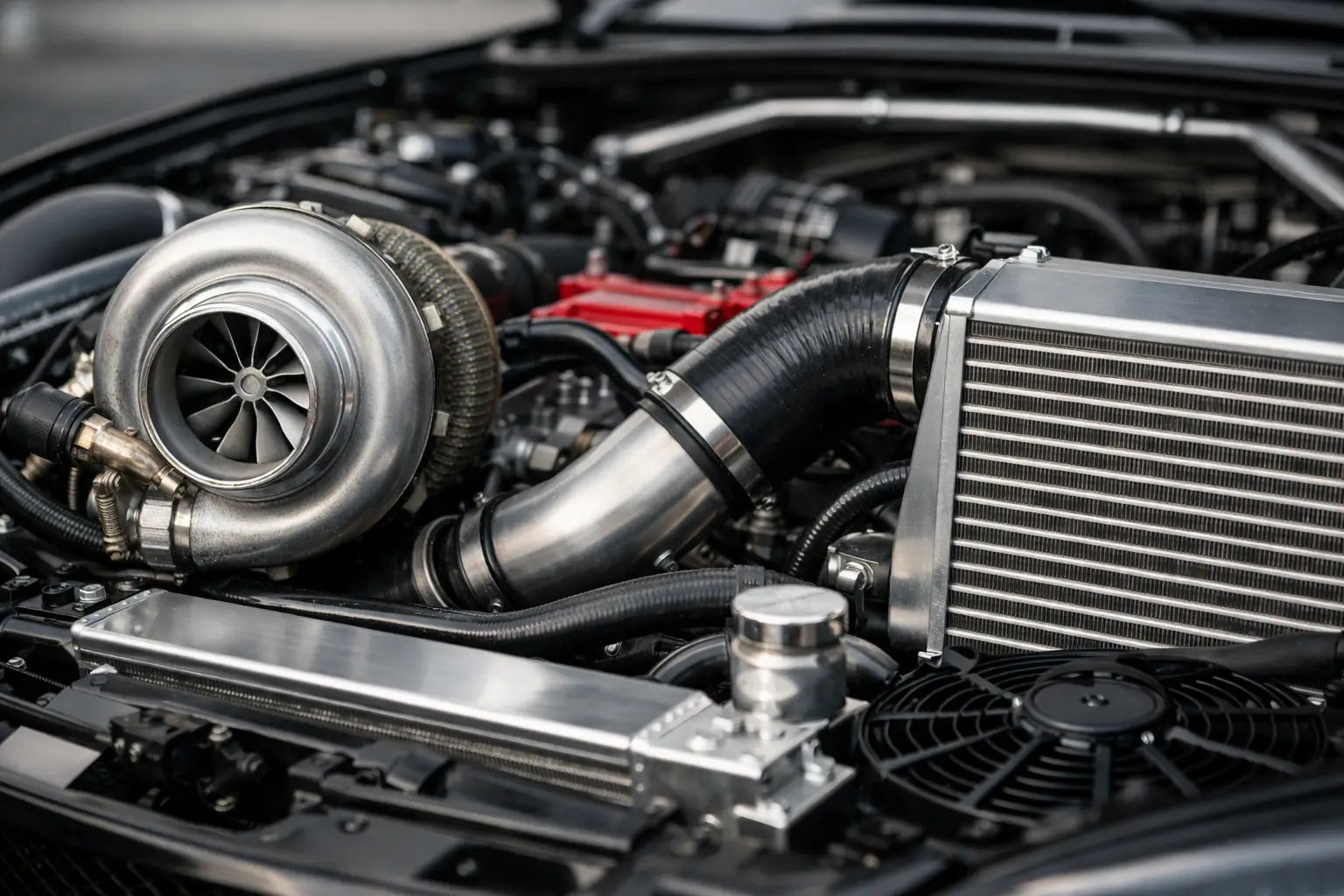
More boost does not only raise cylinder pressure - it raises the workload on every system trying to keep the engine alive. This turbocharged engine cooling guide is for the fast-road build that sees hard pulls, the track car stuck in pit-lane queues, and the tuned daily that must still behave properly on a hot summer commute.
The common mistake is buying the biggest radiator available and calling the job done. Cooling is a system: coolant capacity, airflow, charge-air temperature, oil temperature, radiator position, ducting, fan control and ECU protection all need to work together. Get one part wrong and a good component can become a restriction.
Why turbo cars create a tougher cooling problem
A turbocharger uses exhaust energy to compress the intake charge. That process produces heat before the air reaches the cylinders, while extra fuel and cylinder pressure create more heat during combustion. The turbine housing also sits close to the engine bay, radiating heat into hoses, wiring, intake pipework and anything else in its path.
On a lightly modified car, the factory cooling package usually has useful headroom. Once you add a remap, larger turbo, freer-flowing exhaust, repeated launch control or track use, that margin can disappear quickly. The issue is not always a dramatic overheating event. Often, it is a car that runs acceptably for one lap, then pulls timing as intake air temperatures climb, oil temperature rises, and coolant temperature starts following it upwards.
Coolant temperature alone is not the full story. A dashboard gauge may sit in the middle while the ECU is reducing ignition advance to protect the engine from high charge-air or oil temperatures. If performance feels soft after a few hard minutes, heat soak deserves as much attention as boost pressure.
Start with data, not a shopping basket
Before fitting upgrades, establish what the car actually does. Log coolant temperature, intake air temperature, oil temperature where available, and ideally oil pressure. Compare a normal road drive with the kind of use the car is being built for. A single third-gear pull tells you far less than several repeated pulls or a 20-minute session.
Look at the trend, not just the peak figure. Intake temperature that rises rapidly and never recovers points towards an undersized or poorly fed intercooler. Coolant temperature that climbs at speed can indicate insufficient radiator capacity or restricted airflow. A car that gets hot only in traffic is more likely to have a fan, shroud, wiring or low-speed airflow problem.
Four warning signs should move cooling to the top of the build list:
- Coolant temperature rises steadily during sustained high-load driving.
- Intake temperatures remain high after lifting off or cruising.
- Oil temperature climbs faster than coolant temperature on track.
- The ECU reduces power, throws temperature-related faults, or the cabin heater suddenly loses heat.
Turbocharged engine cooling guide: choose the right upgrades
Radiator capacity is only useful with airflow
An aluminium performance radiator can add core volume and improve heat rejection, but fitment and design matter more than a headline thickness figure. A thicker core with poor fin efficiency, a blocked front bumper opening, or no proper shroud may perform worse than a well-designed, vehicle-specific radiator.
Match the radiator to the build. A modest Stage 1 hatch used on the road may benefit most from replacing an ageing original radiator and refreshing the cooling system. A high-boost track build may need a larger core, improved ducting and a fan package that works at low speed. If air can pass around the radiator rather than through it, it will take that easier route.
Seal gaps between the bumper aperture, intercooler, air-conditioning condenser and radiator where practical. Then give hot air a route out of the engine bay. Pressure differential is what moves air through a heat exchanger. More openings at the front do not automatically help if the air has nowhere effective to exit.
Intercooler choice is about recovery, not just peak power
A larger front-mount intercooler is often one of the best supporting modifications for a tuned turbo engine, particularly where the factory unit is small, side-mounted or tucked behind poor airflow. Its job is to lower charge-air temperature and maintain that control over repeated load cycles.
Bigger is not always better. An excessively large core can increase pressure drop, add pipe volume and obstruct airflow to the radiator behind it. On a street-driven car, a quality intercooler sized for the actual turbo and power target normally beats the biggest universal core that can be squeezed behind the bumper.
Pay attention to the full installation. Smooth pipework, secure couplers and sensible routing matter, but so does how the intercooler is mounted and sealed. A core receiving only turbulent, recirculated air from the bumper cavity will struggle no matter how impressive it looks in product photos.
Oil cooling earns its place on hard-driven builds
Engine oil carries a serious amount of heat away from pistons, bearings and the turbocharger. On track, oil often becomes the limiting temperature before coolant does. A thermostatically controlled oil cooler can stabilise temperatures, preserve oil viscosity and reduce the punishment dealt to the turbo centre section.
The thermostat is critical for a road car. Oil that runs too cool does not evaporate moisture and fuel contamination as effectively, so a permanently open cooler is not a clever shortcut for every build. Use a properly sized core, durable hoses and fittings rated for oil pressure and temperature. Mount it in a genuine airflow path, but avoid stacking it directly in front of the radiator without considering the extra heat load passed downstream.
For serious circuit use, monitor oil pressure as well as temperature. Hot, thin oil and pressure drop through long corners is a far bigger threat than a slightly elevated coolant reading.
Do not ignore the original cooling system
Performance parts cannot compensate for a weak foundation. Before chasing upgrades, inspect the expansion tank, cap, hoses, clamps, thermostat, water pump, auxiliary pump where fitted, radiator mounts and fan connectors. A tired cap can lower system pressure and encourage coolant to boil earlier. A thermostat that opens late, or does not open fully, can mimic an undersized radiator.
Coolant quality matters too. Use the correct specification for the vehicle, mixed with deionised water at the recommended ratio. More antifreeze is not automatically better for heat transfer. For competition-only use, rules and climate may justify a different approach, but a road car needs corrosion protection and freeze resistance as well as cooling performance.
Bleeding is equally important. Many modern turbo platforms have awkward high points, heater circuits and auxiliary cooling loops that trap air. Follow the manufacturer-specific bleeding procedure, bring the car through heat cycles, let it cool fully, then recheck the level. Never remove a pressurised cap on a hot engine.
Fans, ducting and ECU safeguards
Electric fans are there to manage low-speed and stationary conditions, not to replace efficient airflow at speed. A quality puller fan with a full shroud is usually more effective than a poorly mounted universal fan strapped directly to the core. Check that it is pulling in the right direction and that the control strategy switches it on when required.
For track cars, ducting is often the difference between repeatable temperatures and a short-lived hero run. Build a clear path from the grille to the heat exchangers, minimise leakage around their edges, and make sure undertrays, crash bars, number plates and auxiliary coolers are not blocking the system. Every extra cooler needs a reason and a place in the airflow plan.
Finally, set sensible ECU protection. Intake-temperature compensation, coolant-temperature limits, oil-temperature warnings and boost reduction strategies are not signs of a weak tune. They are cheap insurance when a hose fails, a fan relay gives up, or ambient temperatures push the package beyond its usual conditions.
Build for the car you actually drive
A 300 bhp road car, a heavy turbo BMW doing track days, and a stripped time-attack hatch do not need the same cooling package. Be honest about power target, climate, session length and whether air conditioning, road manners and cold-weather use matter to you. That is how you avoid spending twice.
Choose proven, platform-specific parts where possible, then treat installation quality as part of the upgrade. Torque Lab’s cooling range is built around that approach: matching recognised performance hardware to the vehicle and intended use, rather than selling a one-size-fits-all answer.
The best cooling setup is not the one with the most alloy visible through the grille. It is the one that lets you stay on throttle for the whole session, drive home without drama, and return for the next run with the same confidence.