
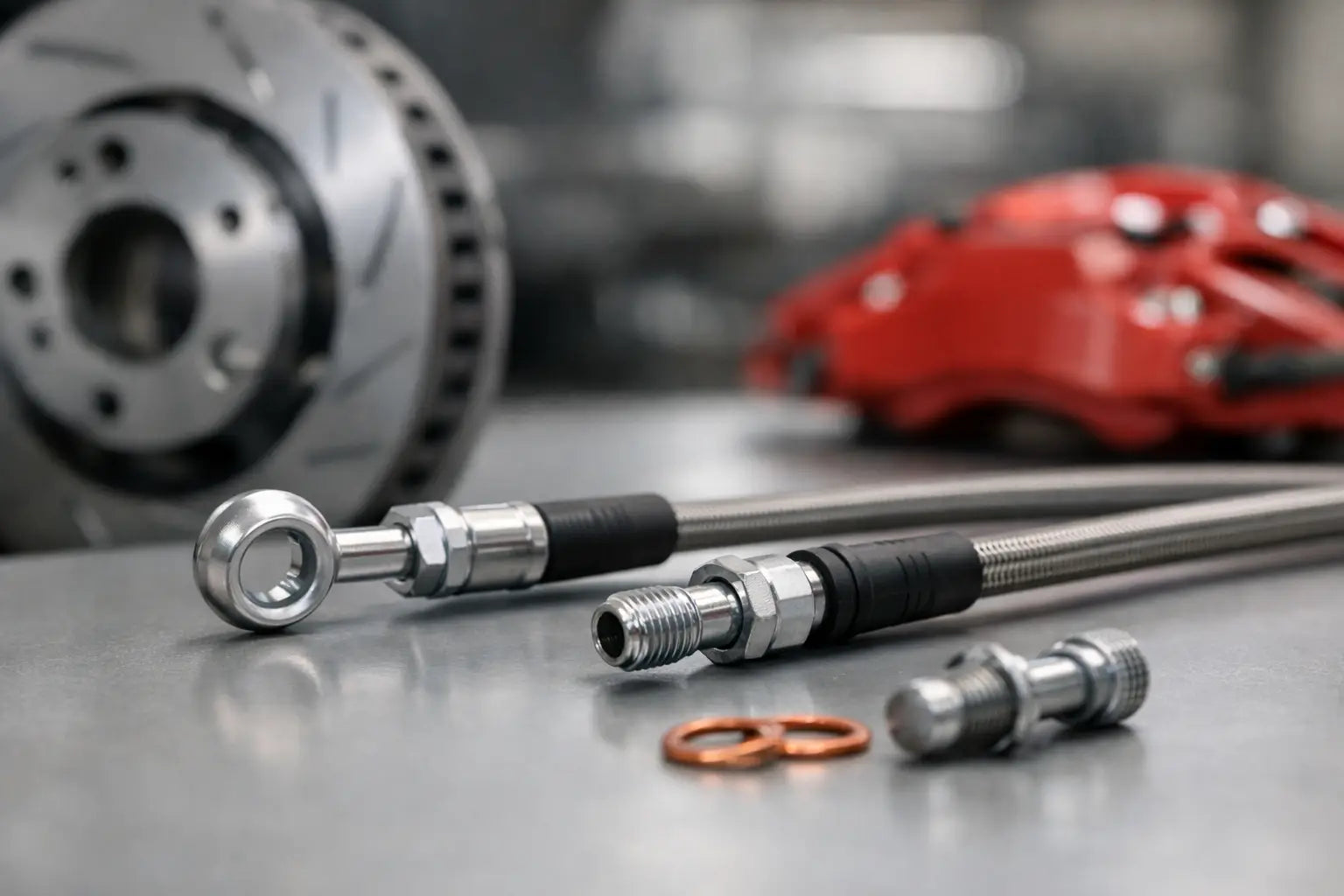
You usually notice brake lines only when the pedal starts feeling vague. One hard stop on a fast B-road, a few hot laps, or repeated downhill braking with a loaded car, and the question turns up quickly: are braided brake lines worth it? For a lot of enthusiasts, the answer is yes - but not for the reasons marketing copy tends to push.
Braided brake lines are not a magic stopping-power mod. They will not suddenly cut your braking distances in half, and they will not fix poor pads, tired fluid, cooked discs or a badly bled system. What they can do is make the pedal feel more consistent, especially when temperatures rise and the rest of the braking system is working harder. If you care about pedal feedback, threshold braking and confidence under repeated heavy use, that matters more than the headline numbers.
Are braided brake lines worth it for road cars?
For a normal daily driven car that never sees hard use, braided lines are more of a refinement than a must-have upgrade. The factory rubber hoses on most modern cars are perfectly adequate for commuting, motorway driving and the occasional spirited run. If your current setup is healthy, you may fit braided lines and come away thinking the change is subtle.
That does not mean the upgrade is pointless. Braided stainless lines reduce hose expansion compared with conventional rubber items. In simple terms, when you press the pedal hard, less of that hydraulic force is lost to line flex. The result is usually a firmer, more precise pedal. On the road, that can translate to better modulation when braking into wet roundabouts, tighter control during quick direction changes, or simply a more confidence-inspiring pedal under pressure.
The key word is confidence. Many enthusiasts upgrade brakes chasing outright stopping force, when what they really want is a pedal that tells the truth. Braided lines help with that. If your car is already on better pads and fresh high-temperature fluid, the improvement becomes easier to feel.
What braided brake lines actually change
The stainless braid wrapped around the hose helps resist expansion under hydraulic pressure. That is the real benefit. You are not creating more grip at the tyre, and you are not adding clamping force out of nowhere. You are making the system respond more consistently to your input.
On a fast road or track car, consistency is everything. A softening pedal after a few heavy stops forces you to second-guess your braking point. Even if the car still has enough stopping power, reduced confidence makes you brake earlier and leave performance on the table. Braided lines can help preserve that solid pedal sensation, especially when paired with quality fluid and a proper bleed.
This is also why they are often recommended as part of a package rather than a standalone miracle cure. Good pads manage heat better. Better fluid resists boiling. Braided lines reduce compliance in the hydraulic system. Together, those upgrades produce a braking setup that feels sharper and holds up better under repeated abuse.
Pedal feel versus braking distance
This is where people get caught out. Braided lines mainly improve pedal feel, not absolute stopping distance. If your tyres are mediocre, your pads are low-grade, or your discs are overheated, the car will still be limited by those factors.
That said, better feel can indirectly help real-world braking performance. If the pedal is firmer and easier to modulate, it becomes simpler to brake right at the limit without overcommitting or backing off too much. For a driver who pushes the car hard, that is a real advantage.
Are braided brake lines worth it for track days?
If your car sees regular track use, the case gets much stronger. Track driving exposes weaknesses in the braking system very quickly. Rubber lines that feel acceptable on the road can start to show their limits once heat builds and braking loads repeat lap after lap.
In that environment, braided lines are one of the more sensible supporting mods you can make. They will not replace the need for proper pads or fluid, but they help the whole system stay more predictable. For track-day regulars, sprint competitors and anyone doing repeated hard runs, that predictability is worth paying for.
They are especially worthwhile on heavier cars, quicker turbo builds, and platforms that are being driven well above stock performance levels. Add sticky tyres, coilovers and more speed on corner entry, and suddenly the brakes have a much harder life than the factory engineers intended for everyday use.
When the upgrade makes the most sense
Braided lines make the most sense when your brake system is already being upgraded in stages. If you are fitting performance pads, replacing ageing hoses, refreshing fluid or preparing a car for track work, it is easy to justify doing lines at the same time. Labour overlaps, bleeding is already on the job list, and you end up with a better-rounded setup.
If your car still runs old fluid, tired discs and cheap pads, start there first. A lot of disappointing brake upgrades come from fitting one shiny component into an otherwise neglected system.
The trade-offs most people ignore
Braided brake lines are not completely free of downsides. The biggest one is simple: quality matters. A well-made, vehicle-specific kit from a reputable manufacturer is one thing. Generic or poorly finished lines are another. Fitment accuracy, hose length, end fittings and protective coatings all matter because this is a safety-critical part.
Some lower-quality lines can be harder to inspect visually than rubber hoses, especially if the outer braid or coating hides underlying issues. That is not a reason to avoid them, but it is a reason to buy properly and install properly.
There is also the reality that some drivers expect too much. If you fit braided lines to a road car with standard pads and old fluid, the difference may not blow you away. The upgrade is usually felt best by drivers who are sensitive to brake modulation or who regularly drive in conditions that expose hose expansion.
Ride quality and noise are not really factors here, but maintenance discipline is. Brake work needs to be done correctly, torqued correctly and bled correctly. If there is any doubt, get the job done by someone who knows performance brake systems rather than treating it like a cosmetic bolt-on.
What matters more than braided lines
If you are trying to decide where to spend budget, be honest about the weak link. On most cars, the first meaningful brake upgrades are usually tyres, pads and fluid. Tyres determine available grip. Pads define bite, fade resistance and temperature behaviour. Fluid determines how well the system copes with heat.
Braided lines sit just behind that group. They are rarely the first mod that transforms a car, but they are often the mod that makes the whole brake package feel finished. That is why serious enthusiasts fit them even when the gains look modest on paper.
A firm, repeatable pedal changes how you drive. It lets you trust the car more, brake later with less drama, and carry confidence from the first stop to the last. For a tuned road car or weekend track build, that has real value.
So, are braided brake lines worth it?
Yes, if you want a sharper, more consistent pedal and you are realistic about what the upgrade does. They are most worthwhile on fast road cars, track-day builds, heavier performance models and any setup already running better pads and fluid. They are less essential on lightly driven daily cars that never get the brakes properly hot.
Think of braided lines as a driver-focused upgrade rather than a headline-grabbing one. They do not sell the fantasy of huge stopping-force gains. They tighten the connection between your foot and the caliper. For enthusiastic driving, that is often exactly the point.
If your current hoses are ageing, if you are refreshing the system anyway, or if you are building a car that needs to stay composed under repeated hard braking, braided lines are money well spent. Not because they look motorsport, but because they make the brake pedal feel like it should have from the start.
The best brake upgrades are the ones that let you trust the car more every time you lean on it. Braided lines fit that brief when the rest of the setup is ready to take advantage of them.