
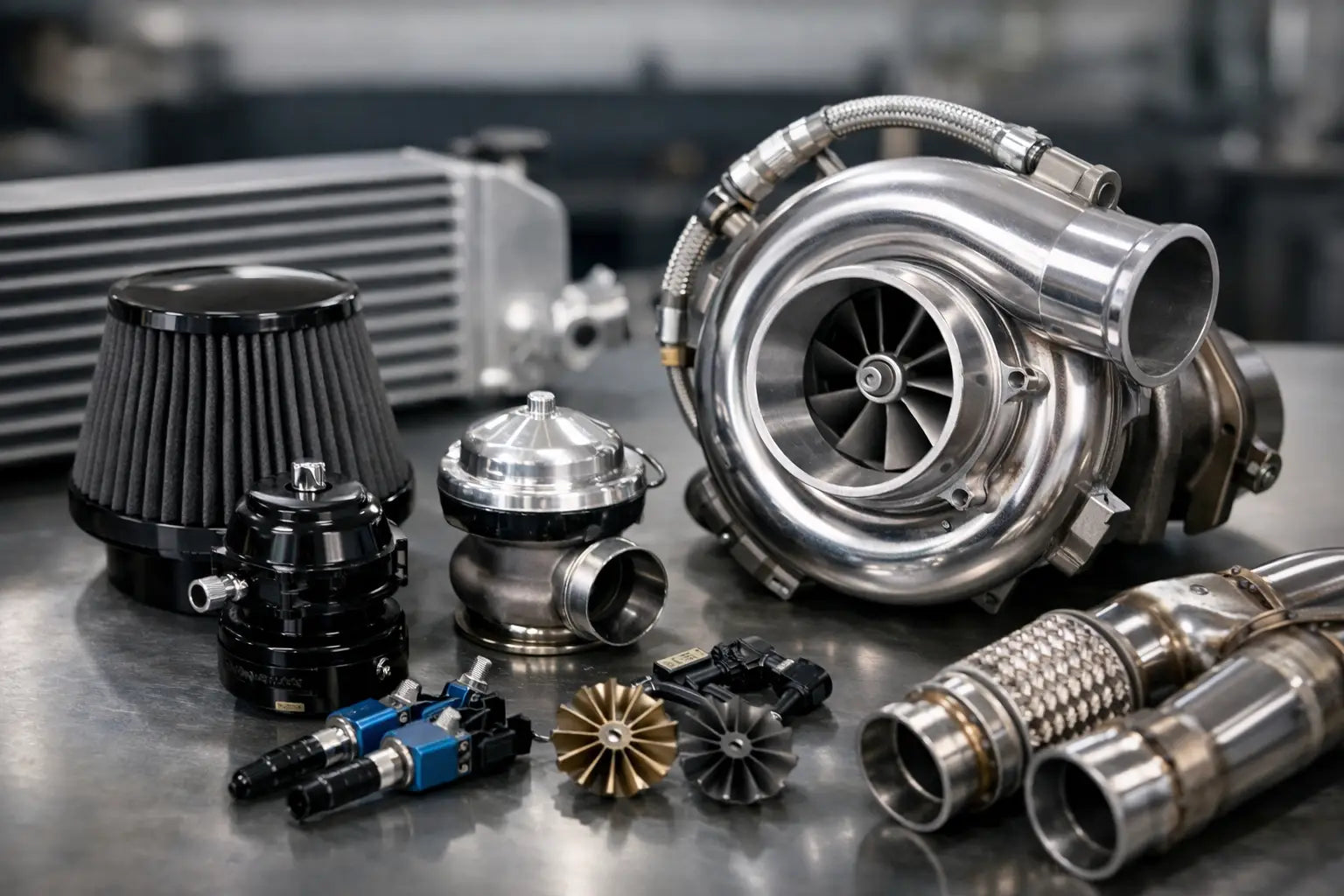
A car that makes strong peak power but feels flat before boost comes in is rarely satisfying for long. If you are chasing the best mods for turbo response, the goal is not just a bigger dyno figure - it is getting the turbo to wake up sooner, build boost harder, and follow your right foot with less hesitation.
That means thinking beyond one headline part. Turbo response is shaped by airflow, exhaust energy, tuning, charge temperatures, and even how well the drivetrain keeps the engine in the useful part of the rev range. Some upgrades transform the car. Others only work when the rest of the setup is ready for them.
What actually improves turbo response?
Turbo response is really about how quickly the turbocharger can generate usable boost when you ask for torque. Smaller rotating mass helps. So does reducing restriction before and after the turbo. Better calibration matters just as much, because poor boost control or lazy throttle mapping can make a decent hardware setup feel slow.
The catch is that response and peak power do not always move together. A huge turbo might make more power at the top end, but if you use the car on the road, on tighter circuits, or in autocross-style events, it can feel slower everywhere that counts. For most enthusiasts, the best result comes from a balanced package rather than the most aggressive part on the shelf.
Best mods for turbo response that actually make a difference
1. ECU remap or proper custom tuning
If the car is still on a factory calibration, tuning is often the smartest place to start. Modern turbo cars rely heavily on software for throttle mapping, boost targeting, wastegate control, ignition timing and torque management. A well-written remap can sharpen spool behaviour and improve part-throttle response without changing a single hard part.
This is also where a lot of bad builds go wrong. Generic files that chase boost numbers can create a punchy mid-range but poor control, heat build-up, or inconsistent delivery. A proper calibration matched to the fuel quality and hardware is usually one of the highest-value upgrades you can make.
On many platforms, tuning alone will not eliminate mechanical lag, but it can remove the soggy feeling that makes the car seem less responsive than it really is.
2. A freer-flowing downpipe and exhaust
The turbo lives on exhaust energy. If the turbine side is fighting backpressure, response suffers. A high-flow downpipe is one of the most proven ways to help the turbo spool earlier and recover faster between shifts, especially on factory turbo cars with restrictive catalytic sections close to the turbine outlet.
A full exhaust can help too, but the biggest gain is usually closest to the turbo. You are not just chasing noise here. Reducing post-turbine restriction lets the turbo work more efficiently, which tends to improve both response and top-end breathing.
There is a trade-off. Some setups become louder than you want for daily use, and emissions compliance matters depending on your car and where it is used. If you want a sharper car without making it tiring, choose components with sensible sizing rather than assuming the largest pipe is automatically best.
3. High-flow intake and better turbo inlet
Factory intake systems are often designed around packaging, noise reduction and cost before outright performance. On many turbo platforms, a high-flow intake combined with a less restrictive turbo inlet pipe improves the compressor's ability to draw air, especially at lower shaft speeds where every bit of efficiency counts.
This is one of those upgrades that depends heavily on the platform. Some cars respond well because the original inlet is genuinely narrow or awkwardly shaped. Others gain more induction noise than actual performance. The best results come when the intake path is improved as a system, not just by swapping the visible air filter.
Heat management matters here as well. An open filter sitting in a hot engine bay can sound great and perform worse in traffic. A well-designed intake with proper shielding is usually the better choice for a fast road car.
4. Intercooler upgrade when heat is the real problem
An intercooler does not usually make the turbo spool dramatically earlier on its own, so it is not always the first answer when someone asks about the best mods for turbo response. But if your car is pulling timing, reducing boost, or feeling soft after a few hard pulls, charge temperature is already hurting response.
A good intercooler stabilises intake air temperatures and lets the calibration hold performance more consistently. On tuned cars, especially those used in warm weather or on track, that consistency matters. The first pull is one thing. The fourth lap or repeated overtakes on a B-road are where cooling upgrades prove their worth.
Go too large, though, and you can add volume to the charge system, which may slightly affect transient response. That does not mean bigger intercoolers are bad - only that the right core and end-tank design matter more than headline dimensions.
5. A better-matched turbocharger
If the stock turbo is running out of efficiency or the current aftermarket unit is simply too big for the job, changing the turbo itself can completely alter how the car drives. This is where response is won or lost.
For road and mixed-use builds, a well-matched turbo with efficient modern compressor and turbine design often beats an oversized unit every time. Twin-scroll housings, ball-bearing centres, and properly chosen A/R ratios can all improve spool characteristics while still supporting useful power.
This is not a simple bigger-is-better category. A turbo that is perfect for a high-revving circuit build may be miserable in traffic or on a heavier street car. Think honestly about how you use the vehicle. If you spend most of your time between 2500 and 5000 rpm, build for that range.
6. Boost control hardware and recirculation components
Weak or inconsistent boost control can make a turbo car feel lazy even when the main hardware is sound. An upgraded boost control solenoid, a properly set up wastegate system, and healthy diverter or recirculation valves can sharpen how the car comes onto boost and how quickly it recovers after lifting off.
This matters a lot on older turbo platforms and modified cars with pieced-together parts. If the wastegate is creeping, the actuator is poorly matched, or the recirculation valve is leaking, you are leaving response on the table.
Not every car needs aftermarket hardware here, but every turbo car needs this system to be working properly. It is worth checking before throwing money at more visible parts.
7. Supporting mods that keep the engine in boost
Sometimes the best improvement in response is not on the turbo system at all. Lighter wheels can reduce rotational inertia and make the car feel more eager. Shorter gearing can keep the engine closer to boost threshold. A well-sorted clutch and flywheel setup can also change how quickly the engine picks up revs, though a very light flywheel can make daily driving less smooth.
These are not direct turbo mods, but they affect how responsive the whole package feels. On track-focused builds, they can be the difference between a fast car on paper and one that actually pulls hard out of slower corners.
The most effective upgrade paths
If your car is close to stock, a remap plus a downpipe and a quality intake path is often the sweet spot. That combination tends to bring the biggest real-world gain without pushing too far into compromise.
If you already have those basics and the car still feels soft after repeated hard use, look at intercooling and boost control next. If the setup is built around a turbo that only comes alive too late, be honest and rethink turbo sizing rather than trying to tune around the wrong hardware.
For higher-power builds, treat response as a system. Exhaust manifold design, cam timing, fuelling headroom and gearbox ratios all start to matter more as the setup becomes more specialised.
What to avoid when chasing faster spool
Cheap parts with vague fitment claims are the usual trap. A poor-quality intake, a badly designed manifold, or an inconsistent tune can make the car worse, not better. Turbo response depends on control and efficiency, not just airflow marketing.
It is also easy to chase internet opinions from totally different builds. A mod that works brilliantly on an EA888 Golf GTI might be mediocre on an N54 BMW or a 2JZ Toyota. Platform matters. Usage matters. Fuel quality matters too.
That is why proven brands and fitment-specific parts are worth the money. You are not only buying a component - you are buying a known result, or at least a much better chance of one.
Choose parts that suit the way you drive
The best turbo response setup for a road car is rarely the same as the best setup for drag racing or long circuit sessions. A punchy, fast-spooling package makes the car feel alive in everyday driving and on tighter roads. A bigger, later-hitting setup may suit drivers who live at the top of the rev range.
Be clear about the target before you start buying. If you want the car to feel sharper, quicker and easier to place on throttle, build around usable torque and efficient hardware. That is where the best results live, and it is where a properly chosen set of parts from a specialist performance catalogue pays off.
Get the combination right, and the car will not just make boost earlier - it will feel like it wants to hunt for the next straight.