
A brake upgrade can feel disappointing for one simple reason: the discs were chosen for looks, not for the temperature and use the car actually sees. Knowing how to choose brake discs means matching the rotor to your platform, pads, tyres and driving - whether that is a quick B-road car, a heavy turbo build or a track-day weapon that repeatedly brakes from three-figure speeds.
For most performance builds, the right answer is not automatically the most expensive drilled and grooved disc. Start with fitment and thermal capacity, then spend where it will make a measurable difference.
How to choose brake discs: start with fitment
Before comparing disc designs, confirm the non-negotiables: diameter, thickness, centre bore, stud pattern, offset or hat height, mounting arrangement and whether the disc is left- or right-specific. A disc can share the same diameter as your original part and still be wrong because its offset places it out of line with the caliper.
This is particularly relevant on modified cars. A big-brake kit, different hubs, uprated caliper brackets or a factory performance brake option can all change the disc required. Never assume every version of a chassis uses the same brake setup. BMW, Volkswagen Group, Honda and Toyota platforms often have several front brake packages across trims, engines and model years.
Wheel clearance matters too. A larger disc may physically fit behind the caliper but clash with the wheel barrel or spoke profile. If you are moving to a bigger setup, check the brake manufacturer’s wheel-clearance template before committing. It is a far cheaper check than discovering your favourite wheels need spacers, different tyres or replacing altogether.
Choose thermal capacity before surface style
A brake disc’s main job is to absorb and shed heat. More thermal mass generally means a disc can take more repeated braking before temperatures climb into the range where pads fade, fluid boils or the disc distorts. For hard use, disc diameter and thickness matter far more than cosmetic machining.
A larger diameter increases leverage at the wheel, which can reduce the caliper force needed for the same braking torque. A thicker disc carries more heat, while a properly designed vented disc moves air through its internal vanes to cool itself. Directional vane designs can be especially effective, but only when fitted to the correct side of the car.
For a lightly modified road car, an OE-size high-carbon replacement disc is often the smart move. High-carbon castings tend to deal well with heat cycles and can reduce noise and vibration. Add a quality fast-road pad and fresh fluid, and the result is usually more confidence without creating cold-bite, dust or noise issues.
For regular track use, look for a disc with proven vane design, suitable thickness and a material specification designed for sustained heat. If your existing disc is marginal for the car’s weight and speed, a larger rotor and caliper package may be the real upgrade. No surface pattern can compensate for an undersized brake system being asked to stop a 1,600kg car lap after lap.
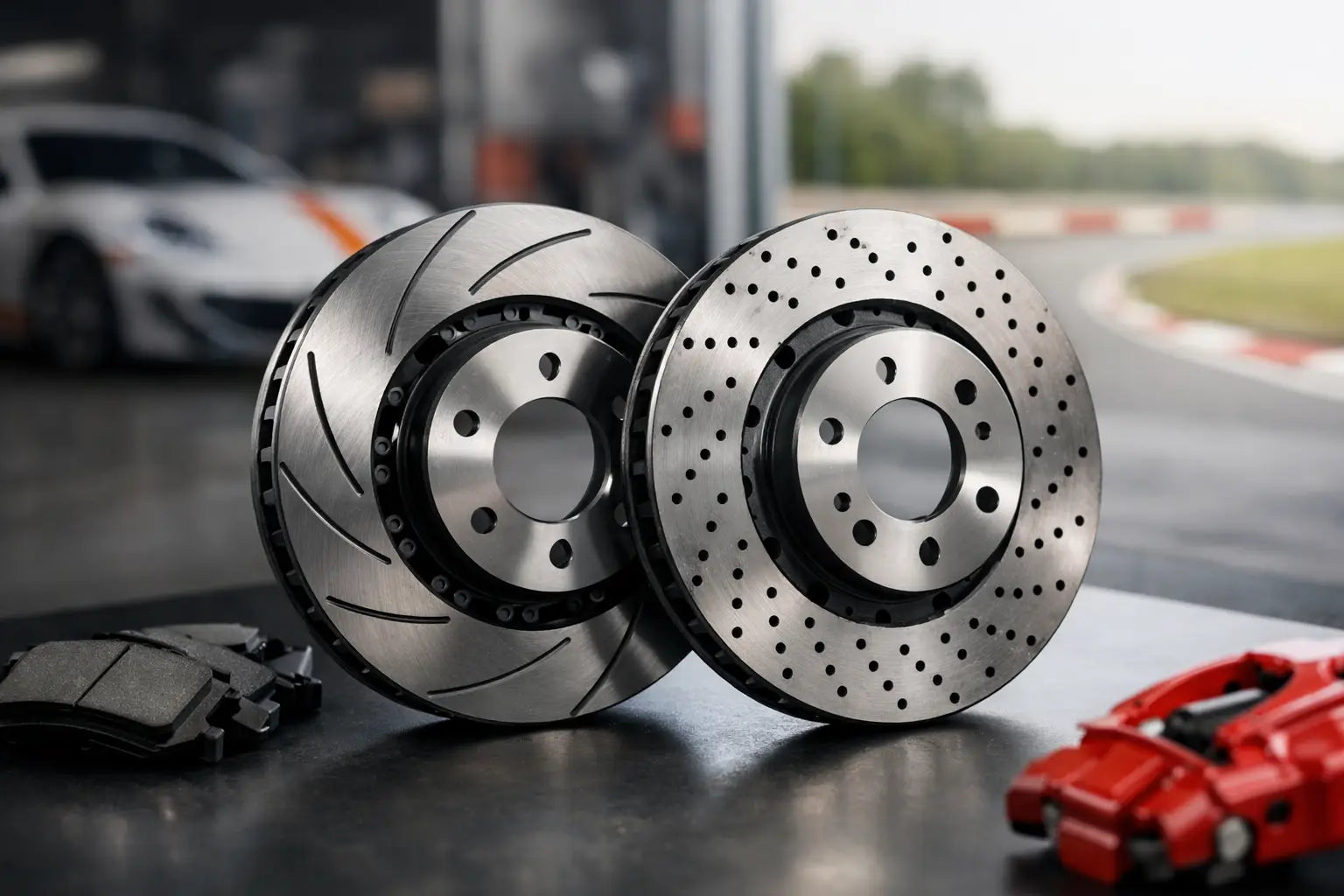
Plain, grooved, drilled or dimpled?
Surface design has a purpose, but it should be treated as the finishing choice after fitment and capacity.
Plain discs offer the largest uninterrupted friction surface and are often the best-value choice for road cars. They are quiet, durable and work very well with modern pad compounds. Do not mistake plain for basic: a quality plain disc from a respected braking manufacturer can outperform a cheap drilled disc where it counts.
Grooved discs use machined channels to keep the pad face clean and provide a more consistent initial response under hard braking. They can suit enthusiastic road driving and track work, particularly with pads that leave material on the disc surface. The trade-off is faster pad wear and, depending on the groove pattern and pad compound, more audible braking.
Cross-drilled discs can improve the initial bite and give a purposeful motorsport look. However, drilled holes concentrate stress. On a car that sees repeated high-temperature cycles, especially a heavier vehicle or turbocharged track build, cracks can form around the holes. That does not mean every drilled disc is unsuitable - quality casting, correct pad choice and sensible temperature management all matter - but they need regular inspection.
Dimpled discs give some of the cleaning effect and visual appeal of drilled rotors without drilling completely through the friction ring. They can be a sensible middle ground for a fast road car, though the exact benefit depends on the disc and pad combination.
Match the discs to the pad compound
Discs and pads work as a system. A disc upgrade paired with an unsuitable pad can bring noise, inconsistent cold response, heavy dusting or rapid wear. Equally, a capable track pad on a standard disc can create enough heat to expose the limits of the rotor, fluid and cooling.
For daily-driven performance cars, choose a pad with reliable cold bite and a temperature range that covers spirited road use. A fast-road compound is usually more appropriate than an aggressive circuit-only pad. The latter may feel poor on a cold morning, squeal around town and wear the disc unnecessarily.
For track-day cars, select a pad for your vehicle weight, tyre grip, power level and session length. Sticky tyres and added power raise brake temperatures quickly. A pad with a higher operating range can resist fade, but it may also transfer more heat into the disc and caliper. That is where better fluid, stainless braided lines and brake cooling become part of a complete package rather than optional extras.
Bed the pads and discs in exactly as the manufacturer specifies. This builds an even transfer layer of pad material on the disc face. Skipping the process can leave uneven deposits that feel like warped discs, even when the disc itself is still true.
Consider car weight, power and real driving use
A 1,100kg naturally aspirated hatchback and a 1,800kg four-wheel-drive turbo saloon may both run similar wheel sizes, but their braking demands are worlds apart. Vehicle mass, acceleration, tyre grip and track layout all affect disc temperature.
Be honest about where the car is used. A polished set of grooved discs is rarely the priority for a road-only build that needs quiet, dependable braking through winter. Conversely, if you are doing repeated sessions at Spa, the Nürburgring or your local circuit, saving money on rotors can become false economy after one weekend of pad fade, cracked discs or vibration.
Also consider whether the factory rear brakes are correctly balanced with any front upgrade. Increasing front brake capacity can be useful, but braking performance is not simply about fitting the biggest possible front discs. The car needs stable brake bias, compatible ABS behaviour and tyres capable of using the extra stopping force.
Inspect the details that affect reliability
Quality shows up in areas that product photos rarely emphasise. Look for a reputable casting, corrosion protection on non-friction surfaces, accurate machining and clear minimum-thickness information. Coated hats and edges help keep a road car looking tidy through wet UK winters, although the coating will naturally wear from the braking face.
If you run two-piece discs, factor in ongoing costs. They can reduce unsprung and rotating mass, and replacement friction rings may be more economical over time. But the initial outlay is higher, hardware needs correct torque procedures and they make most sense where the weight saving and thermal performance will actually be used.
Check discs at every wheel change or service interval if the car sees hard use. Watch for heat checking, cracks around drill holes, deep scoring, a lip at the outer edge and thickness approaching the stated minimum. A brake pedal vibration is not proof of a warped disc; it is often caused by uneven pad deposits, hub run-out or poor installation. Clean the hub face thoroughly and torque wheel bolts evenly to prevent problems before the first drive.
Spend for the build you have, not the build you imagine
The strongest brake setups are matched systems, not shopping-basket trophies. A quality OE-size disc, suitable pads, fresh high-temperature fluid and good tyres will transform many fast-road cars more effectively than oversized rotors behind budget tyres. For serious circuit use, build around heat management first: adequate rotor mass, proven pads, fluid that can handle the temperature and cooling where the platform allows it.
Torque Lab’s performance catalogue makes it easier to filter by vehicle and choose from established brake brands, but the best result still comes from defining the job first. Choose discs that will run comfortably within their limits, and your next hard stop will feel controlled rather than hopeful.