
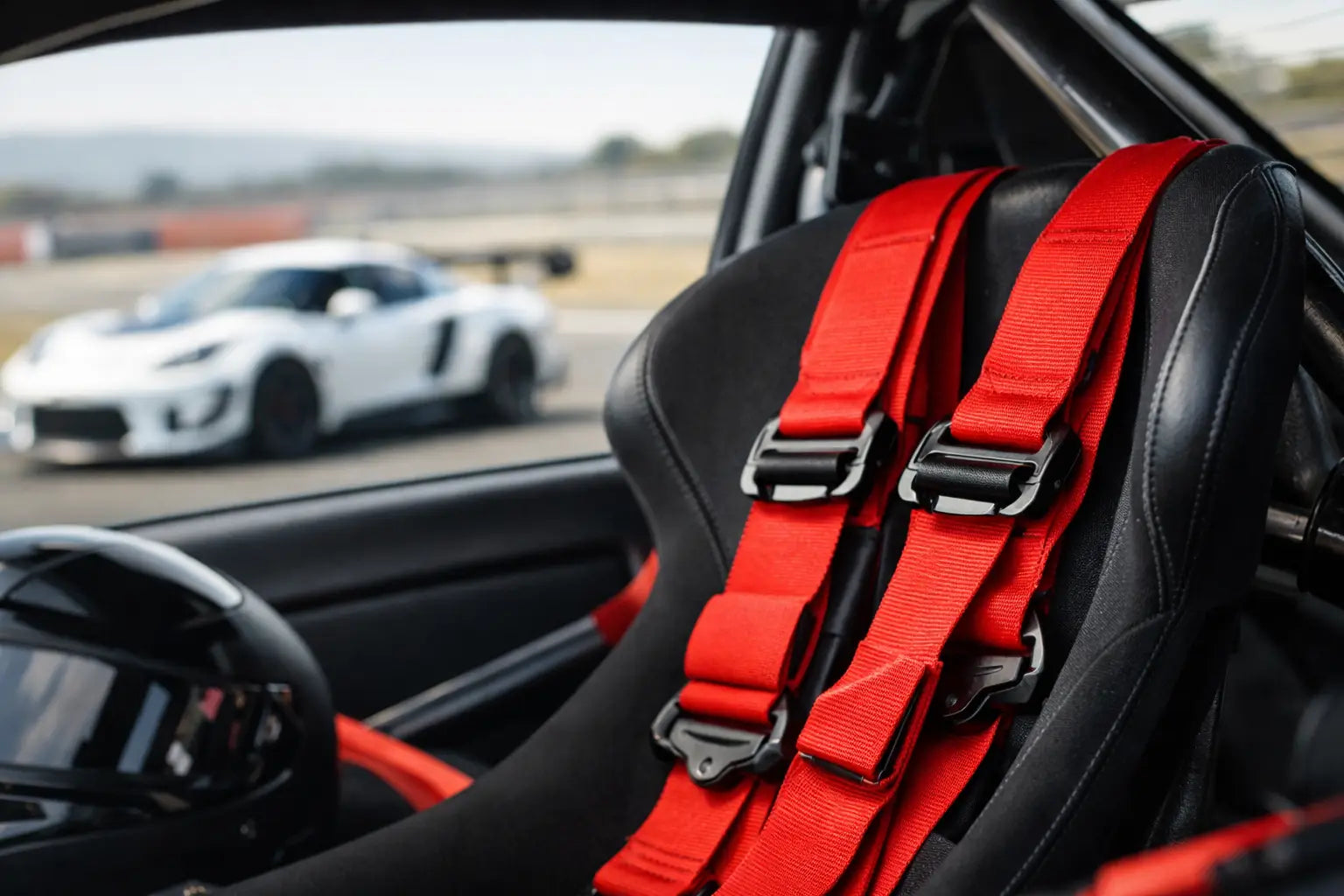
A harness that looks serious on social media can be the wrong choice the moment you brake from 120 mph. The best racing harness for track car use is not simply the one with the most straps, the biggest shoulder pads or the familiar motorsport logo. It is the one that works with your seat, mounting points, roll structure, helmet and intended events.
For a track-day build, restraint choice is a safety system decision. Get the geometry right and the car feels more controlled under braking, turn-in and kerb strikes. Get it wrong and a harness can be less effective than the factory three-point belt it replaced. Build the mounting and seating position first, then choose the harness to suit.
What makes the best racing harness for a track car?
Start with the driving you actually do. A road car that sees occasional track days has different requirements from a stripped BMW E46 race car, a turbo Honda Civic sprint build or a time-attack Toyota GT86 with a full cage. The right product depends on whether you need current FIA homologation for competition, whether passengers will use the car, and whether you can install proper shoulder-bar and lap-belt mounts.
A quality harness should provide firm, repeatable restraint without forcing the webbing over sharp angles or allowing the buckle to migrate under load. Most track-focused drivers will look at four-, five- or six-point designs. The extra anti-submarine straps on five- and six-point harnesses are not decoration: they help prevent the pelvis from sliding beneath the lap belt in a frontal impact.
For serious circuit use, a six-point harness is usually the stronger choice when combined with a suitable fixed-back seat and correctly designed mounts. It spreads restraint through the pelvis and shoulders while allowing the lap belts to stay low and tight. A four-point harness can be appropriate in certain road and track applications, particularly where an anti-submarine solution is built into the design, but it is not a universal shortcut to a race-ready cockpit.
FIA approval matters, but fitment matters more
Current FIA approval is essential if your car will run events with scrutineering requirements. Regulations vary by championship, organiser and country, and harness homologation periods can expire even when the webbing still looks fresh. Check the label, homologation standard and expiry date before buying, then confirm the rules for the events you plan to enter.
For non-competitive track days, an FIA-labelled harness still brings reassurance that it was designed around motorsport standards. But do not let the label override installation quality. A current FIA six-point harness mounted badly is not a safe upgrade.
There are two common approval routes you may encounter: FIA standards aimed at competition use, and ECE-approved road-oriented systems. Neither should be chosen by badge alone. If you need a harness for a race series, follow the series rulebook. If you need a road/track solution, consider legal use, insurance implications, airbag compatibility and the practicalities of using a harness every time you drive the car.
Choose the seat and harness as one package
The shoulder holes in a bucket seat are there to control belt position. They should guide the shoulder straps cleanly from your shoulders towards the rear mounts, without rubbing the edge of the shell or pulling the belts outwards. If the holes are too low, too narrow or badly aligned for your body shape, the harness will not sit as intended.
This is why a fixed-back FIA seat, suitable side mounts and a harness bar or roll cage are such a common track-car combination. It gives you a known seating position and proper structure behind the driver. A reclining seat can work in some setups, but many are not designed for harness use and may not control the belts correctly. Never assume that a sporty-looking seat is harness compatible.
Seat size deserves the same attention. A seat that is too wide lets your hips move, while one that is too narrow creates pressure points and makes it harder to pull the lap belts tight. Sit in the seat wearing the clothes you normally drive in, and ideally with your helmet on. The best cockpit is one you can drive hard in for a full session without constantly readjusting yourself.
Shoulder strap angle is non-negotiable
Shoulder straps should run rearwards from the seat at a shallow downward angle, generally close to horizontal. The precise acceptable range comes from the harness manufacturer, so follow its instructions rather than guessing. Steeply downward shoulder straps can create unwanted compression loads in an impact.
A harness bar is only suitable if it is engineered for the job and places the straps at the required height. Cosmetic bars and generic rear braces are not automatically safe anchor points. For dedicated track builds, a properly designed roll cage with a harness cross bar is often the cleanest solution.
Keep lap belts low on the pelvis
Lap belts must sit low across the pelvic bones, not across the stomach. Their mounts should pull rearwards and slightly downwards according to the manufacturer’s specified angles. This is one of the biggest reasons not to improvise with seat-belt bolts, thin floor panels or convenient holes in the chassis.
Use the supplied eye bolts, clip-in fittings or wrap-around mounts only where the vehicle structure and harness instructions allow. A professional fabricator or motorsport preparation specialist is worth involving if your car needs reinforcement plates, welded mounts or cage work.
Four-point, five-point or six-point?
A four-point harness is the simplest dedicated harness arrangement, with two shoulder straps and two lap straps. It can be practical in a dual-use car, but only when the design and installation address the risk of submarining. Do not assume every four-point harness offers the same protection or is accepted by every organiser.
A five-point harness adds a single anti-submarine strap. It is effective, but the central strap can be less comfortable and less convenient than a six-point arrangement. A six-point harness uses two anti-submarine straps, typically routing either side of the seat opening. That layout is widely preferred in modern race-car installations because it holds the pelvis securely without concentrating load in one central strap.
For a focused track car with a fixed-back bucket seat and cage, choose a six-point FIA harness from a recognised motorsport manufacturer such as Schroth, Sabelt, Sparco or OMP, provided the model suits your mounts and event rules. For a road-driven car, the answer may be to retain the original three-point belt for the road and build a dedicated, properly mounted track restraint system rather than compromise both uses.
Width, adjusters and buckle type
Harness webbing is commonly available in 2-inch and 3-inch widths. A 3-inch shoulder strap offers a broad load area and remains a familiar choice in many race categories. A 2-inch shoulder strap can sit more comfortably with a HANS device, depending on the harness and head restraint combination. If you are planning to use a frontal head restraint, choose components designed to work together rather than mixing parts based on appearance.
Adjuster placement affects day-to-day usability. Pull-up lap adjusters are common and can be easier to tighten in cars with limited room between the seat and transmission tunnel. Pull-down adjusters suit other cockpit layouts. Sit in the car and check that you can reach every adjuster once the steering wheel is fitted.
Rotary buckles are fast and intuitive when gloved, while latch-and-link systems have a traditional race-car feel and can be straightforward to service. Neither automatically makes a harness safer. Buy the buckle type you can operate confidently, including when you are tired after a session or need to exit quickly.
Do not ignore the rest of the safety package
A harness holds you upright, which changes how your body interacts with the car in an incident. That makes helmet, seat, head restraint, cage padding and fire safety part of the same conversation. A harness without suitable rollover protection can create its own risks if the vehicle overturns, particularly in a convertible or a car with a weak roof structure.
It also changes airbag considerations. Factory seat belts, pretensioners and airbags are engineered as a system. Replacing one element can affect how the others work. For a dual-purpose road car, take advice from a qualified motorsport safety specialist and understand the legal and insurance position before modifying the restraint system.
Inspect harness webbing regularly for fraying, fading, contamination, damaged stitching and worn hardware. Fuel, oil, cleaning chemicals and sustained UV exposure can degrade materials. If the harness has been loaded in a crash, replace it. Do not treat a safety component like a used suspension arm that can simply be cleaned up and refitted.
Buy for your build, not the packaging
The fastest way to waste money is buying a harness before measuring the car. Check seat aperture height, shoulder-bar position, lap-belt anchor locations, anti-sub strap routing and the mounting hardware required. Confirm whether you need clip-in, bolt-in or wrap-around ends, and make sure the belts will not foul the seat sliders, handbrake or centre console.
Torque Lab customers build everything from fast-road hot hatches to full circuit machines, but the rule stays the same: restraint hardware must match the vehicle’s actual specification. A good harness should disappear once you are strapped in. You should feel planted, able to steer freely and able to reach every control - not pinned into an awkward driving position.
Before the next track day, sit in the finished car with your helmet on, tighten the belts in the correct sequence and have someone check the routing from outside. That ten-minute check can tell you far more than the logo on the shoulder pads.