
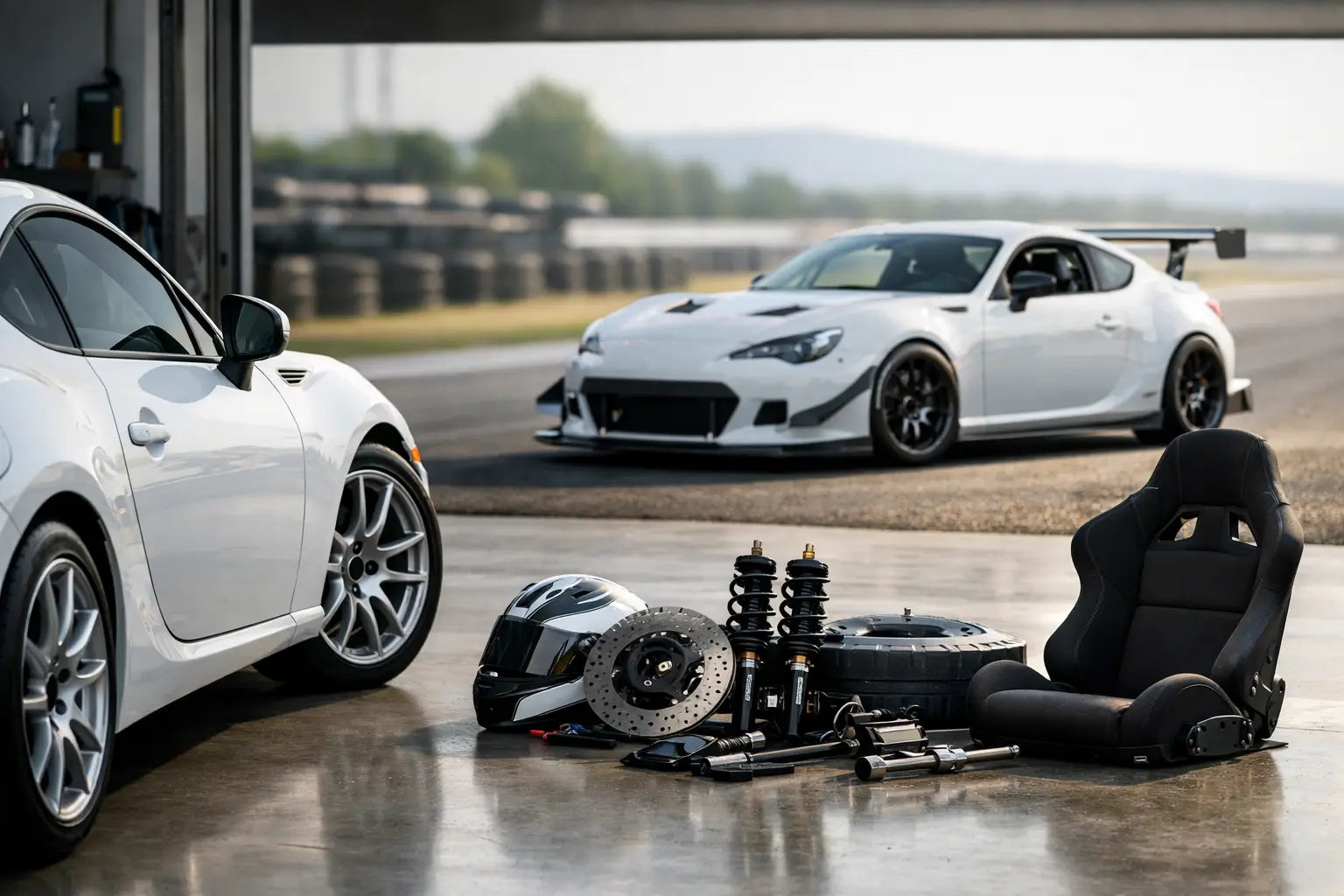
A quick road car can survive a few gentle laps. A proper street car to track build is different: it has to brake repeatedly, manage heat, communicate through the steering wheel and still get you home without feeling like a punishment. The aim is not a catalogue of expensive parts. It is a balanced car with a clear job.
Most first-time track builders chase power because it is easy to measure and fun to talk about. On a circuit, though, the stopwatch usually rewards the car that carries speed, stays composed and gives its driver confidence at the end of a 20-minute session. Build the platform underneath you first. Add power once the car can use it.
Start With the Car You Actually Have
Before buying anything, be honest about the platform, its condition and the type of events you will attend. A lightweight Civic, Clio, MX-5 or GT86 needs a different approach from a turbocharged Golf GTI, BMW M car or Audi S model. Front-wheel drive cars often ask more of their front tyres and brakes. Heavier all-wheel-drive machinery can generate huge pace, but cooling, consumables and brake wear become serious budget lines.
Maintenance is the first performance modification. Fresh high-temperature brake fluid, correct engine oil, healthy coolant hoses, sound wheel bearings and suspension bushes with no play are non-negotiable. A track day exposes weaknesses that commuting never finds. If the engine is already using oil, the clutch is marginal or the radiator has seen better days, solve that before fitting a bigger turbo or aggressive coilovers.
Set a realistic target, too. A road-biased car used for six track days a year should retain more compliance and weather capability than a machine trailered to every event. There is no prize for making the journey home miserable.
Tyres and Brakes Set the Pace
Tyres are the biggest single change most street-to-track cars will feel. They determine braking distance, lateral grip, steering response and how much confidence you have when the circuit goes greasy. Choose a tyre that matches your use, climate and wheel size rather than simply buying the stickiest-looking semi-slick available.
A fast road and occasional track car may suit a performance road tyre with strong wet behaviour. Once track mileage becomes regular, a track-focused tyre can make sense, but it brings compromises: quicker wear, less wet margin, more noise and a narrower operating window. Keep an eye on pressures after every session. A good tyre at the wrong hot pressure is still a bad setup.
Brakes come next, and the answer is rarely a giant front brake kit on day one. Start with quality track-capable pads, fresh fluid with a high dry boiling point, properly inspected discs and brake lines in sound condition. This is where brands such as Ferodo and EBC Brakes earn their place: the right compound gives a firmer, more consistent pedal when the car is hot.
If repeated track work overwhelms the standard hardware, then look at improved discs, cooling ducts or a correctly engineered big brake kit. Balance matters. An over-braked front end on poor rear pads or tired suspension can make the car unstable under trail braking. The goal is repeatable stopping power, not just a dramatic parts list.
Suspension: Control Before Stiffness
The common mistake is fitting the stiffest coilovers available, lowering the car until the tyres disappear into the arches and calling it track-ready. That may look purposeful in the paddock, but a car that skips across kerbs and bumpy braking zones has less grip, not more.
Good suspension gives the tyre a stable contact patch. Quality coilovers from a proven manufacturer, such as BC Racing, offer useful adjustment, but the spring rate, damping range and ride height must suit the chassis. Lower is not automatically faster. Too much drop can ruin suspension geometry, reduce bump travel and place the roll centre in the wrong place.
Have the car aligned after any suspension work. For many track-oriented road cars, additional negative camber is one of the most valuable changes available, particularly at the front. It helps the loaded outside tyre work through a corner rather than rolling onto its shoulder. Exact figures depend on chassis, tyre and driving style, so treat internet settings as a starting point rather than gospel.
Do not ignore the supporting hardware
Worn top mounts, tired control-arm bushes and weak anti-roll-bar links can undo the benefit of new dampers. Uprated bushes and adjustable arms have a place when they improve geometry control or provide the adjustment you need. Avoid turning every rubber component into a hard-mounted race part unless the car’s purpose justifies the added noise and vibration.
Manage Heat Before Adding More Power
Power is addictive, but heat is what ends sessions. Turbocharged cars are especially vulnerable to high intake temperatures, oil temperatures and coolant temperatures after several hard laps. A car that feels strong on the first flyer but pulls timing by lap five needs a cooling plan, not another remap.
Start by monitoring. Use reliable gauges or data logging to see coolant, oil and intake air temperatures under real load. Then upgrade the weak point. Depending on the platform, that might mean a larger radiator, oil cooler, intercooler, better ducting or a motorsport-grade coolant hose setup. Mishimoto and other established cooling specialists offer platform-specific parts that make more sense than universal improvisation.
The same thinking applies to fuelling. If you plan more boost, ethanol blends or extended high-load use, confirm injector capacity, fuel pump health and tune calibration first. A conservative, well-supported tune that runs lap after lap is more valuable than a headline figure followed by limp mode.
Build the Drivetrain Around Traction
A limited-slip differential can transform a front-wheel-drive or rear-wheel-drive car more than a modest power increase. It helps put torque down on corner exit and reduces the one-wheel spin that overheats tyres and frustrates drivers. It is not a cheap modification, especially once labour is included, but it is one of the clearest examples of buying lap time rather than buying bragging rights.
Consider the clutch, gearbox and driveshafts as part of the same system. More torque, sticky tyres and hard launches all increase load. For a manual car, a clutch upgrade should retain sensible pedal feel if road use remains important. For dual-clutch or automatic platforms, investigate transmission cooling and software behaviour before chasing big torque figures.
Safety and Driving Position Are Performance Parts
If you slide around in the seat or stretch for the wheel, you cannot be consistent. A supportive bucket seat, correctly mounted to the car, plus a secure driving position can be a revelation. Your wrists should reach the top of the steering wheel with a slight bend in your arms, and your legs should operate the pedals without locking out.
Harnesses, roll bars and cages need careful thought. A harness without the correct seat, mounting points and rollover protection can create its own risks. For a road car, retain the standard three-point belt unless you are fitting a complete, correctly designed restraint system. Check the rules of the organiser and your insurer before changing safety equipment.
A helmet, suitable clothing and a compact fire extinguisher are sensible track-day kit. So are a torque wrench, tyre pressure gauge, spare fluids, basic tools and a way to get home if something fails. Motorsport preparation is rarely glamorous, but it prevents a small issue becoming a ruined day.
Upgrade in Stages, Then Test Properly
The best street car to track build is rarely completed in one order. Make a change, test it, record tyre pressures and temperatures, note brake feel, and assess what the car is doing at turn-in, mid-corner and exit. If it understeers, do not automatically buy a rear anti-roll bar. The cause could be front tyre pressure, alignment, driving technique, damping or simply entering too fast.
A useful first phase is maintenance, tyres, pads, fluid and alignment. Phase two can add suspension refinement, cooling and a seat. Once those foundations are proven, move into differential, aero and power upgrades with a clearer understanding of what the car needs.
Torque Lab’s platform-specific performance catalogue makes it easier to build this way: choose parts around your vehicle and intended use, not because they happened to be on sale or looked right in a social post.
The final advantage is seat time. Book another track day, arrive with a car that is checked and prepared, and focus on smooth inputs. The fastest builds are not always the loudest ones. They are the cars that finish every session with stable temperatures, predictable brakes and a driver ready to go again.