
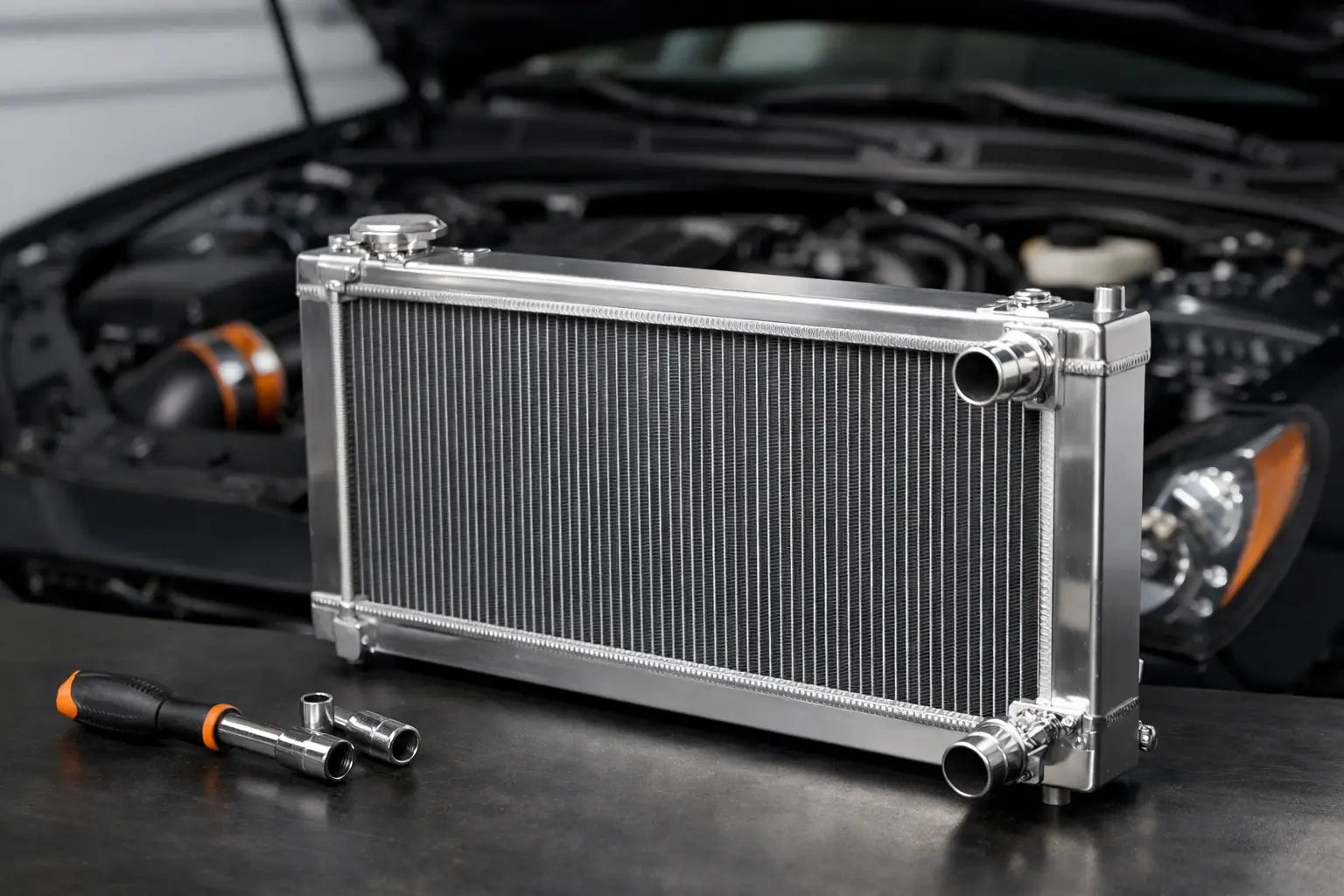
A cooling upgrade is rarely the most glamorous purchase in a build, but it becomes very interesting when the temperature needle starts climbing halfway through a track session. This Mishimoto radiator review looks at where the brand’s aluminium radiators make sense, where expectations need managing, and how to choose one that suits the way your car is actually used.
For a standard road car that never sees prolonged load, an OEM-quality replacement radiator can be perfectly adequate. For a tuned turbo platform, a hard-driven naturally aspirated engine, or a car that repeatedly sits in traffic before being pushed on a B-road or circuit, the factory cooling margin can disappear quickly. That is the space Mishimoto targets.
What a Mishimoto radiator is designed to solve
Mishimoto is best known for direct-fit aluminium cooling upgrades across a huge range of Japanese, European and American platforms. The usual recipe is a larger or more efficient core, aluminium end tanks, vehicle-specific mounting points and a design intended to increase coolant capacity and heat transfer compared with many original radiators.
The key word is intended. A radiator does not create power, nor does it fix every overheating issue. What it can do is give the cooling system more reserve under sustained heat load. That matters when boost is raised, ignition timing is more aggressive, ambient temperatures are high, or the car spends lap after lap operating well beyond the demands of normal commuting.
On popular tuner cars, the appeal is straightforward: you get a recognised performance brand, application-led fitment and a component built for more abuse than a thin, ageing factory unit. It is also a sensible preventative upgrade when an original plastic end-tank radiator is showing its age.
Mishimoto radiator review: build quality and design
Most Mishimoto performance radiators use all-aluminium construction, rather than the plastic end tanks commonly found on OEM radiators. That is a major selling point for enthusiasts who have experienced cracked tanks, tired crimps or a factory radiator failing at the worst possible moment. Aluminium end tanks can tolerate heat cycles well, and the welded construction has a purposeful motorsport look in the engine bay.
Core thickness varies by application. Some radiators are close to an upgraded OEM replacement, while others use a substantially thicker core designed around higher-capacity cooling. Bigger is not automatically better, however. A thick core needs enough airflow to use it properly. If the fan shroud is missing, the fans are weak, the air conditioning condenser is clogged with debris, or the front bumper ducting lets air escape around the radiator, the upgrade will not show its full value.
Fit and finish are generally a strong part of the Mishimoto proposition, particularly on well-supported platforms. Mounting tabs, hose locations and drain fittings are designed around the intended vehicle rather than being a universal radiator made to fit with brackets and hope. That is valuable on a road-and-track car where installation time, clearance and serviceability all matter.
Still, treat every fitment as vehicle-specific. Cars with aftermarket turbo kits, altered front ends, non-standard fans, larger intercoolers or previous accident repairs can introduce complications that no catalogue listing can predict. Check the exact chassis, engine code, transmission type and production year before ordering. Automatic models may need provision for an integrated transmission cooler, while manual versions may not.
Where the cooling gains are most noticeable
The biggest benefit is usually consistency, not a dramatically lower temperature on a gentle drive. If your standard car normally sits at its controlled operating temperature, fitting an upgraded radiator may change very little during everyday use. Modern thermostats and ECU strategies are designed to regulate temperature, after all.
The difference becomes clearer under sustained load. Think repeated pull after pull on a mapped Golf GTI, a turbocharged Honda on a summer track day, a BMW that sees long uphill runs, or a Toyota being used for drifting. Once the whole system is heat-soaked, extra core area and coolant volume can slow the temperature rise and improve recovery between hard sessions.
That reserve can protect more than the engine. Lower, more stable coolant temperatures reduce the likelihood of an ECU pulling timing, can make oil temperature management easier, and help keep a track day from ending early. It is not a substitute for a proper oil cooler on platforms that need one, but it is part of a cooling package that works together.
For modified forced-induction cars, radiator choice should be considered alongside intercooler placement. A large front-mount intercooler can restrict airflow to the radiator, especially with dense bar-and-plate cores. In that situation, a better radiator is useful, but intelligent ducting, a sealed shroud and correctly specified fans can be just as important.
The trade-offs to consider before buying
A Mishimoto radiator is an upgrade, but it is not always the first upgrade to buy. If the car overheats because the thermostat is sticking, the water pump is worn, the expansion cap cannot hold pressure, the system has air trapped inside it, or the fans are not switching on, replacing the radiator alone is expensive guesswork.
There is also the question of installation. Direct-fit does not mean zero-effort. Aluminium radiators need careful handling, especially around the fins. Hoses must sit without stress, clips must be secure, and the cooling system needs to be filled and bled correctly. On certain cars, removing the front bumper, fan assembly or intake hardware is part of the job.
A larger radiator can also expose weaknesses elsewhere. A failing thermostat that was just coping with the factory radiator may become obvious during a proper bleed cycle. An old silicone-free rubber hose may split after being disturbed. This is not a fault of the new radiator - it is a reminder that cooling systems should be refreshed as systems.
Price is the final trade-off. Mishimoto products usually cost more than a basic replacement radiator, and rightly so when the application, construction and intended use justify it. But a road car with standard power and no cooling problems may get more meaningful performance per pound from tyres, brake fluid, servicing or driver coaching. Spend according to the car’s real job, not just the parts list you want to post online.
Choosing the right setup for your build
Start with the failure mode you are trying to prevent. If your OEM radiator is leaking or its plastic tanks are deteriorating, a direct-fit Mishimoto unit can be a quality long-term replacement. If coolant temperatures rise only on circuit, assess airflow, fan control and oil temperature before choosing the biggest core available. If you have added significant power, then upgrading the radiator as part of a wider cooling plan is the sensible route.
For fast-road use, a standard-performance radiator paired with fresh coolant, a healthy thermostat and properly functioning fans is often enough. For track work, forced induction or towing, look more closely at high-capacity options, fan shrouds and whether the platform benefits from an oil cooler as well.
Do not overlook the basics during fitting. Use the correct coolant specification for your vehicle, inspect hoses and clips, clean leaves and dirt from the condenser and radiator stack, and bleed the system according to the manufacturer’s procedure. A high-quality radiator filled with air pockets will perform worse than a standard unit that has been serviced properly.
Is a Mishimoto radiator worth buying?
For the right car, yes. Mishimoto radiators make the most sense where factory cooling is a known weak point, where an original unit is approaching failure, or where tuning and sustained hard use have moved the car beyond its original thermal design brief. The all-aluminium construction, platform coverage and performance-led focus make them a credible choice for enthusiasts building reliable fast-road and track machinery.
The honest answer remains dependent on the build. A Stage 2 hatchback doing occasional spirited road miles has different needs from a dedicated drift car or a turbocharged track build running in high ambient temperatures. Buy the radiator that matches the car’s thermal load, verify exact fitment, and support it with the airflow and maintenance the system deserves.
A cooling upgrade earns its place when it lets you stay on throttle for longer with confidence. That is far more satisfying than watching the gauges and backing off just as the car starts to come alive.