
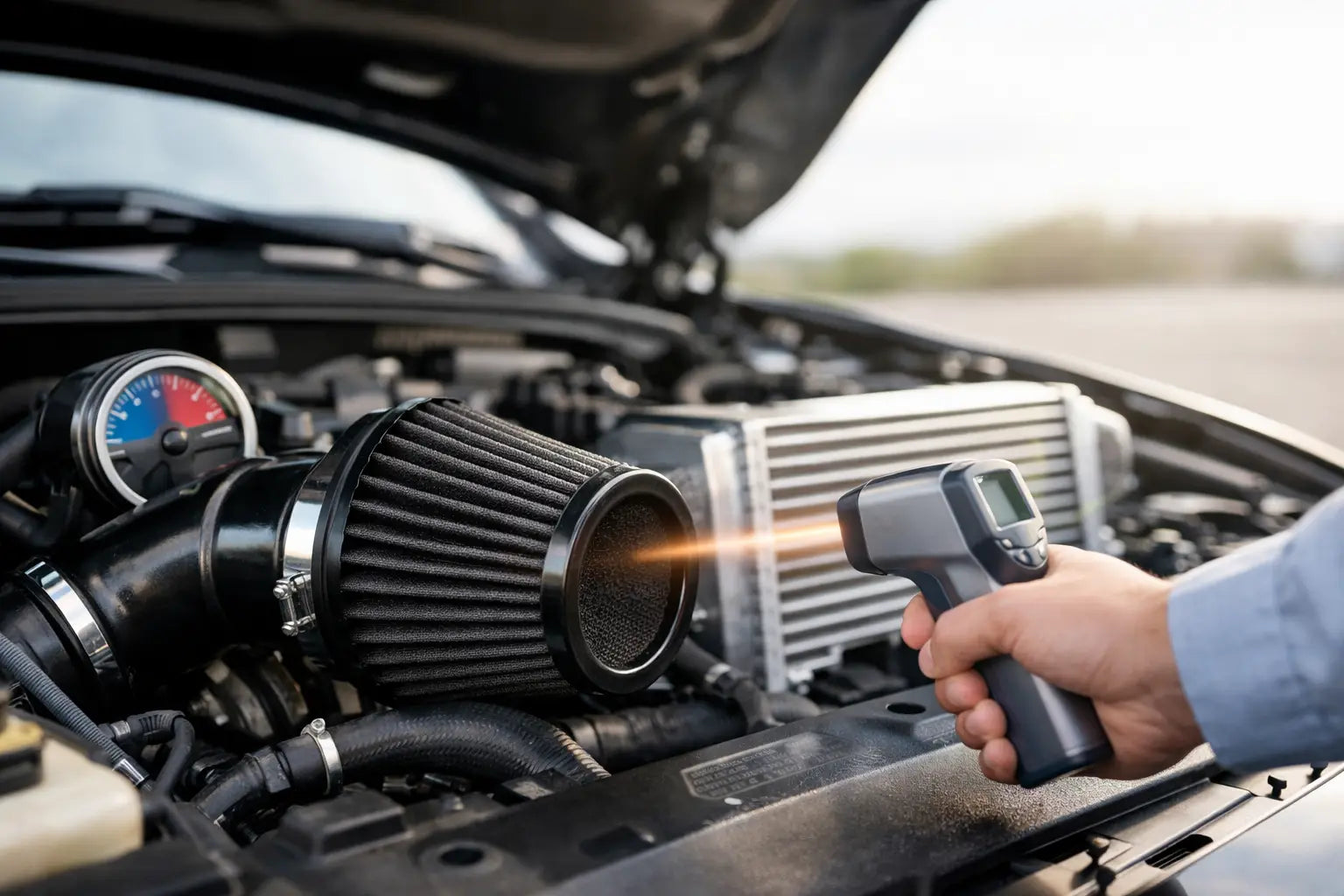
A hard pull that feels sharp at the start of a session, then flat by lap four, is often an intake air temperature problem. Knowing how to improve intake temperatures is not about fitting the biggest cone filter you can find. It is about getting cooler, denser air to the engine consistently, while stopping the intake tract from absorbing heat when the car is stationary, in traffic or working hard on track.
Lower intake temperatures can support more stable ignition timing, improve knock resistance and help a forced-induction engine hold its intended power. The right route depends on the platform, the power target and whether the car spends its life on the road, at roll-racing events or doing repeated track laps.
What intake temperatures actually tell you
The intake air temperature, usually shortened to IAT, is the temperature the ECU sees from its intake air temperature sensor. On a naturally aspirated engine, that is generally close to the air entering the intake manifold. On a turbocharged or supercharged engine, it is more significant: compressing air creates heat, so the temperature after the compressor can rise rapidly under boost.
The ECU uses IAT alongside other inputs to manage ignition timing, fuelling and, on many modern cars, boost targets. Once temperatures climb beyond the calibration’s preferred range, the ECU may pull timing to protect the engine. That is why a car can make a strong first pull and progressively lose pace in the same weather conditions.
Do not judge the issue from a single dashboard reading after a short drive. Log IAT against ambient temperature, vehicle speed, boost pressure, coolant temperature and ignition correction. The useful number is the temperature rise above ambient, especially during the kind of use you care about. A car sitting at 45°C in a queue may not have a serious issue if it drops quickly once moving. A car that remains 25°C above ambient at speed during a full-throttle pull needs attention.
How to improve intake temperatures: diagnose before buying
Start by identifying where the heat enters the system. A heat-soaked open filter in the engine bay, a poorly sealed cold-air feed, a restrictive intercooler, inadequate radiator airflow and an overly aggressive tune can all produce similar symptoms. Replacing parts at random is an expensive way to chase a temperature number.
Check the basics first. Inspect the intake pipework for loose couplers, collapsed hoses, gaps around airbox lids and damaged seals. On boosted cars, pressure-test the charge system. A boost leak forces the turbo to work harder, raises compressor outlet temperature and can make an intercooler upgrade look ineffective.
Sensor position matters too. A sensor mounted after the intercooler tells a different story from one positioned near the filter. If you are comparing logs between cars or before-and-after parts, make sure you are comparing the same measurement point. A questionable sensor, or heat radiating into its mounting location, can send you in the wrong direction.
Keep the filter supplied with outside air
For naturally aspirated cars and mildly tuned turbo cars, the intake path ahead of the turbo or throttle body deserves proper attention. The goal is simple: draw air from outside the engine bay, through a route that remains effective at speed.
A sealed factory airbox with a larger panel filter and an improved cold-air feed is often a better street solution than an exposed cone filter. Factory boxes are commonly designed to pull from the grille, wing or slam-panel area, and they offer useful protection from under-bonnet heat. On platforms where the standard box becomes restrictive at higher airflow, a vehicle-specific enclosed induction kit can provide the extra capacity without sacrificing temperature control.
Heat shields help only if they separate the filter from engine-bay air and are paired with a real cold-air source. A thin shield around an open filter, with no seal to the bonnet or feed from the front of the car, can look purposeful while doing little in slow traffic. Use high-quality edge trim and inspect clearances carefully. An intake rubbing through on a sharp bracket is not a performance upgrade.
Larger ducting is not automatically better. A huge feed with a poor pickup location may ingest hot air from behind the radiator or suffer from turbulent flow. A well-positioned, sealed duct with a sensible cross-section usually wins. Keep water ingestion in mind if the pickup sits very low in the bumper, particularly on a road car that sees heavy rain.
On turbo cars, prioritise charge-air cooling
Once boost and power rise, the intercooler becomes the main player. The turbocharger heats compressed air far more than the intake filter ever will, so fitting a cold-air intake alone will not solve high IATs on a remapped turbo car.
A larger, more efficient front-mount intercooler gives the charge air more core volume and surface area to shed heat. What matters is not headline size but an intercooler designed for the airflow, pressure and packaging of your platform. A core that is excessively thick, badly ducted or blocked by other coolers can create pressure drop and reduce airflow through the radiator pack.
Look for a setup with smooth end-tank design, correctly sized pipework and secure fitment. Shorter charge pipes may improve response slightly, but the biggest temperature gain normally comes from intercooler efficiency and clean airflow through the front of the car. A quality upgrade from a proven cooling specialist is worth more than a universal core with uncertain internal design.
Ducting around the intercooler is frequently overlooked. Air takes the path of least resistance. If there are large gaps around the core, much of the high-pressure air entering the grille will bypass it rather than pass through it. Proper shrouding and sealing force air through the intercooler, then out through the radiator pack, rather than allowing it to escape around the edges.
Give hot air somewhere to go
Cooling is a system, not just a component. The front bumper needs a clear inlet, the intercooler and radiator need a clean path through their fins, and the engine bay needs a low-pressure exit route. Bent fins, leaves, road debris and an air-conditioning condenser packed with grime all reduce heat rejection.
Bonnet vents can help under-bonnet temperatures and reduce pressure behind the radiator, but fitment and placement matter. Poorly positioned vents may draw water onto sensitive components, create unwanted turbulence or simply offer more style than airflow. For a track-focused build, use parts engineered for the specific bonnet and platform rather than cutting openings at random.
Support the intercooler with the rest of the cooling package
High intake temperatures do not always begin at the intercooler. If coolant and oil temperatures climb during repeated hard use, the entire engine bay becomes a hotter environment. The turbocharger, intake pipework and intercooler end tanks then have less opportunity to recover between pulls or laps.
A higher-capacity radiator, effective fan control and an oil cooler can make a meaningful difference on track-driven builds, particularly on turbocharged BMW, Audi, Volkswagen, Honda and Toyota platforms with raised boost targets. These upgrades should be selected as a package. Adding a large intercooler in front of an already marginal radiator can improve IAT while worsening coolant temperature.
Water-methanol injection is another option for suitable high-output builds. It can significantly reduce charge temperatures and suppress knock when correctly installed and calibrated. It is not a substitute for a properly sized intercooler, and it adds a maintenance requirement. If the system runs dry, fails or delivers inconsistently, the tune must be safe enough to protect the engine.
Tune for repeatable temperature control
The calibration must match the hardware. A tune that delivers impressive peak figures in cool weather but demands excessive timing at high IAT is not a sensible fast-road or track calibration. Ask for logging support and review ignition correction, boost, lambda and IAT over repeated runs, not just one dyno pull.
For some builds, a small reduction in peak boost produces a much faster car over a full session because it avoids heat saturation. This is especially true where the turbo is being pushed beyond its efficient range. A better-matched turbocharger, freer-flowing exhaust and improved charge cooling can outperform a high-boost setup that spends most of its time pulling timing.
Choose parts around the car’s real job
A daily-driven Golf GTI, a high-power GR Yaris and a circuit-prepped Civic Type R need different answers. The road car may benefit most from an enclosed intake, a fresh service of the cooling stack and a sensible intercooler upgrade. The track car may need full duct sealing, radiator and oil cooling work, plus detailed data logging.
Build the system in stages and measure each change. At Torque Lab, the useful upgrade is the one that fits your platform, supports your power goal and keeps delivering when the engine bay is hot. Chasing the lowest possible stationary IAT figure is less valuable than building a car that returns close to ambient quickly and holds stable temperatures when you stay on the throttle.