
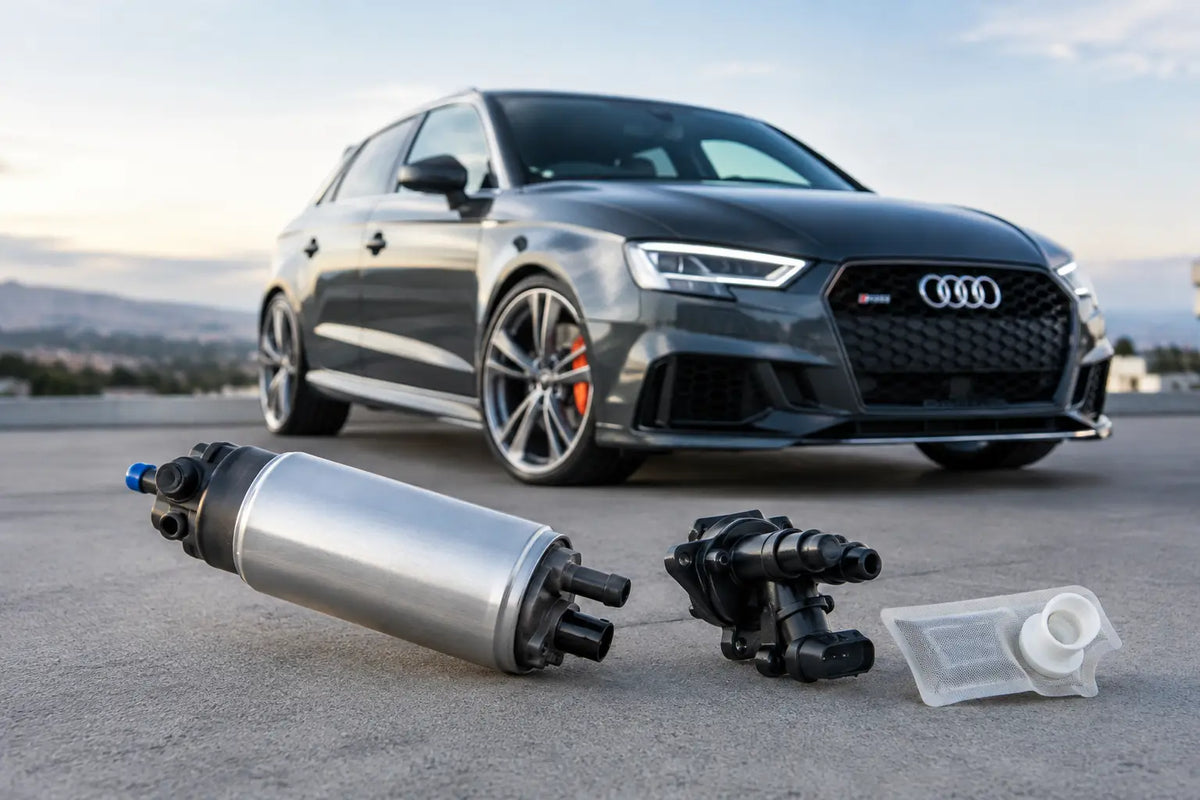
A tuned Audi S3 can make serious power on a compact four-cylinder platform, but the Audi S3 fuel pump becomes a hard limit long before many owners expect. More boost, freer-flowing intake hardware and a sharper calibration all demand more fuel. When the fuel system cannot hold commanded pressure, the result is not merely a smaller dyno figure. It can mean hesitation, fault codes, lean running and a build that is one hard pull away from becoming expensive.
Fuelling is not the glamorous part of a fast S3 build. It is, however, what gives every other power modification room to work. The right upgrade depends on your S3 generation, engine, fuel choice, turbocharger and genuine power target.
How the Audi S3 fuel pump system works
Most S3 models use two stages of fuel delivery. The low-pressure fuel pump sits in the tank and moves fuel forward at relatively low pressure. The high-pressure fuel pump, driven mechanically by the engine, raises that supply to the pressure required by direct injection.
That distinction matters when selecting parts. A high-pressure pump upgrade does not automatically cure a low-pressure supply restriction, and fitting a larger in-tank pump will not increase the capacity of a high-pressure pump already at its limit. Your tuner needs stable pressure on both sides of the system.
On an 8P S3 with the EA113 engine, upgraded high-pressure pump internals are a familiar route for higher-output builds. The cam-driven pump and its cam follower deserve attention together. The follower is a known service item on this platform, and ignoring it while chasing more rail pressure is poor economy.
The 8V S3 uses the EA888 Gen 3 engine, while later 8Y cars use a newer EA888 evolution. Both respond extremely well to tuning, but their factory fuel systems, calibrations and upgrade choices are not interchangeable by assumption. Always buy by engine code and vehicle fitment, not simply by model badge and year.
When the standard pump is no longer enough
For a mild pump-fuel remap on an otherwise healthy car, the factory system is often sufficient. This is why a fuel pump should not be treated as an automatic Stage 1 purchase. Spend where the data says you need to spend.
The equation changes with a hybrid turbo, big-turbo conversion, upgraded injectors where applicable, or ethanol-blend tuning. Ethanol requires a greater volume of fuel than standard petrol to make equivalent power, so a setup that holds pressure happily on 99 RON may struggle badly on an E30 or E85 calibration. That is where upgraded pump hardware and a proper low-pressure solution move from optional to essential.
Signs that the system is reaching its limit include:
- Actual rail pressure falling behind requested rail pressure under sustained load
- Fuel pressure-related fault codes or an EPC warning after hard acceleration
- Power dropping away at high rpm despite a healthy ignition system
- Misfires or hesitation that only appear at full throttle and high boost
High-pressure pump upgrades
High-pressure upgrades generally come as improved internal kits or complete pumps. Larger-capacity internals can provide more fuel per pump stroke, giving a tuner additional headroom at high load. For the right EA113 or EA888 build, this can be the difference between a safe, consistent calibration and a tune that must be pulled back at the top end.
There is a trade-off. More mechanical capacity requires calibration that is written for it. Do not fit upgraded internals and run a file that does not account for their flow characteristics. Fuel pressure control is precise work, not a bolt-on guessing game.
Build quality is equally important. The pump operates at extreme pressure, so dimensional accuracy, sealing and materials are not areas for bargain-bin components. Choose proven performance manufacturers and use fresh seals and correct installation procedures. If the original pump is worn or contaminated, a complete quality unit can make more sense than refreshing only its internals.
Low-pressure fuel pump upgrades
The in-tank pump becomes particularly relevant as power targets rise or ethanol content increases. If the high-pressure pump is being starved at its inlet, it cannot maintain rail pressure no matter how large its internals are.
A low-pressure upgrade may involve a higher-flow in-tank assembly, upgraded pump controller support, wiring improvements or a complete fuel supply package. The correct route varies by platform. Some cars need a straightforward higher-flow pump, while others require a matched controller strategy to avoid overworking factory electronics or triggering faults.
This is also where real-world use matters. A road car that sees occasional fast B-road runs has different requirements from a track S3 that spends long periods at high load with a low tank level. On circuit, fuel movement in the tank can expose pickup issues that never show up during a brief third-gear pull. If you run track days, keep the tank level sensible and discuss surge control if your build is pushing the platform hard.
Match the pump to the rest of the build
Fuelling should be planned as a package. A sensible S3 upgrade path starts with the target, then checks every supporting component rather than collecting parts around a single headline figure.
For a quick road-focused S3 on premium pump fuel, a healthy standard pump system, fresh plugs, suitable intake and exhaust hardware, and a reputable calibration may be all that is required. For a hybrid-turbo car, the conversation should include high-pressure capacity, low-pressure flow, charge cooling, ignition headroom and transmission calibration. For ethanol, add fuel-content monitoring where relevant and leave a meaningful safety margin rather than tuning to the last available millibar of pressure.
Do not overlook the basics. Fit a fresh fuel filter where the platform uses a serviceable one, inspect connectors, check voltage supply and confirm the tank is free from contamination. A premium pump kit cannot compensate for poor supply voltage or a restricted filter.
What to check before ordering
Start with your engine code and model generation. Then establish your current turbo, intended fuel, power target and whether the car is road-only or regularly tracked. Finally, speak to the tuner who will calibrate the vehicle. They should specify whether the restriction is on the low-pressure side, high-pressure side, injectors or a combination of all three.
This approach avoids the common mistake of buying the biggest available component without a compatible tune or a clear need for it. Bigger is not automatically better. Excess capacity that is poorly controlled is no improvement over inadequate capacity.
Torque Lab's performance-focused catalogue approach makes sense here: filter for the exact Audi platform, compare proven brands, then build around the fuel and turbo package rather than chasing generic "Stage" labels. Fitment accuracy is worth more than a tempting universal claim.
Installation and calibration are part of the upgrade
Fuel pump work demands care. Depressurise the system correctly, keep the work area clean and replace seals that are designed as single-use items. A tiny installation error can become a fuel leak, pressure loss or repeat dismantling job.
After fitting, the car needs a calibration matched to the hardware. The final check should include datalogging under controlled load, watching requested and actual rail pressure, low-pressure supply, lambda, ignition correction and fuel trims. If a tuner cannot verify the result in data, you do not yet know whether the fuel system is doing its job.
A properly specified fuel system is not a trophy modification. It is the quiet confidence behind every clean pull, every consistent lap and every extra bar of boost your S3 can safely use. Build the supply first, then let the power follow.