
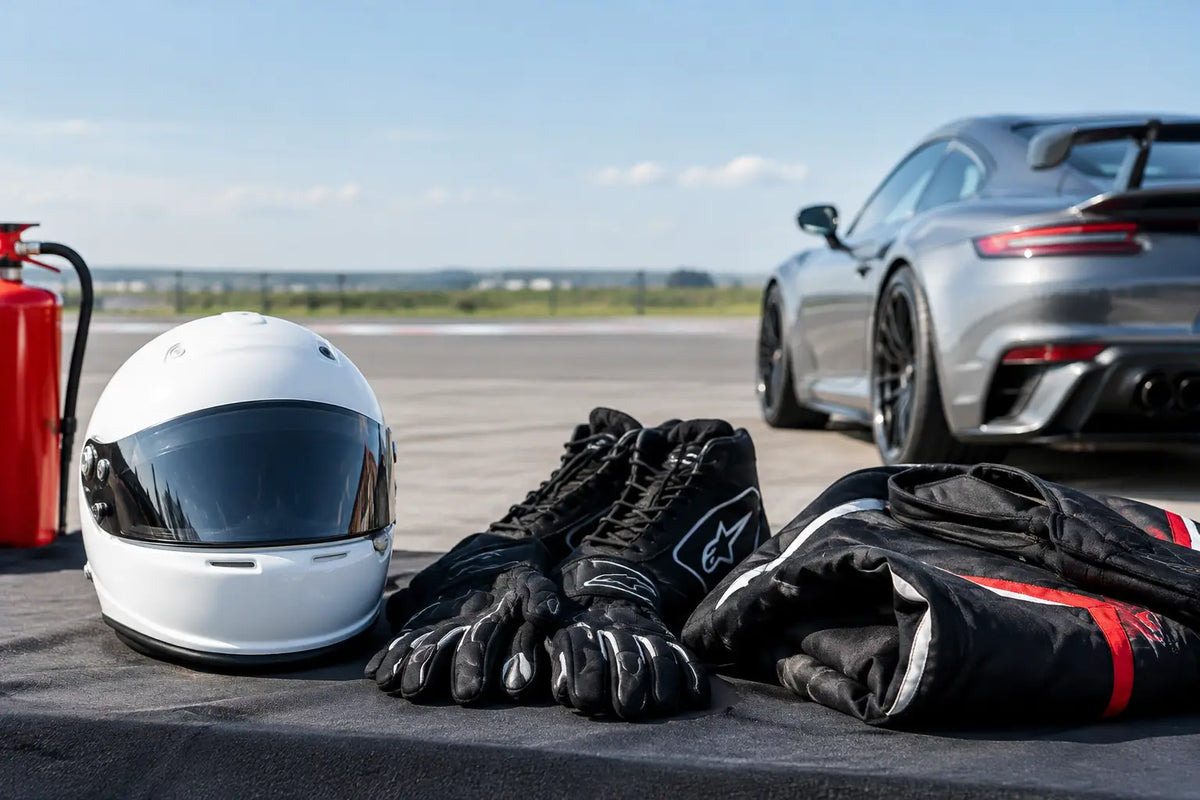
The first serious stop of the day is not the pit lane. It is the braking zone after a few hard laps, when tyre temperatures are up, your heart rate is higher, and every loose item or poor-fitting helmet suddenly becomes obvious. This track day safety equipment guide focuses on the kit that protects the driver, keeps the cabin controlled, and gives your car the best chance of finishing the session without drama.
Track days are not wheel-to-wheel racing, but they are still high-load driving. Requirements differ between organisers, circuits and sessions, so read the event regulations before buying anything. A casual road-car evening may require little more than an approved helmet, while a fast-road build with buckets, harnesses and a roll bar needs a more considered approach.
Start with the organiser's rules
Do not build your safety setup around hearsay from the paddock. Check the organiser's helmet standard, passenger policy, noise limit, clothing guidance and rules on towing eyes, battery security and fire extinguishers. Some circuits have specific restrictions on open cars, harnesses, cameras and external mounts.
A helmet that is perfectly usable for one event may not meet another organiser's rules. The same goes for passengers: an instructor or friend needs appropriate protection too. If you are travelling to a European circuit from the UK, confirm the rules directly rather than assuming that a UK track-day standard applies.
Treat the minimum requirement as the entry point, not the whole plan. The right kit should suit the pace of the car, the layout of the circuit and how often you intend to drive it.
Helmet fit matters more than the badge
For most drivers, the helmet is the first purchase. Choose an approved motorsport or track-day helmet accepted by your organiser, then prioritise fit. It should sit level on your head, feel snug around the cheeks and crown, and resist movement when you try to rotate it. A helmet that shifts under braking is distracting. One that creates a pressure point becomes painful before lunch.
Full-face helmets give more protection from debris and are a sensible choice in open cars. Open-face designs can offer better airflow and easier communication in a closed road car. Neither is automatically better - visibility, ventilation, intercom use and the car itself all matter.
Try helmets on with the balaclava, glasses or earplugs you will actually use. If you have a roll cage or fixed-back seats, make sure the helmet clears the head restraint and roof structure in your normal driving position. A large helmet in a cramped cabin can compromise both comfort and head clearance.
Clothing, gloves and footwear for proper control
A standard track day does not always demand a race suit. Natural-fibre clothing that covers arms and legs is a sensible baseline, especially in a car with no airbag, a stripped interior or a modified fuel system. Avoid loose scarves, synthetic layers that melt easily and bulky jackets that interfere with harness straps.
Driving gloves are not mandatory for every driver, but they are useful once temperatures rise or an aftermarket wheel gets slippery. Look for a close fit and enough feel through the palms. Thick, fashion-led gloves reduce feedback just when you need to sense front-end grip.
Footwear deserves more attention than it gets. Slim-soled driving shoes make it easier to modulate brake pressure, heel-and-toe smoothly and avoid catching two pedals at once. Heavy trainers can work, but wide soles are a poor match for tightly spaced pedals. Your feet should be secure, dry and able to feel the pedal, not perched on a soft foam platform.
Seats, harnesses and head restraint must work together
A bucket seat and harness can transform driver support, but this is not a category for mixing random parts. The seat, mounting hardware, harness angles, anchorage points and head restraint need to function as one system. A harness installed at the wrong angle can load the body badly in an impact. A reclinable road seat may also be unsuitable for certain harness arrangements.
If your car retains factory three-point belts and standard seats, make sure the belt retracts correctly, latches positively and is not frayed or twisted. Factory safety systems are engineered as a package. Replacing one element without understanding how it interacts with airbags, pretensioners or seat structure can create problems rather than solve them.
For dedicated track cars, use recognised motorsport hardware, correct vehicle-specific mounts and professional installation where needed. Pay particular attention to head position. With a helmet on, the top of your head should have sensible clearance from the roof and any cage structure. Padding designed for motorsport contact zones is essential where there is a realistic risk of striking a bar.
The car safety kit that earns its place
A well-prepared car should be boring in the best way: nothing moves, leaks, rubs or overheats. Before loading tools and spare parts, deal with the basics that can turn a manageable issue into a red flag.
- Secure the battery with the correct clamp. A bungee cord is not a solution.
- Remove loose bottles, floor mats, chargers, tools and shopping from the cabin and boot.
- Check that seats are locked, doors latch cleanly and mirrors are adjusted for circuit use.
- Fit a rated towing eye if the car has a provision for one, and know where it is kept.
- Inspect brake lines, fluid level, wheel bolts or nuts, tyre condition and coolant hoses.
Cars with significant power upgrades, turbo conversions, aftermarket fuel systems or track-only wiring deserve an especially close inspection. Look for chafed hoses, unsecured wiring, fuel smells and heat exposure around exhaust components. More performance increases the demand on every supporting system.
Brakes, tyres and fluids are safety equipment too
The most expensive helmet cannot compensate for fading brakes or tyres at the cords. Your braking system is part of your safety package. Use pads suitable for circuit temperatures, quality brake fluid with an appropriate dry boiling point, and inspect disc condition before every event. If the pedal starts going long, do not chase one more lap. Come in, diagnose it and fix the cause.
Tyres need enough tread, no sidewall damage and pressures that are monitored hot rather than guessed from cold road settings. Road tyres can be excellent for a novice day, but they may overheat during long sessions on a heavy or powerful car. Semi-slicks offer more grip but can mask poor technique, require temperature management and behave differently in standing water.
Check oil level, coolant level and any known weak points for your platform. A BMW, Honda, Renaultsport, Audi or turbocharged VW can each have its own track-day failure patterns. Research your specific engine and cooling setup before the first hard day, then log temperatures and pressures rather than relying on optimism.
Pack for the paddock, not just the laps
Bring a tyre-pressure gauge, torque wrench, basic socket set, tape, gloves, fluids, spare brake pads if appropriate, and a way to check tyre temperatures if you are developing the setup. Keep the kit organised so you can work quickly between sessions. A folding chair and water are less glamorous, but driver fatigue is a safety issue as well.
For a road car, the best setup is usually not the most extreme one. An approved helmet, good brakes, healthy tyres, secure seating and a careful pre-event inspection will do more for a first track day than a rushed cage or a catalogue full of mismatched race parts. As your pace and commitment grow, upgrade the safety package with the same discipline you apply to suspension, cooling and power.
Pack the car the night before, check the organiser's rules one last time, and leave enough margin to learn the circuit properly. Fast laps feel better when the equipment beneath you is ready for them.