
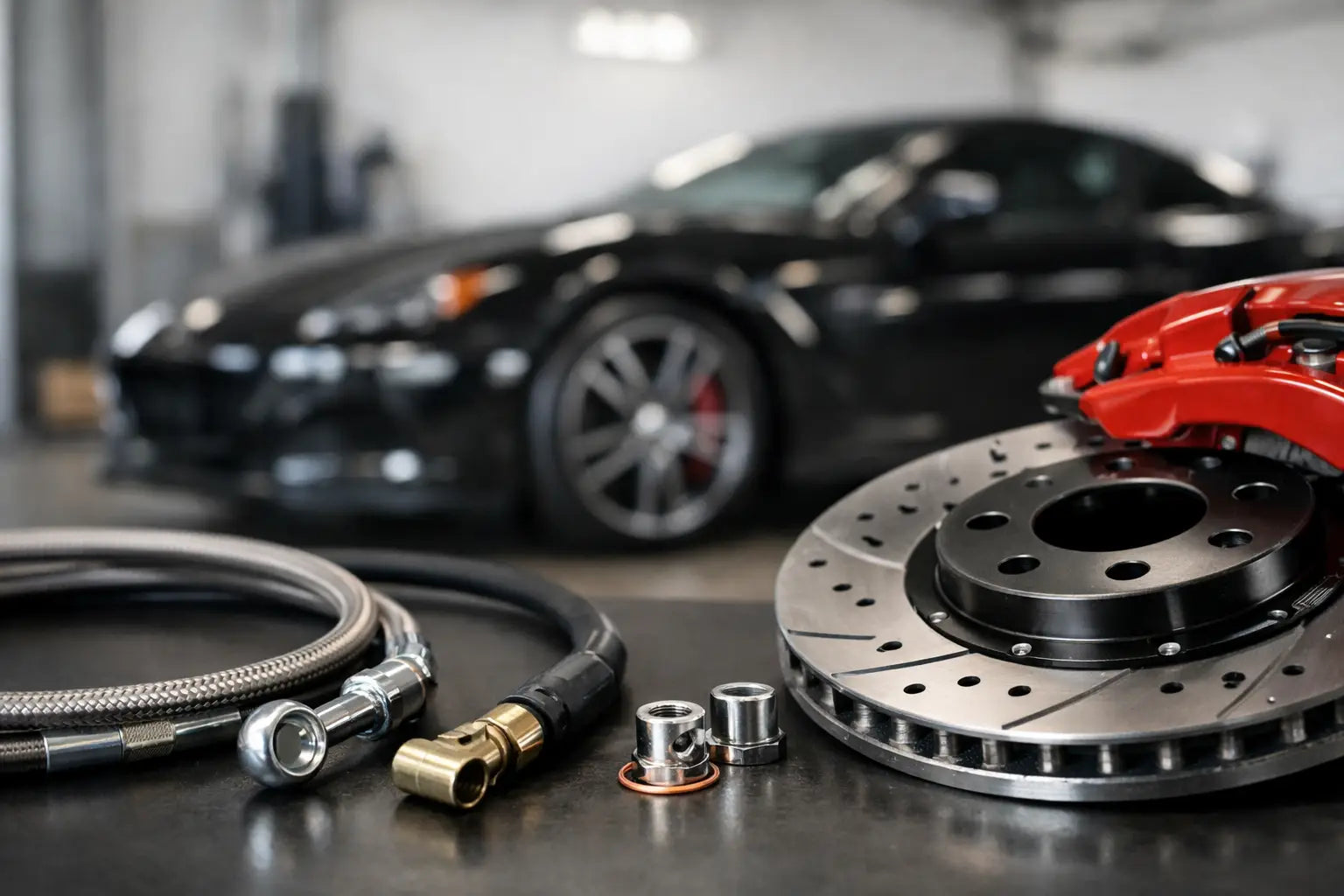
A firm pedal that goes soft after a few hard laps can ruin an otherwise sorted build. It is also why the question, “is a brake lines upgrade worth it?”, comes up so often when enthusiasts are choosing between pads, fluid, discs and hoses. The honest answer is yes for the right car and use case - but braided lines are not a magic shortcut to shorter stopping distances.
For a fast-road car, track-day project or motorsport build, quality braided brake lines can make the brake pedal feel more consistent and direct. They make the most sense as part of a properly matched braking package, especially when the original rubber hoses are ageing or the car sees repeated heavy braking. Fit them to compensate for worn pads, old fluid or a poor bleeding job, however, and you will be disappointed.
What a brake lines upgrade actually changes
Most factory cars use flexible rubber brake hoses between the hard brake pipes on the chassis and the moving suspension or caliper. They do the job well on a standard road car, but rubber can expand slightly when hydraulic pressure rises. That expansion is usually modest on a healthy modern system, yet it can become more noticeable as hoses age, particularly under repeated high-pressure braking.
Braided brake lines typically use a PTFE inner hose protected by a stainless-steel braid, often with an additional coloured outer coating. The construction is designed to resist expansion better than conventional rubber. Less hose movement under pressure means more of your pedal input is transferred directly into caliper clamping force.
The result is normally a firmer, clearer pedal rather than dramatically more braking force. The tyres, pad compound, disc condition and caliper design still determine how much retardation the car can generate. A braided line will not turn an overheating street pad into a track pad, nor will it create grip where the tyre has none.
That distinction matters when planning a build. Brake lines improve communication. Pads, tyres, cooling and fluid usually make the bigger difference to repeatable stopping performance.
Is a brake lines upgrade worth it for fast road driving?
For an enthusiast road car, the value depends heavily on the condition of the original hoses and how hard the car is driven. If your vehicle is newer, serviced correctly and used mainly for commuting with the occasional spirited B-road run, fresh OEM rubber hoses are often entirely adequate. Manufacturers engineer them for long service life, noise control and normal road use.
The case for braided lines gets stronger if the car is ten or fifteen years old, the factory hoses show cracking or corrosion around the fittings, or you already run better pads and fluid. At that point, fitting a quality vehicle-specific kit while the system is open is a sensible preventative upgrade. You gain a cleaner pedal feel and replace a wear item at the same time.
For many performance platforms - a Civic Type R, Golf GTI, BMW 3 Series, Renaultsport or Toyota GT86, for example - the improvement is noticeable without making the car unpleasant on the road. It is not the headline modification you brag about at a meet, but it is one of those supporting changes that makes a well-driven car feel properly finished.
Track days are where braided hoses earn their place
Repeated braking from high speed exposes every weak point in a brake system. Fluid temperatures rise, pads lose bite, discs heat-cycle and an inconsistent pedal makes threshold braking harder than it needs to be. Braided hoses do not solve every one of these problems, but they remove one variable from the equation.
On a track-driven car, a brake lines upgrade is worth it when paired with high-temperature brake fluid, pads suited to the car’s pace and use, and a thorough bleed. This combination gives the driver a more dependable pedal at the end of a session, which is valuable when braking points are tight and confidence matters.
It is particularly worthwhile on heavier, faster cars or vehicles with sticky tyres. More grip allows greater braking force, which asks more from the entire hydraulic system. Owners often add a big brake kit first, but quality hoses and fluid should not be overlooked simply because they are less visible behind the wheel.
That said, if your pedal becomes long only after several laps, check the fluid specification and condition before blaming the hoses. Boiled fluid causes a very different problem from hose expansion. Likewise, vibration through the pedal points more towards disc runout, uneven deposits or wheel and suspension issues than flex hoses.
Choose the whole braking package, not one fashionable part
A braided line kit works best when it complements the car rather than being treated as a standalone cure. Before buying, assess the current system honestly. Are the pads glazed? Are the discs within their minimum thickness? Has the fluid been changed recently? Is the pedal spongy because air is trapped in the system? These basics come first.
For a lightly modified road car, good pads, fresh high-quality fluid and braided lines can be an excellent combination. Select pads that deliver cold bite and manageable noise, then use a fluid with a dry boiling point appropriate for your driving. There is little benefit in choosing an extreme race fluid if the car is rarely driven hard and servicing intervals will be ignored.
For track use, move further towards a track-capable pad compound, high-temperature fluid and regular inspections. Brake cooling may offer more meaningful fade resistance than another expensive hardware upgrade. On dedicated builds, consider caliper condition, master-cylinder sizing and pad shape availability before spending on larger discs or six-pot calipers.
Torque Lab customers building platform-specific brake packages should also check whether the hose kit is intended for the exact model, generation and brake setup. A car with optional factory performance brakes can use different hose lengths or fitting types from the base model. Never assume that similar-looking calipers mean identical fitment.
What to look for in a braided brake line kit
Not all braided lines deserve a place on a performance car. The braid may be the visible feature, but the fittings, hose material, protective coating and manufacturing quality matter just as much. Choose a reputable kit made specifically for your vehicle, with correct mounting points and properly crimped fittings.
Look for lines with a protective outer sheath. Bare stainless braid can trap grit and moisture against adjacent components or gradually abrade parts if routed poorly. A coated line is generally easier to inspect and kinder to paintwork, suspension arms and wheel-arch liners.
Compatibility is non-negotiable. Confirm whether the kit suits right-hand-drive vehicles where relevant, standard or upgraded calipers, and the specific ABS arrangement on your platform. If you run a big brake kit, check with the brake-kit manufacturer or line supplier rather than trying to make a generic set fit.
Road legality and approval requirements can vary by market, insurer and vehicle modification rules. For UK road use, retain proper mounting hardware, avoid any contact at full steering lock or suspension travel, and keep documentation for the parts fitted. A quality installation matters as much as the badge on the hose.
Installation is a safety job, not a quick cosmetic mod
Brake lines carry high hydraulic pressure. If you are not fully confident working on braking systems, have an experienced technician fit and bleed them. A minor fluid leak or a line routed incorrectly can become a serious failure under braking.
During installation, inspect the hard lines, calipers, bleed nipples and retaining clips. Replace damaged clips, clean corroded mating surfaces and use the correct flare-nut spanners to avoid rounding fittings. Do not twist the hose as it is tightened. Once installed, turn the steering from lock to lock and check full suspension movement before the wheels go back on.
Bleeding deserves patience. Use fresh fluid from a sealed container, follow the vehicle’s recommended bleeding order, and do not let the reservoir run dry. Some cars with complex ABS systems require a diagnostic procedure to cycle the pump or valves after the system has been opened. The pedal should be consistently firm before any road test.
After the first careful drive, inspect every connection for seepage. Check again after a few heat cycles and whenever the wheels are removed. A performance part should make maintenance easier to take seriously, not give you an excuse to forget it.
When you should spend the money elsewhere
There are situations where braided lines are not the priority. If your tyres are old or low-grip, spend there first. If the brake pedal is soft because the fluid is overdue, flush the system. If you are getting fade, fit a suitable pad compound and investigate cooling. If the car pulls under braking, diagnose seized caliper slides, sticking pistons or uneven pad wear.
Also be realistic about feel. Some drivers expect a night-and-day transformation and then call the upgrade pointless when the difference is subtle. On a healthy, lightly used modern car, it often is subtle. The reward is a more consistent pedal under load and long-term confidence in a critical service item, not a dramatic new brake personality.
For a road-and-track car, fit quality braided lines when you are refreshing the fluid and building a braking package that matches the car’s pace. Do it once, route them correctly, inspect them regularly, then focus on the next braking zone rather than wondering what the pedal will do.