
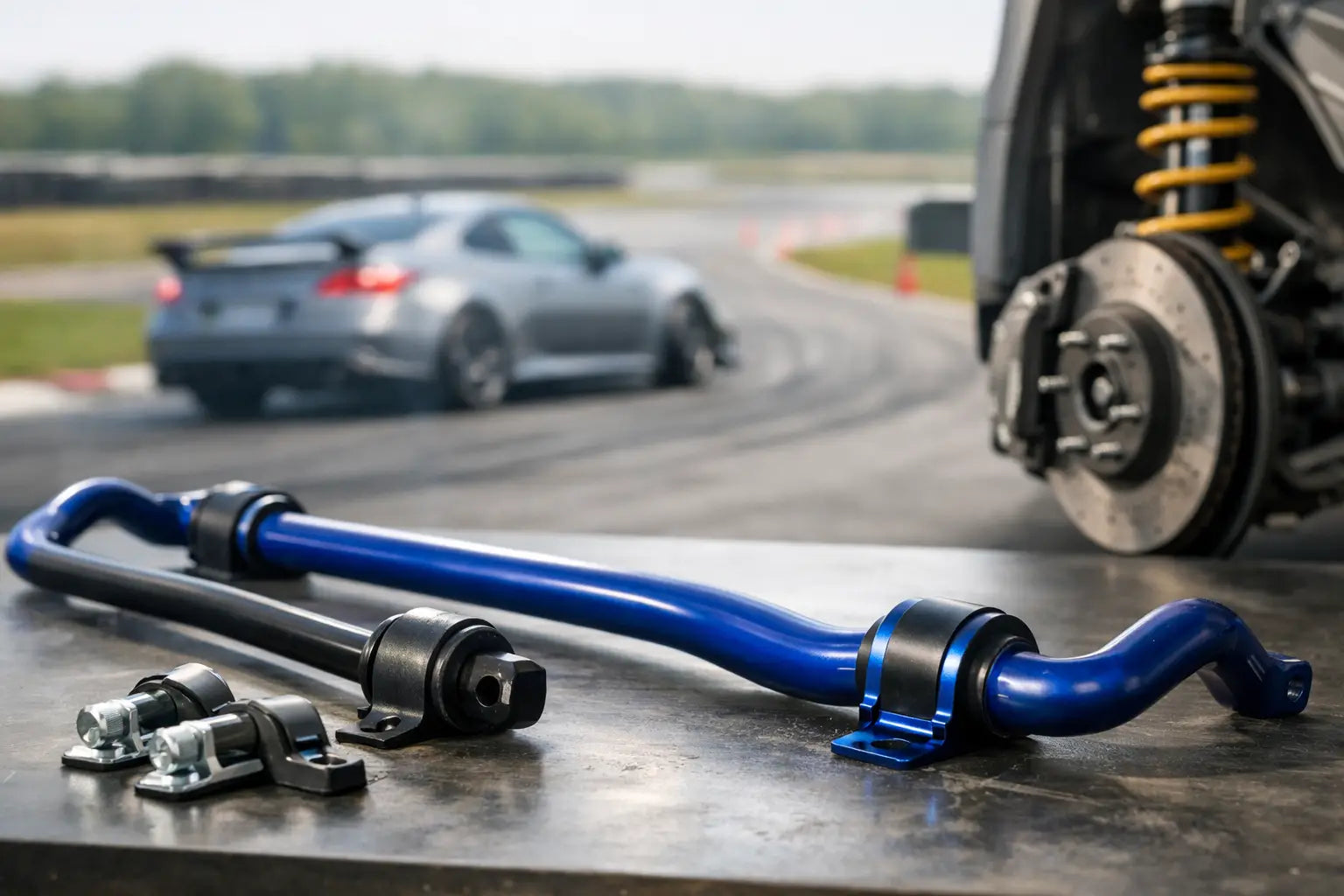
A fast road car that rolls hard through a roundabout can feel vague, slow to react and far less confidence-inspiring than its power figure suggests. So, do bigger anti-roll bars help? Usually, yes - but not simply because a thicker bar is automatically better. An anti-roll bar can sharpen response, reduce body roll and alter front-to-rear balance, yet the wrong specification can reduce grip where you need it most.
For track-day builds, spirited road cars and competition setups, anti-roll bars are a proper chassis-tuning tool. Treat them as part of the system, not a quick fix for every handling complaint.
What a bigger anti-roll bar actually does
An anti-roll bar, also called a sway bar or stabiliser bar, connects the left and right suspension on an axle. When both wheels move together, such as over a crest or dip, the bar has little effect. When the car corners and one side compresses while the other extends, the bar twists and resists that difference in movement.
A bigger bar is generally stiffer because its resistance rises dramatically with diameter. Even a modest increase in bar thickness can make a noticeable difference. Stiffer bushes, shorter lever arms and adjustable mounting positions can also increase effective stiffness, which is why diameter alone never tells the whole story.
The immediate result is reduced body roll. That can make the car feel flatter, more planted and more direct on turn-in. It also helps keep suspension geometry closer to its intended working range, particularly on cars with soft factory springs and substantial roll movement.
But an anti-roll bar does not create grip from nowhere. It redistributes load across the tyres on the axle where it is fitted. That distinction is where a well-sorted setup separates itself from a car that merely feels stiff.
Do bigger anti-roll bars help grip and cornering?
They can help overall cornering performance when they correct an imbalance in the chassis. They can also hurt it if they are used without considering tyre load, spring rate, damping, alignment and the road surface.
As a car corners, weight transfers to the outside tyres. Because tyres do not gain grip in a perfectly linear way as load increases, concentrating too much load on the outside tyre can reduce the total grip available at that axle. A stiffer anti-roll bar changes how the left and right tyres share that load. It limits independent suspension movement and can reduce the axle's ultimate grip.
That sounds backwards until you look at the whole vehicle. If a front-wheel-drive hatch understeers heavily, increasing rear roll stiffness can reduce rear-axle grip slightly relative to the front. The car rotates more willingly and may become faster through a corner. On a rear-wheel-drive car that is already lively, too much rear bar can make the rear axle break away abruptly, especially over bumps or when applying power.
So the answer depends on what the car does now:
- A stiffer front bar usually adds understeer at the limit.
- A stiffer rear bar usually adds oversteer or reduces understeer.
- Stiffening both bars can reduce roll while broadly retaining the existing balance, although the final result still depends on the rates chosen.
- An adjustable bar lets you tune stiffness without replacing the entire component, which is valuable when a car sees both road and circuit use.
Bigger is not always better
The biggest mistake is choosing an anti-roll bar as though it were a cosmetic upgrade. Excessive roll stiffness can make a car skittish on broken B-roads, kerbs and uneven circuits. Instead of allowing each wheel to follow the surface, the bar couples the suspension more tightly. Hit a mid-corner bump and the disturbance can be transferred across the axle, reducing compliance and unsettling the car.
This is particularly relevant for lowered cars. If springs are very stiff, dampers are poorly matched, or suspension travel has been lost, adding an aggressive bar can mask the real problem for a while and then make it worse at the limit. A car that feels flat in a smooth car park may be slower and less predictable on a rough road.
There is also no point fitting a premium adjustable anti-roll bar with tired drop links, worn bushes or loose mounting hardware. Play in the system delays response and creates unwanted noise. Quality bushes and strong, correctly fitted links matter because they ensure the bar begins working when the suspension moves rather than after several millimetres of slack.
Choose the bar around the rest of the chassis
Before ordering parts, define the job. A daily-driven Golf GTI on decent tyres needs a different approach from a stripped Civic used for sprint events, and both differ again from a BMW running wide semi-slicks on track.
For a fast road setup, a mild increase in rear stiffness is often popular on front-wheel-drive platforms because it improves rotation without making the ride objectionable. An adjustable rear bar is often the sensible choice: use the softer setting for wet roads and longer journeys, then test a firmer setting at a track day if the car still pushes wide on corner entry.
For regular circuit use, the target is repeatable balance rather than the flattest possible cornering stance. Spring rates, damper valving, geometry and anti-roll bars must work together. A car on coilovers may need less bar than one on soft springs, while a car with substantial aerodynamic load can need a different setup again at speed.
Tyres deserve special attention. A tyre upgrade can transform grip and alter balance enough that a bar setting which worked on road rubber no longer works on track-focused tyres. Likewise, more front camber may increase front-end bite and allow a different anti-roll bar choice. Chassis tuning is iterative: make one meaningful change, test it, and record what the car does in dry and wet conditions.
Adjustable anti-roll bars are worth considering
An adjustable bar normally has two or more holes at the end of each arm. Moving the drop link closer to the bar's main section shortens the lever arm and makes the bar effectively stiffer. Moving it outward makes it softer.
That adjustability is useful, but it is not a substitute for choosing the correct range. A very stiff bar on its soft hole may still be too aggressive for a road-biased car. Conversely, a lightly uprated bar on its hardest setting may not provide enough control for a dedicated track build.
When fitting an adjustable anti-roll bar, set the car at normal ride height before tightening preload-sensitive components. The bar should not be twisted at rest with the car sitting level, unless a deliberate corner-weighting setup calls for it. Preload can create inconsistent left-versus-right behaviour and make diagnosis needlessly difficult.
Signs your car may benefit from an upgrade
Body roll alone is not enough reason to buy parts. Some roll is normal and can even help a driver read the car. Look instead for a clear handling limitation: persistent understeer despite suitable tyres and alignment, sluggish direction changes, excessive outside-edge tyre wear caused by roll, or a car that feels uncontrolled during quick transitions.
If the car skips across rough bends, loses traction over bumps or already feels nervous at the rear, a bigger bar is unlikely to be the first answer. Check tyre pressures, damper condition, bush wear, alignment and spring choice first. More stiffness cannot compensate for worn suspension or poor geometry.
A proven platform-specific kit from a respected performance manufacturer takes much of the guesswork out of fitment and rate selection. Torque Lab's approach is simple: match suspension parts to the vehicle, the tyre and the way you actually drive it, rather than chasing the largest number on a product page.
The best anti-roll bar upgrade is the one that makes you carry speed with more confidence, lap after lap or corner after corner. Start with the car's current behaviour, choose an appropriate stiffness range, and give yourself room to tune. That is how a handling upgrade becomes faster rather than merely firmer.