
A restrictive factory catalyst can be a real bottleneck once boost, fuelling and calibration start moving beyond stock. But the decat pipe vs sports cat decision is not simply a choice between louder and quieter. It affects how the car delivers power, how it smells in traffic, whether the engine light stays off, and whether the car remains practical for road use.
For a track-focused build that only needs to perform at full chat, a decat can make sense. For a fast road car that sees commuting, B-roads and the occasional circuit day, a quality sports cat is usually the smarter upgrade. The right answer comes down to the platform, the tune and where the car will actually be driven.
Decat Pipe vs Sports Cat: The Core Difference
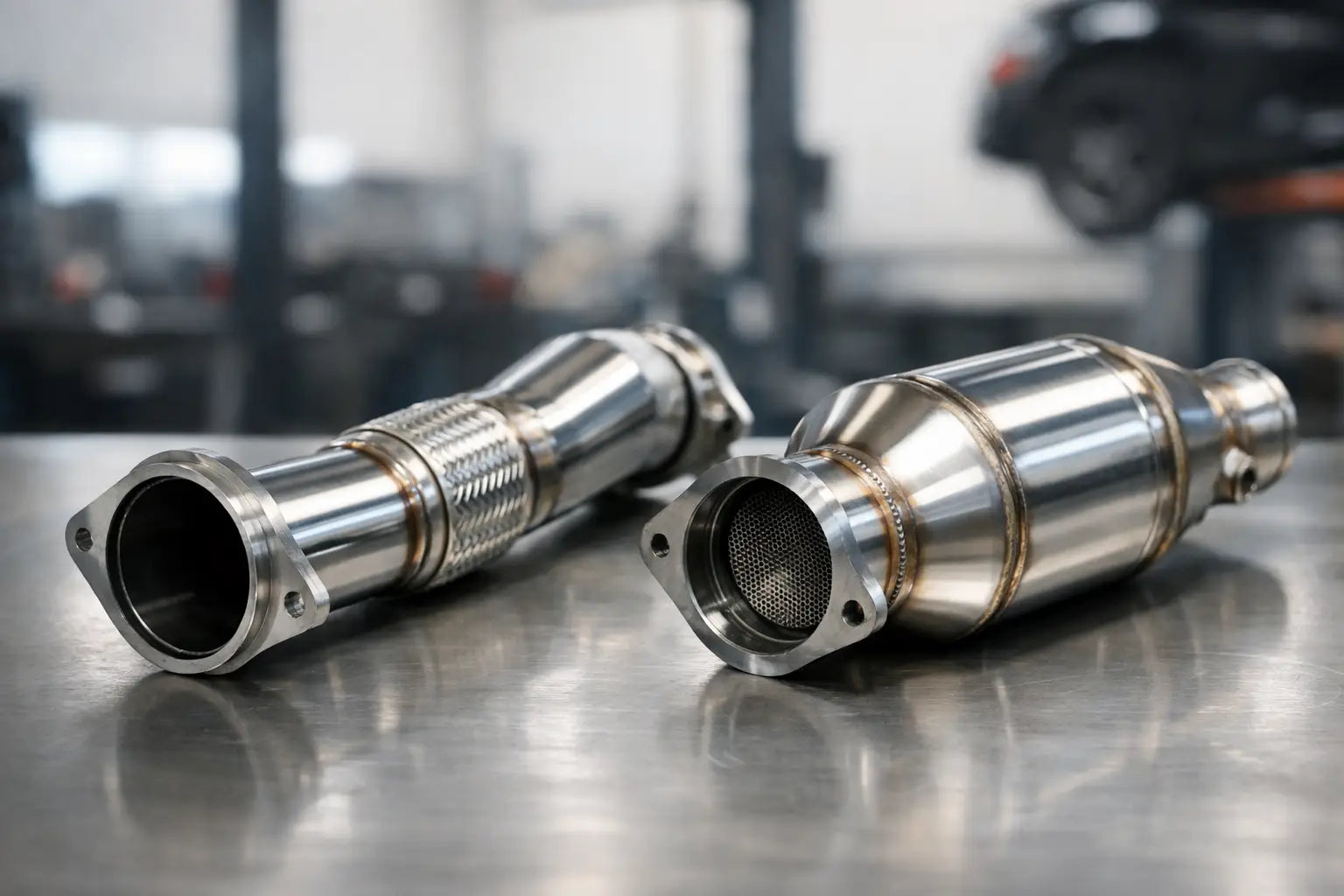
A decat pipe replaces the original catalytic converter with a straight-through section of exhaust pipe. There is no catalyst material inside to clean up exhaust gases. With less restriction in the system, exhaust flow improves, turbocharged cars can spool more freely, and the exhaust note becomes more aggressive.
A sports cat retains a catalytic converter, but uses a less restrictive core than the factory unit. Most performance examples are described by their cell count, commonly 200-cell or 100-cell. Fewer cells generally mean more flow, but also less emissions-cleaning capacity. A 200-cell sports cat is normally the more sensible fast-road option, while a 100-cell unit sits closer to decat territory in both flow and emissions behaviour.
Neither part is automatically an upgrade just because it is less restrictive. Build quality, correct fitment, flange design, thermal shielding, sensor locations and compatibility with the rest of the exhaust all matter. A cheap pipe that cracks, leaks or causes constant warning lights is not a performance part.
Power Gains: Where Does a Decat Actually Win?
On a turbocharged engine, the catalyst is positioned in a high-heat, high-pressure section of the exhaust. Reducing restriction immediately after the turbine can lower back pressure and help the turbo work more efficiently. That is why decat pipes are popular on modified turbo platforms such as the EA888, BMW B58, Honda K-series turbo conversions and many Japanese boosted engines.
A decat will generally offer the greatest possible flow. On an engine already running a larger turbo, higher boost and supporting fuelling upgrades, that extra margin can be useful. It may help the tuner achieve power targets with lower turbine back pressure and potentially improved top-end performance.
The important word is may. On a lightly modified car, the difference between a good sports cat and a decat is often smaller than internet arguments suggest. The calibration, intake temperatures, intercooler capacity, fuel quality and turbo efficiency may have a far larger effect on the final result. A well-designed 200-cell sports cat can support serious power on many street and track builds without the compromises of a fully catless system.
Naturally aspirated engines deserve an even more measured approach. They can respond well to a freer-flowing exhaust, particularly when combined with headers and a proper ECU calibration, but simply fitting a decat pipe rarely creates a dramatic transformation on its own. Avoid buying on noise alone and expect gains that match the engine’s overall specification.
A tune is often part of the package
Changing the catalyst section can alter how the ECU sees the exhaust through its oxygen sensors. Many modern cars use a pre-cat sensor to help control fuelling and a post-cat sensor to monitor catalyst efficiency. A decat commonly triggers an engine management light because the ECU correctly detects that the catalyst is no longer doing its job.
A sports cat can also trigger a fault code, especially with very free-flowing 100-cell units or sensitive factory calibrations. A professional calibration may be needed to make the most of the hardware and to manage expected sensor behaviour. That does not make a decatted car road legal, and it should never be confused with a workaround for emissions rules.
Sound, Smell and Daily-Driving Reality
A decat makes the exhaust sharper, louder and more raw. Turbo whistle is usually more noticeable, overrun can become far more pronounced, and the car may produce pops and bangs with the right calibration. For some builds, that motorsport edge is exactly the point.
It also brings the parts many drivers only notice after the first week. With no catalyst, exhaust fumes are much more obvious at idle, in traffic and when reversing into a garage. Cabin drone can increase, particularly when the car already has a non-resonated cat-back system. Cold starts may be antisocial, and long motorway journeys can become tiring rather quickly.
A sports cat still adds volume and character compared with the original catalyst, but it tends to retain a more controlled, higher-quality sound. It can deepen the exhaust note and improve response without making every early-morning start feel like a pit-lane exit. For a car used on public roads, that balance matters.
The rest of the exhaust determines the final result. Pairing a decat with a large-bore non-resonated system is a recipe for maximum volume. Pairing a sports cat with a resonated system can produce a quick, purposeful exhaust that remains comfortable on longer runs. Choose the system as a package, not as isolated catalogue parts.
Emissions, MOTs and Road Use
For UK road cars originally fitted with a catalytic converter, removing it is not a sensible road-use modification. A decat pipe is generally intended for off-road or competition use only. It can cause an MOT failure, create insurance complications and leave the car non-compliant with road-traffic and emissions requirements.
A sports cat is not a blanket legal pass either. Its suitability depends on the vehicle, the specific part, the installation and applicable emissions regulations. A high-flow catalyst still needs to operate effectively enough for the car to meet the required emissions standard. Some vehicles also require an approved replacement catalyst for road use, so do not assume that any 200-cell item will satisfy an MOT tester or local regulations.
This is where product selection deserves more attention than a quick search for the cheapest downpipe. Buy a system designed for your exact engine and chassis, and check the manufacturer’s intended use, emissions status and sensor provision before ordering. If the car must pass an MOT and remain easy to live with, a quality sports cat is the far safer starting point.
Heat, Reliability and Fitment Considerations
Exhaust components live in a brutal environment. Turbo downpipes see extreme heat cycles, vibration and pressure, so material quality is not cosmetic. Properly formed stainless steel, accurate welds, strong flex sections and correct mounting points protect both performance and reliability.
Thermal management matters too. A freer-flowing downpipe can alter under-bonnet temperatures and heat transfer around wiring, driveshaft boots and nearby components. Use the correct heat shields where applicable, inspect clearances after installation and replace tired clamps or gaskets rather than reusing hardware that has already seen years of heat cycles.
Fitment should be platform-specific. A part designed around a manual front-wheel-drive car may not clear the subframe, prop shaft or transmission hardware on another variant. Check whether the system is for OPF or GPF-equipped models, whether it retains factory sensor positions, and whether it mates to your existing cat-back diameter. Torque Lab’s vehicle-specific performance catalogue approach is useful here: start with the exact chassis, engine and model year, then build the exhaust around confirmed compatibility.
Which One Should You Choose?
Choose a decat pipe when the car is a dedicated competition, track or off-road project, emissions compliance for public-road use is not required, and you are prepared for the extra noise, smell and calibration work. It is a focused solution for a focused build.
Choose a sports cat when you want meaningful exhaust flow improvements without turning a fast road car into a compromise. A good 200-cell unit is often the sweet spot for tuned hot hatches, turbocharged saloons and weekend track cars that still need to cover real miles. If your build is chasing every final horsepower at the top end, a 100-cell sports cat may be worth considering, but check emissions expectations before committing.
The best exhaust upgrade is the one that matches the car’s actual job. Build for the roads, track days and power target you have now, not just the loudest clip you heard online.