
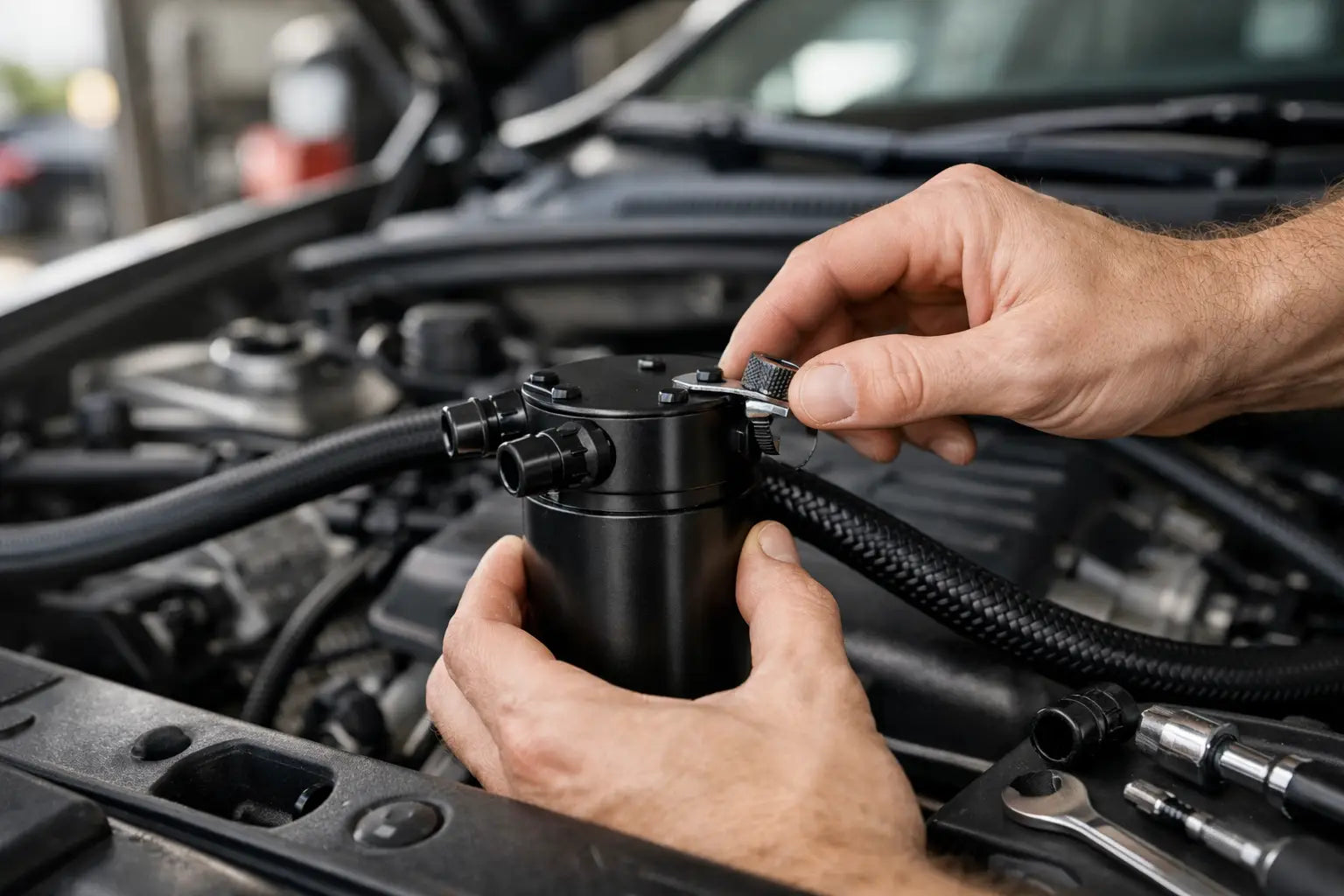
A catch can is one of those upgrades that looks simple on a build list, then becomes surprisingly easy to get wrong once the bonnet is open. A proper oil catch can installation is not just a case of mounting an alloy tank and joining two hoses. It needs to suit your engine’s PCV layout, retain the correct crankcase ventilation under vacuum and boost, and leave no opportunity for an intake leak.
Get it right and you reduce the oil vapour and moisture returning to the intake tract. That matters on hard-driven turbo cars, direct-injection engines prone to inlet-valve deposits, and track builds that spend long periods at high load. Get it wrong and you can create poor idle quality, boost leaks, excessive crankcase pressure or an oily mess around the engine bay.
Start with the PCV system, not the catch can
Before buying brackets or cutting hose, understand what the factory system is doing. Combustion gases that slip past the piston rings are known as blow-by. If those gases stay in the crankcase, pressure builds and can force oil past seals, gaskets and breathers. The positive crankcase ventilation system routes those gases back into the inlet so the engine can burn them.
Most petrol engines have two distinct ventilation paths. At idle and light throttle, inlet-manifold vacuum draws vapour through the PCV valve. Under boost or heavy throttle, when the manifold is pressurised, flow is usually redirected to the turbo inlet pipe or intake pipe before the throttle body. A naturally aspirated engine may use a simpler arrangement, but the same principle applies: the crankcase must still breathe in every operating condition.
That is why universal instructions can be misleading. A catch can for a Honda K-series, BMW N54, VW EA888 or turbocharged Toyota application may look broadly similar, but hose routing and valve requirements are platform-specific. Check the engine’s original hose routing, then select a kit designed for that layout where possible.
Choosing the right oil catch can kit
A cheap empty can with two fittings may collect some oil, but it is rarely the best choice for a performance build. Separation happens inside the can, so internal design matters. Look for a properly baffled unit with a multi-stage separator, mesh or directional baffling that helps vapour condense without seriously restricting flow.
Capacity matters too. A compact can may suit a lightly modified road car, but a tuned turbo engine, high-mileage motor or regular track car can produce enough contamination to fill a small reservoir quickly. A larger can gives more service interval headroom, although it still needs checking regularly.
For most road-driven cars, a closed-loop kit is the sensible route. It returns cleaned vapour to the intake and keeps the crankcase ventilation system functioning as intended. Vent-to-atmosphere systems can smell of oil vapour, leave residue in the bay and may not be road legal or emissions compliant. They are a motorsport-specific solution, not an automatic upgrade for every modified car.
Also pay attention to the unglamorous parts: oil-resistant hose, clamps, fittings and mounting hardware. Ordinary rubber vacuum hose can soften over time when exposed to oil. Poor-quality jubilee clips can cut into hose or loosen with heat cycles. A catch can is only as good as the plumbing around it.
Oil catch can installation: plan the routing
The ideal mounting point is secure, accessible and away from serious heat. You need enough room to remove the can or open its drain without dismantling half the intake. Many vehicle-specific kits use an existing threaded point or a purpose-made bracket near the strut tower, inner wing or radiator support. That is preferable to drilling into structural panels or hanging the can from a flimsy plastic cover.
Keep the hose runs as short and direct as practical, but do not force tight bends. A kinked hose restricts ventilation, while a hose routed against the exhaust manifold, downpipe or turbocharger is asking for trouble. Use heat shielding where proximity cannot be avoided, and leave enough movement for engine rock under acceleration.
On a boosted engine, identify both sides of the system before disconnecting anything. The manifold-side PCV circuit and the turbo-inlet-side breather circuit may require separate cans, a dual-port setup or a kit with integrated check valves. Do not assume one line can simply be blanked off because the new can has only two ports.
A useful rule is to preserve the factory flow direction. The catch can sits in the vapour path, not as a replacement for every valve, restrictor and separator built into the original system. If the kit instructions specify an inlet and outlet, follow them. Reversing a baffled can may reduce its ability to separate oil from vapour.
Protect the PCV valve and check valves
The PCV valve is there to prevent boost pressure entering the crankcase through the manifold line. If it sticks, is removed or is bypassed incorrectly, pressurised intake air can turn the crankcase into a boost leak reservoir. That can push oil out of seals and cause inconsistent running.
Some aftermarket catch can kits include check valves because the factory arrangement is being altered. Others are designed to reuse the OEM valve. Either route can work, but the valve orientation is critical. Blow through it by hand before installation if there is any doubt, and confirm it allows flow only in the intended direction.
Fit it cleanly, then test it properly
With the engine cool, remove the original breather hose or hoses carefully. Brittle factory plastic lines and quick-connect fittings are common failure points, especially on older German performance platforms. Avoid levering aggressively against a cam cover or intake manifold fitting. If an original hose is already split or oil-soaked, replace it rather than trying to make it serve a new setup.
Mount the can first, then measure each hose run with the fittings installed. Cut hose squarely, push it fully over each barb or adapter and secure it without overtightening. Any unused ports must be capped with oil- and heat-resistant caps designed for the job, not a random piece of hose with a screw in the end.
Before the first drive, inspect every connection and make sure the dipstick, oil cap and engine covers still fit correctly. Start the engine and listen closely for hissing around the intake, manifold and catch can lines. A fresh whistle, a high idle or rough idle can point to a vacuum leak.
For turbo cars, a smoke test or pressure test is the best final check. It can reveal a loose coupler or an incorrectly capped connection that a quick visual inspection misses. After a short drive, check for oil weeping around clamps and confirm no hose is rubbing on belts, pulleys or sharp edges.
Draining and servicing the can
A catch can is not fit-and-forget hardware. The collected fluid is normally a mixture of oil, water and fuel vapour, particularly during cold weather and short journeys. In winter, it can look like a thin beige emulsion. That does not automatically mean the engine has a head-gasket problem - it often reflects condensation that would otherwise have gone back through the intake.
Check the level after the first few hundred miles, then establish an interval based on how the car is used. A weekend track car, tuned turbo road car and daily-driven commuter will all collect different amounts. Check more often after track days, during cold weather and after long periods of high boost.
Drain the contents responsibly as waste oil. While the can is off, inspect the internal baffle or filter element if your model has a serviceable one. A blocked separator can restrict crankcase flow, which defeats the point of fitting it.
When a catch can is worth fitting
A catch can makes the most sense when the car is modified, driven hard or known for oil contamination in the intake system. It is especially relevant when fitting a larger turbo, increasing boost, adding a remap or preparing for track use. It can also be sensible preventative maintenance on an older engine with increased blow-by, provided the underlying issue has been diagnosed rather than hidden.
It is not a cure for worn piston rings, a failed PCV valve or excessive oil consumption. If the can fills rapidly, smoke appears from the exhaust or oil is being pushed from seals, investigate the engine’s condition. Treat the catch can as a supporting performance part, not a shortcut around a mechanical fault.
Choose a kit that matches your platform, route it as the manufacturer intends and inspect it like any other service item. Done properly, it is a tidy, functional upgrade that keeps more oil out of the intake and lets a hard-worked engine breathe as it should.