
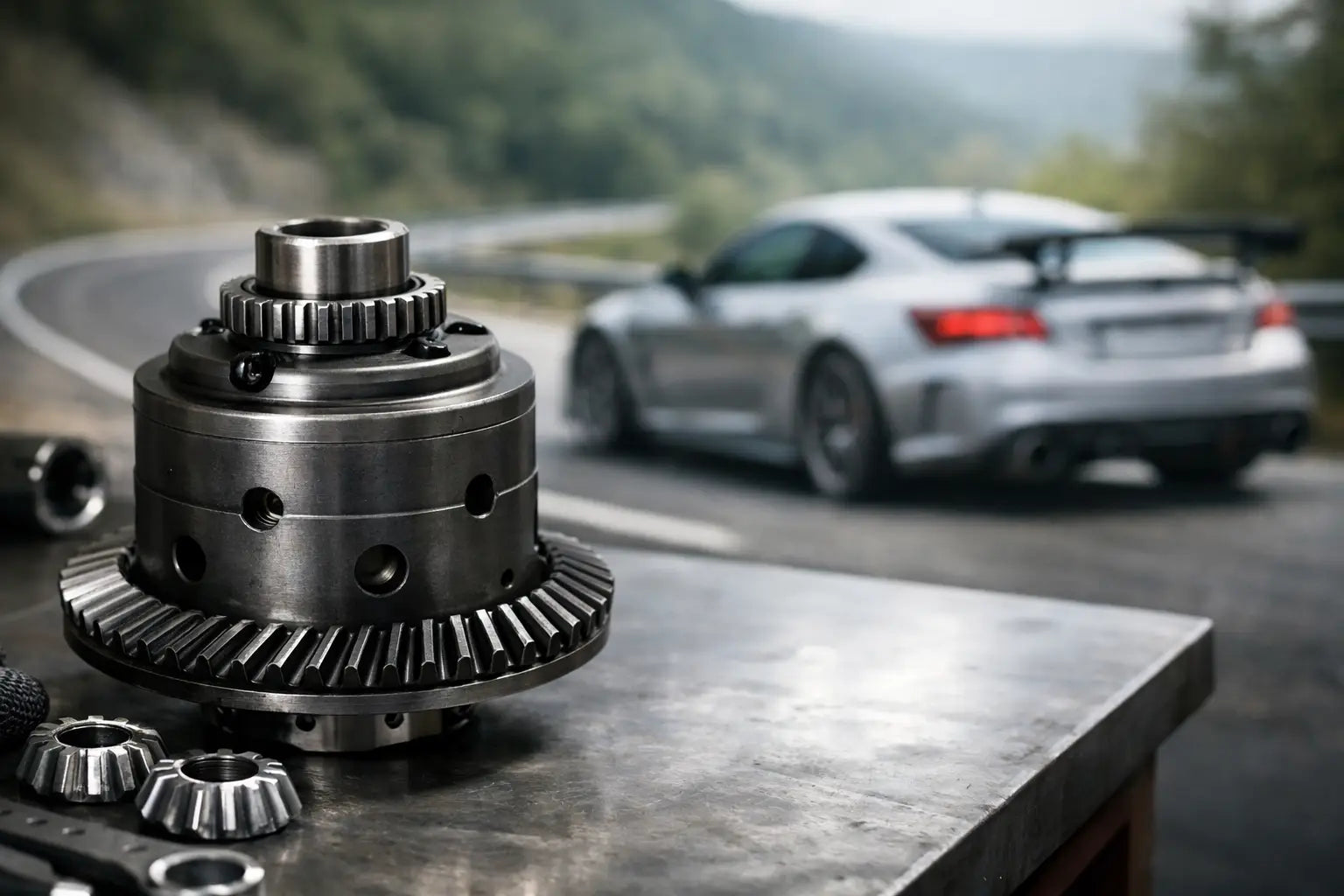
Put power down hard out of a wet roundabout or a second-gear hairpin and an open differential will quickly show its limits. The unloaded inside wheel spins, the car loses drive, and your throttle input turns into noise rather than forward motion. This limited slip differential guide explains what an LSD changes, which type suits your build, and the fitment details that separate a proper drivetrain upgrade from an expensive mismatch.
For fast-road cars, track builds and competition projects, an LSD is often one of the most transformative upgrades available. More power can make a car faster in a straight line. More controlled torque transfer makes it faster, calmer and more exploitable once the road starts asking questions.
What a limited slip differential actually does
A conventional open differential lets the left and right driven wheels rotate at different speeds. That is essential in a corner, where the outside wheel travels farther than the inside one. The downside comes when one tyre has much less grip than the other. An open diff sends torque along the path of least resistance, so the wheel with less available traction spins first.
A limited slip differential restricts that speed difference and transfers more torque to the wheel with grip. It does not lock both wheels together all the time. Instead, it adds resistance to the differential action, giving the loaded tyre a better chance to drive the car forward.
The real gain is not simply traction in a straight line. In a front-wheel-drive car, an LSD can reduce one-wheel spin as you unwind lock and get back on the throttle. In rear-wheel drive, it gives more consistent exits and makes power delivery easier to read. In an all-wheel-drive platform, upgraded front, rear or centre differentials can alter the balance of the entire car.
Limited slip differential guide: the main LSD types
The right differential depends on your drivetrain layout, power level, tyre choice and how the car is used. There is no universal winner.
Helical or torque-biasing LSD
Helical differentials use sets of precisely machined gears to bias torque towards the wheel with more grip. They have no clutch plates, usually operate quietly and need little specialist maintenance beyond correct oil choice. For a fast-road build that sees regular road miles, this is often the easy recommendation.
They are progressive rather than aggressive, which suits front-wheel-drive hot hatches particularly well. The steering generally feels more planted under power, with less wasted wheelspin on uneven surfaces. Brands such as Quaife and Wavetrac are well known in this category.
There is a caveat. A helical unit needs some resistance at both wheels to create torque bias. If one wheel is completely unloaded, such as over a high kerb or in certain rally conditions, its effect can reduce sharply. Brake-based torque control can sometimes help, but that depends on the vehicle’s electronic systems.
Plate or clutch-type LSD
A plate LSD uses friction discs and pressure rings to lock the axle progressively when torque is applied and, depending on the setup, when the car is off-throttle. It is the familiar choice for serious track, drift, rally and race applications because it can provide strong, predictable locking even when a wheel becomes light.
The payoff is adjustability. Ramp angles, plate arrangement and preload can be selected to change how the differential behaves under acceleration, deceleration and turn-in. A 1.5-way unit is common for track-focused rear-wheel-drive cars because it locks hard on power while retaining a milder degree of lock under braking. A 2-way locks more aggressively in both phases, which can suit drift or competition use but may feel demanding on the road.
Plate diffs need the right oil and periodic servicing. They can also chatter or feel tight in low-speed manoeuvres. That is not automatically a fault, but it is a trade-off worth accepting only if the car’s job calls for it.
Viscous LSD
A viscous differential uses a silicone fluid and internal plates to react to speed differences. It is smooth and simple in principle, and many older Japanese performance cars used one as original equipment. Its response is slower than a helical or plate unit, and ageing fluid can reduce its effectiveness. For a restoration or period-correct build it may make sense; for a fresh performance upgrade, modern alternatives are usually stronger.
Electronic and active differentials
Many newer performance cars use electronically controlled clutch packs or brake-based torque vectoring. A true active differential can deliver impressive adaptability, but it is tied closely to the vehicle’s ECU, sensors and calibration. Retrofitting one is rarely a straightforward aftermarket job.
Brake-based systems can improve an open differential’s behaviour, but they build heat and consume brake capacity. For repeated hard use, a mechanical LSD remains the more dependable foundation.
Choose the LSD around the car, not the catalogue claim
Start with the driven axle and the car’s primary use. A 280 bhp front-wheel-drive hatch used on B-roads and occasional track days usually benefits from a helical unit. It delivers cleaner exits without turning every commute into a mechanical event. Pair it with quality tyres, sensible alignment and compliant engine mounts, and the improvement is obvious.
A rear-wheel-drive BMW, Toyota or Nissan that sees track days may suit either helical or plate type. Choose helical for lower maintenance and progressive behaviour. Choose a plate LSD where repeatable locking, trail-braking stability and setup control matter more than refinement.
For a drift car, the requirement is different again. Consistent lock and predictable breakaway matter most, so a properly configured 2-way plate differential is often the tool for the job. It will not be the most civilised option in car parks, but it is not designed around car-park manners.
Power matters, but tyre grip and vehicle weight matter just as much. A modestly powered car on sticky tyres can load a differential harder than a higher-powered road car on ordinary rubber. Be honest about where and how you drive before choosing locking characteristics.
Fitment checks that prevent a costly mistake
A differential is never a universal part. Even within one model range, axle codes, transmission variants, final-drive ratios, spline counts and production years can differ. Confirm the exact gearbox or differential casing, the number of splines on the driveshafts, ring gear compatibility and whether the unit is intended for your final-drive assembly.
For front-wheel-drive cars, many LSDs fit inside the gearbox rather than in a separate rear casing. Installation can require gearbox removal, bearing replacement, correct shimming and accurate backlash measurement. On rear-wheel-drive cars, the job may involve transferring the crown wheel, setting pinion depth and establishing proper gear contact. These are precision operations, not jobs to rush because a video made them look simple.
Budget for the full installation, not just the differential. That can include new bearings, seals, fasteners, gear oil, labour and potentially upgraded mounts or driveshafts. If the clutch is nearing its limit on a manual car, doing it while the gearbox is out can make financial sense.
Torque Lab customers should also check the product listing against their exact platform and engine before ordering. A strong brand name is not a substitute for matching the part to the correct transmission code.
Preload, ramp angles and why setup changes behaviour
Plate LSD terminology can sound technical, but it describes what you will feel from the driver’s seat. Preload is the static resistance in the diff before significant torque is applied. More preload generally gives earlier engagement and a more locked feel. It can improve consistency, but excessive preload may make turn-in feel reluctant and increase low-speed chatter.
Ramp angles determine how readily the differential locks under acceleration and deceleration. A steeper ramp generally produces less locking effect, while a shallower ramp produces more. The exact relationship varies by manufacturer and differential design, so use the maker’s setup data rather than applying a generic number from a forum thread.
For a track car, a setup that feels slightly assertive on the road may work brilliantly when tyres and suspension are loaded properly. For a daily-driven hot hatch, the same setup can add steering tug and make wet-weather driving needlessly tiring. The best calibration is the one that supports your driving, not the one with the biggest locking percentage.
Supporting upgrades make the LSD work harder
An LSD cannot create grip where tyres and suspension have failed to provide it. Fresh tyres with an appropriate compound, correct pressures and a sensible alignment are the first supporting upgrades. On a front-drive car, excessive toe-out or a poorly controlled front end can make torque steer feel worse, even with an excellent differential.
Engine and gearbox mounts also deserve attention. Worn mounts allow driveline movement that dulls shifts and makes torque application less consistent. Stiffer mounts improve control but can add vibration and cabin noise, so select them to suit the car’s intended use.
After installation, give the differential a proper bedding-in period if the manufacturer specifies one. Change the oil at the recommended interval, use the stated grade and friction modifier where required, and investigate any sudden change in noise or behaviour. Plate differentials are service items, not fit-and-forget components.
A well-chosen LSD rewards precise driving. Build the tyres, geometry and drivetrain around it, then use the extra traction where it counts: earlier throttle, cleaner exits and more confidence every time the road opens up.