
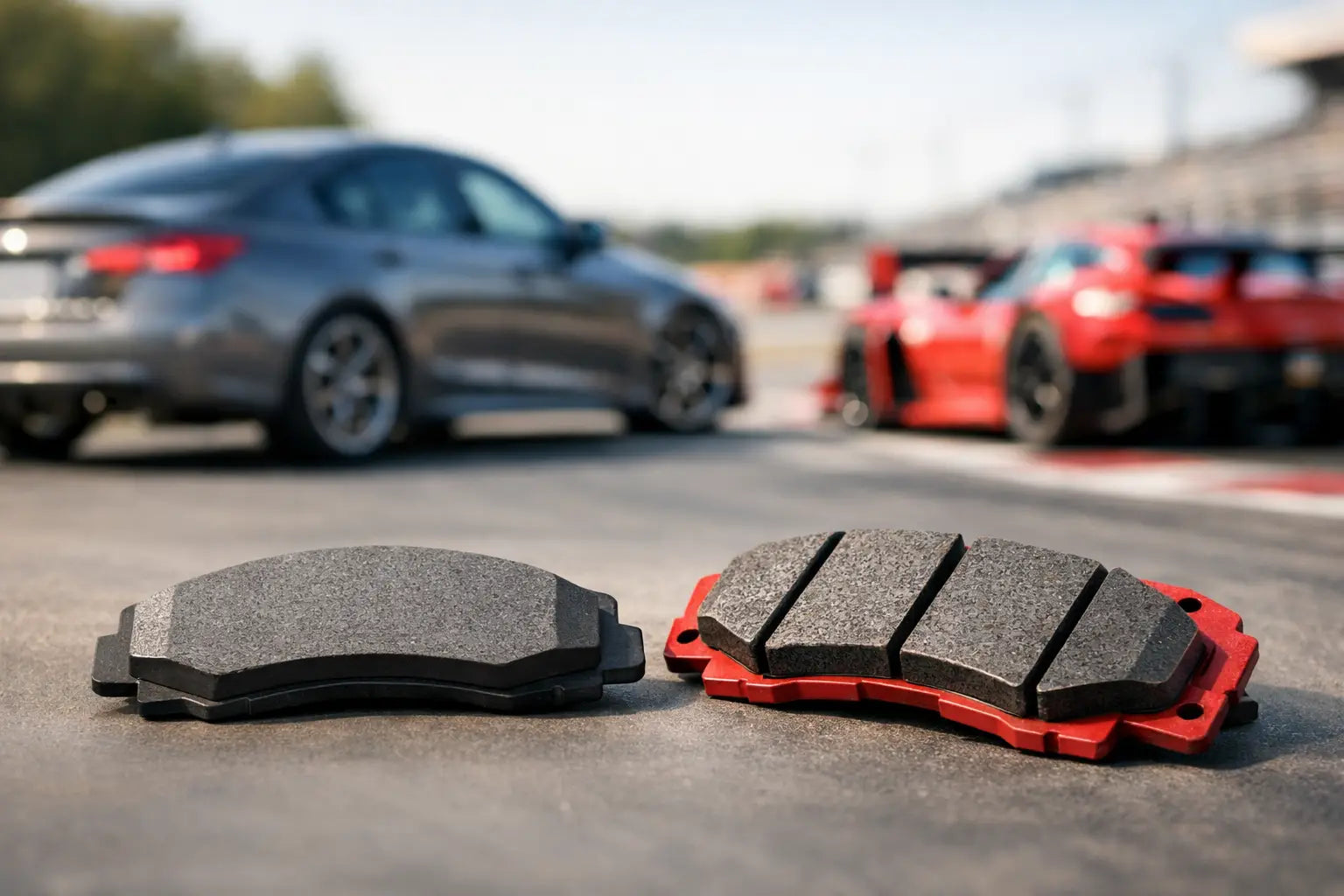
Your brake pedal can feel firm and reassuring on a fast B-road, then go long and vague after a few hard laps. That difference is exactly why the street pads vs track pads decision matters. Brake pads are not a generic upgrade: their compound, temperature range and friction behaviour determine whether your car stops consistently in the conditions you actually drive.
A track-biased pad on a daily-driven Golf GTI, Civic Type R or BMW 3 Series may sound like the serious choice. It can also be noisy, dusty and unimpressive until it has heat in it. Equally, a quality fast-road pad can transform confidence on the road yet reach its limit during repeated heavy braking at a circuit. The right answer is not about choosing the most aggressive compound. It is about matching the pad to the car, tyre, brake hardware and use case.
Street Pads vs Track Pads: The Core Difference
The main distinction is the temperature window in which the compound works best. Street pads are designed to generate dependable friction from cold, cope with wet weather and stay civilised during normal driving. They need to work when you leave home on a cold morning, ease through traffic and make one unexpected emergency stop.
Track pads are formulated to retain friction under sustained, extreme heat. Repeated braking from high speed puts far more energy into the brakes than any normal road journey. A proper track compound is built to resist fade, maintain a stable pedal and recover lap after lap without smearing material across the disc.
That does not make track pads universally better. A pad that performs brilliantly at 600°C may offer limited cold bite, particularly on the first stop of the day. Some compounds need a deliberate warm-up before they feel right. For a car that spends 95 per cent of its time on public roads, that compromise can quickly become tiring.
What Street Pads Do Best
A good street or fast-road pad is engineered for the real-world conditions most tuned cars face. It delivers predictable response from cold, works in rain, keeps noise under control and is generally kinder to discs than a full competition pad.
For enthusiastic road use, look for a pad with a stronger initial bite and better fade resistance than standard equipment, without moving into a race-only operating range. Brands such as EBC Brakes and Ferodo offer compounds across this middle ground, but the exact product matters more than the logo on the box. Each compound has its own intended temperature range and character.
Street-oriented pads are the sensible choice if your car is used for commuting, weekend blasts, European road trips or occasional spirited driving. They are also usually the better choice for heavier cars on standard brake systems, where tyre grip and fluid condition may be the real limiting factors before pad compound becomes the issue.
The trade-off is that prolonged circuit use can overwhelm them. Once the pad exceeds its working temperature, the resin in the compound can release gas and friction may fall away. You feel it as a hard pedal with less stopping power, or a pedal that requires increasingly more pressure as the session continues. That is brake fade, and it is a warning that the pad is out of its depth.
Why Track Pads Feel Different
Track pads prioritise thermal stability over refinement. Their friction material is intended to withstand repeated high-energy stops, maintaining a consistent coefficient of friction when discs, calipers and pad faces are seriously hot.
On circuit, this consistency is worth more than dramatic initial bite. You want the same braking reference point at the end of lap six that you had at the end of lap two. A track pad lets you brake hard and repeatedly without wondering whether the pedal will change halfway through a session.
The compromises are real. Track compounds often create more brake dust, more noise and faster disc wear. Squeal at low speed is common, especially when the pads are cold. Some pads can also be harsh on discs because they work by transferring a stable friction layer to the disc surface. If bedding-in is poor, or if pad materials are mixed carelessly, that transfer layer can become uneven and lead to vibration or judder.
For a dedicated track car, those downsides are simply part of the programme. For a road car, they are reasons to be honest about how often you actually book track days.
The Temperature Range Is Only Half the Story
It is tempting to compare pads purely by advertised maximum temperature. That figure is useful, but it is not a shortcut to the correct choice. A compound also needs suitable cold performance, a stable friction curve and compatibility with your disc, caliper and driving style.
Vehicle weight changes the equation. A heavy Audi, BMW or performance SUV asks much more from its brakes than a lightweight MX-5, Clio or stripped-out track hatch at the same speed. Tyres matter too. Stickier tyres allow higher braking forces, which means more heat enters the system. More power, repeated high-speed running and late braking all add load.
Brake cooling has the same effect. Fresh air directed through the disc can lower operating temperatures enough to make a fast-road pad viable for shorter sessions, or give a track pad a longer and more consistent life. On a hard-driven car, cooling ducts are not a cosmetic modification. They can be the difference between a repeatable brake package and one that cooks fluid, seals and pads.
Do Not Ignore Fluid, Discs and Calipers
Pads do not work in isolation. If your brake fluid is old or has a low dry boiling point, a more aggressive pad will not cure a soft pedal caused by fluid boil. If the pedal goes soft after several hard stops and improves when the system cools, start by checking the fluid and bleeding the system correctly.
Disc condition is equally important. Cracked, heavily lipped or heat-spotted discs should not be paired with fresh performance pads and expected to behave. Use discs that suit the application, check their minimum thickness and ensure caliper sliders or pistons move freely. A seized slider can overheat one pad, create uneven wear and make even the best compound feel inconsistent.
For regular track use, the usual upgrade path is high-temperature fluid, fresh pads, healthy discs and inspection of the complete braking system. Only then does it make sense to consider more cooling, larger discs, multi-piston calipers or a dedicated motorsport setup.
Can You Run Track Pads on the Road?
You can, but it depends on the compound and your tolerance for compromise. Some track-day pads are road legal and retain decent cold performance, making them workable for a car driven to the circuit and home again. They are often the sweet spot for enthusiasts doing several events a year.
A full race compound is another matter. It may be legal only for competition use, offer poor cold response and chew through discs during ordinary road miles. Wet, cold road conditions amplify the downside. If you need to use the car every day, choose a pad that is designed to operate from cold rather than hoping a race pad will behave like an upgraded road pad.
There is also the practical issue of noise. A pad that squeals every time you roll up to a junction can make a technically capable setup feel like a bad purchase. Anti-squeal shims, correct grease in the right places and careful bedding can help, but they cannot turn a competition compound into a quiet OEM-style pad.
Should You Keep Two Pad Sets?
If you attend frequent track days but still value a quiet, clean road car, two sets of pads can be the smartest solution. Run a quality street compound for normal use, then fit track pads before an event alongside suitable fluid and a proper inspection. This approach keeps daily manners intact while giving you the heat capacity required on circuit.
It is not a zero-effort option. Changing pads requires time, care and a bedding procedure, and you should avoid switching compounds on discs with an incompatible transfer layer. Ideally, use a dedicated set of discs for your track compound, particularly when moving between a mild street pad and an aggressive race pad. Label everything, monitor thickness and treat the changeover as part of your event preparation.
For many dual-purpose builds, a single track-day compound is more convenient. The best choice depends on event frequency, vehicle weight, brake cooling and how much road comfort you are willing to trade.
How to Choose the Right Compound
Start with the hardest braking your car sees, not the image you want the build to project. One relaxed annual track day does not automatically require a race pad. On the other hand, a powerful, heavy car doing repeated twenty-minute sessions may need more than a popular fast-road compound, even if it is otherwise road driven.
Ask four direct questions: Does the car need strong cold bite every day? How many track days will it do this year? Are the brakes currently fading, or is the issue fluid, tyres or technique? Will you accept noise, dust and increased disc wear for consistent high-temperature performance?
Then buy by exact vehicle fitment and axle application. Pad shape, sensor provision, backing plate design and caliper compatibility all matter. Torque Lab’s performance-focused catalogue makes it easier to narrow the search by vehicle and recognised brake brand, but fitment should always be checked against your specific caliper and model year before ordering.
The best brake setup is the one that gives you confidence to press the pedal at the same point, every time. Build around the driving you actually do, keep the whole system maintained, and let your next track day expose the next genuine weak point rather than guessing at it in advance.